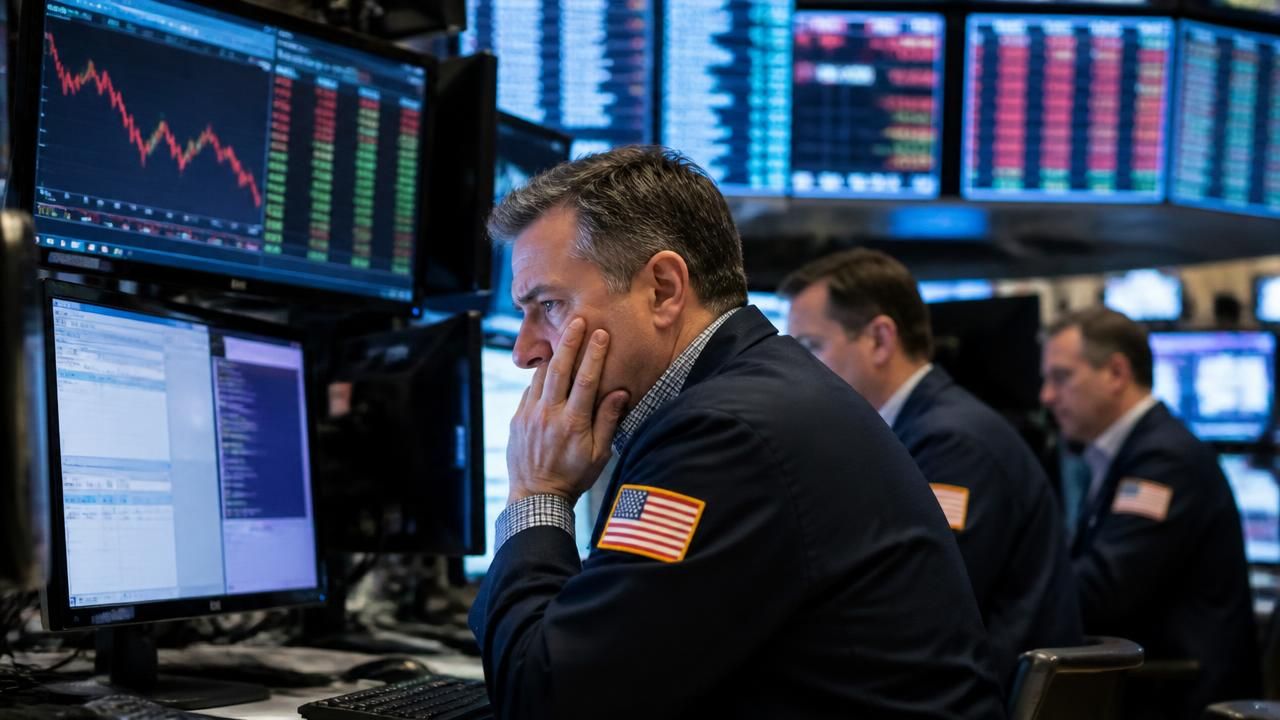
A stark warning from a London investment bank is rippling through financial markets: the artificial-intelligence trade that has powered the S&P 500 to repeated records may be nearing a violent end. The bank’s head of market strategy predicts the AI bubble could burst within two years, triggering the most severe S&P 500 crash since the 2008 global financial crisis. The warning, first reported by Bloomberg Markets and echoed by Seeking Alpha, Forbes, and Yahoo Finance, has renewed debate over whether the market’s AI obsession is a sustainable revolution or a classic speculative mania.
The Warning and Its Sources
Bloomberg Markets reported that the strategist believes “the artificial-intelligence trade may soon be over” and that its unwinding could produce the worst market crash since the global financial crisis. Seeking Alpha sharpened the timeline, warning that the AI bubble “could burst within two years.” Yahoo Finance syndicated the Bloomberg headline to a mass retail audience, while Forbes framed the risk in list form with a piece titled “7 Reasons The AI Bubble Is About To Pop.” Together, the coverage paints a picture of growing alarm among market professionals.
“The artificial-intelligence trade may soon be over in what could trigger the most severe market crash since the global financial crisis.” — Head of market strategy at a London investment bank, via Bloomberg Markets
The strategist’s view is not isolated. It arrives as investors have poured hundreds of billions into AI-related equities, data centers, and chipmakers. Nvidia, Microsoft, Alphabet, Amazon, and Meta now account for a historically large share of the S&P 500’s market capitalization. That concentration means any disappointment in AI earnings could cascade across index funds and retirement accounts worldwide.
Why the AI Trade Looks Fragile
Several vulnerabilities underpin the bubble thesis. Forbes’s headline points to multiple reasons, and while the full list was not accessible, the core concerns are widely shared on Wall Street.
- Extreme valuations: Leading AI companies trade at forward earnings multiples that assume years of hypergrowth. When expectations are that high, even modest misses can trigger sharp sell-offs.
- Index concentration: The top 10 S&P 500 stocks now represent more than a third of the index, a level not seen since the dot-com era. A downturn in a few names would drag the entire market.
- Capital spending race: Hyperscalers are committing record sums to AI infrastructure. If returns lag, investors may punish the spending rather than reward the ambition.
- Monetization gap: Many AI products are still searching for durable revenue models. The gap between investment and profit could close violently.
- Macro headwinds: Stubborn inflation, elevated interest rates, and geopolitical tensions could squeeze the cheap capital that fuels speculative booms.
The strategist’s two-year window suggests the trigger may not be a single event but an accumulation of pressures. A disappointing earnings season, a regulatory crackdown, or a slowdown in AI chip demand could start the slide. Once momentum reverses, forced selling and margin calls could amplify the decline.
Historical Parallels: 2000 and 2008
Comparisons to the dot-com crash are inevitable. From March 2000 to October 2002, the S&P 500 fell about 49%. The 2008 financial crisis was even worse, with the index dropping roughly 57% from its 2007 peak. The strategist’s warning that the coming crash could be the worst since 2008 implies a decline of similar magnitude—a scenario that would erase trillions in household wealth.
But there are important differences. Today’s AI leaders are highly profitable, cash-rich, and embedded in the global economy. Unlike many dot-com startups, they have real earnings and dominant market positions. That does not eliminate bubble risk, but it may change the shape of the bust. A correction could be severe without becoming a systemic banking crisis.
How Different Outlets Frame the Story
Bloomberg Markets treated the warning as a sober market signal from a seasoned strategist. Seeking Alpha, aimed at active investors, emphasized the two-year timeline and tagged the S&P 500 index, making the call actionable for traders. Forbes packaged the risk as a listicle, appealing to retail readers with a punchy headline. Yahoo Finance’s syndication gave the warning mass reach, ensuring that even casual investors saw the words “worst crash since 2008.”
Not everyone agrees. Bulls argue that AI is a general-purpose technology on par with electricity or the internet, and that current valuations are justified by productivity gains still to come. They point to strong corporate balance sheets, robust earnings, and the Fed’s potential to cut rates if growth slows. Bears counter that every bubble has a compelling story, and that the story is precisely what makes the crash so painful.
What It Means for Investors
The strategist’s warning is not a precise timing tool. Markets can remain irrational longer than investors can remain solvent. But it is a risk signal that deserves attention. Investors with heavy AI exposure may want to review their concentration, diversify across sectors and asset classes, and avoid leverage. Hedges such as options or defensive positions can help, though they come with costs.
For long-term savers, the lesson is familiar: bubbles burst, but diversified portfolios recover. The AI revolution may well transform the economy. The question is whether today’s prices already reflect that future—and whether the path there will be smooth or catastrophic. As the London strategist suggests, the reckoning may arrive within two years. Whether it becomes the worst crash since 2008 depends on how much of the AI story is substance and how much is hype.