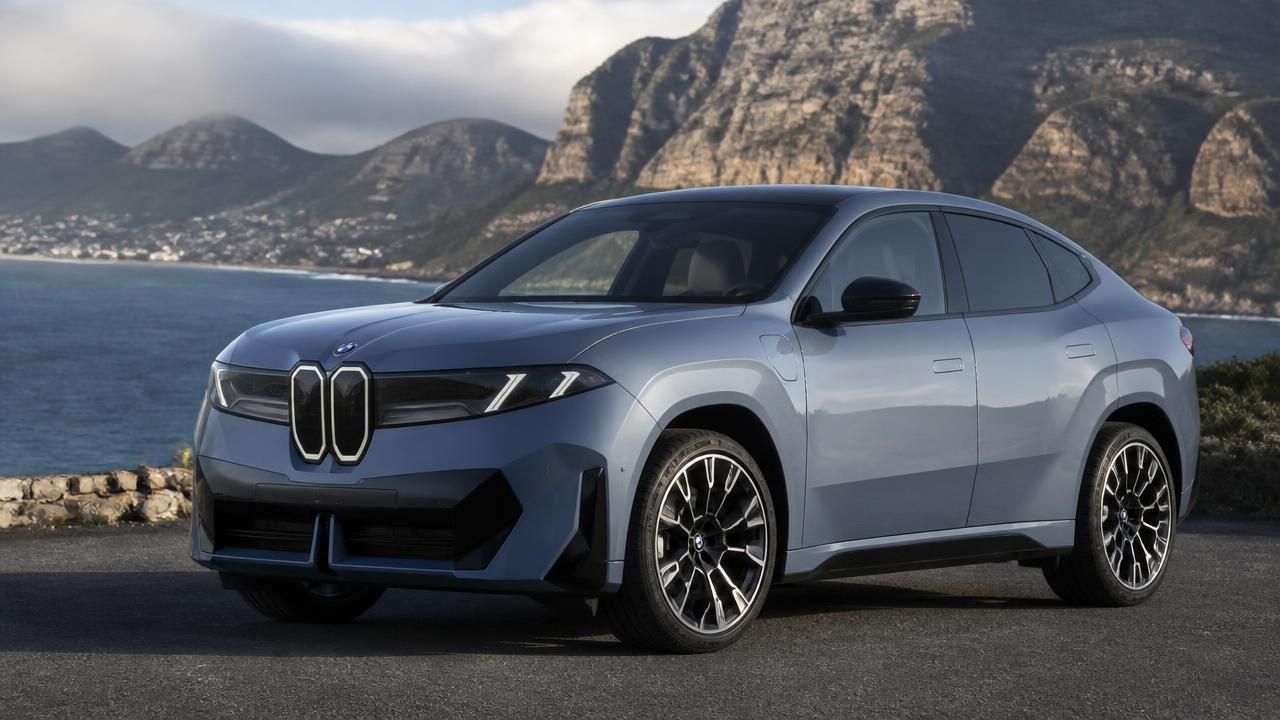
BMW has pulled the wraps off the iX4, a coupe-shaped electric SUV that applies the company's next-generation Neue Klasse architecture to one of the auto industry's most enduring — and most divisive — body styles. The 2027 iX4 will arrive in U.S. and European showrooms beginning in March 2027, with BMW claiming a range of 428 miles and charging speeds of up to 400 kilowatts, figures that place it among the fastest-charging mainstream EVs on sale.
The announcement was covered with markedly different emphases across the automotive press. The Verge framed the vehicle as a geopolitical instrument, describing the iX4 as "a 428-mile defensive weapon against China's EV takeover." Trade outlets including InsideEVs and MSN's syndicated coverage focused on the more conventional scorecard: range, price, specs, and the long-running debate over whether a sloped-roof SUV makes sense at all.
What BMW actually announced
The iX4 is the third vehicle built on Neue Klasse, BMW's ground-up electric platform, following the iX3 SUV and the i3 sedan. It launches first as the iX4 50 xDrive in March 2027, with a higher-performance M60 xDrive variant following later in the year.
- Range: 428 miles (BMW's European WLTP figure; U.S. EPA ratings are typically lower)
- Charging: up to 400 kW DC fast charging, enabled by an 800-volt electrical architecture
- Layout: dual-motor all-wheel drive in xDrive trims, with an M-tuned M60 flagship
- Platform: Neue Klasse, BMW's sixth-generation EV toolkit
- On sale: from March 2027
The 400-kW charging claim is the headline technical achievement. For context, most EVs on the road today peak between 150 and 250 kW, and even Porsche's 800-volt Taycan launched at 270 kW. BMW's figure, if it holds in real-world conditions, would put the iX4 in a narrow band currently occupied by a handful of Chinese flagships and the newest ultra-premium models. As with all such claims, the practical question is the shape of the charging curve — how long the car sustains peak power — rather than the peak itself.
The coupe-SUV, electrified
BMW effectively invented the modern coupe-SUV with the 2008 X6, a vehicle widely mocked at launch and then widely copied. The X4 followed in 2014, and the formula migrated to electric rivals including the Mercedes-Benz EQC and a wave of Chinese models.
"While much of the automotive world sits dumbfounded as China gobbles up all its customers, BMW continues to roll out extremely well-crafted, technologically advanced electric vehicles that impress in both drive quality and price." — The Verge
The Verge's assessment captures the awkward position of legacy European automakers. BMW's EV sales have grown steadily even as rivals including Volkswagen, Stellantis and Mercedes have stumbled, issued profit warnings, or scaled back electrification targets. BMW has also hedged more aggressively than most, keeping flexible powertrain lines that can build combustion, hybrid and electric vehicles on the same assembly lines.
China looms over everything
Framing the iX4 as a defensive weapon is not hyperbole. Chinese manufacturers led by BYD and a fast-consolidating group of domestic brands now account for a majority of EV sales inside China — the world's largest auto market — and have begun exporting aggressively to Europe, Southeast Asia and Latin America. In Europe, Chinese-built EVs have gained share despite European Union tariffs imposed in 2024.
BMW's response has been twofold: build technologically competitive products, and build them in places that dodge tariff exposure. Neue Klasse production begins in Debrecen, Hungary, with additional capacity planned in Munich and at BMW's U.S. plant in Spartanburg, South Carolina — a footprint designed to localize manufacturing on both sides of the Atlantic.
Why the coupe shape still matters
One MSN headline captured the ambivalence neatly: "For better or worse, the 2027 BMW iX4 brings the sloped-roof SUV into the EV era." The compromise is real. A sloping roofline typically costs rear headroom and cargo volume, and on an EV it can also hurt aerodynamic efficiency if poorly executed — a paradox, since the same shape is often chosen precisely to reduce drag.
BMW's answer is that the iX4 rides on a dedicated EV platform, freeing designers from the packaging constraints of a combustion drivetrain. With no transmission tunnel and a flat floor, the coupe silhouette penalizes interior space less than it did on the gasoline X4. Whether buyers agree will be settled by showroom traffic in 2027.
The competitive picture
At 428 miles of WLTP range, the iX4 would slot above most of its premium rivals. Tesla's Model Y, the world's best-selling vehicle, offers roughly 350 miles on the more conservative EPA cycle in its longest-range form. The iX4's true benchmark, however, may be Chinese competitors such as the Zeekr 7X and Xiaomi YU7, which combine coupe-SUV proportions with 800-volt charging and aggressive pricing.
Pricing remains unannounced and is arguably the single biggest variable. BMW's iX3 and i3 have been praised for delivering competitive value relative to their segment, and The Verge's review noted the manufacturer's ability to impress "in both drive quality and price." If the iX4 lands significantly above comparable Chinese imports in Europe, the technological argument may not be enough on its own.
What to watch
Three things will determine whether the iX4 succeeds. First, the EPA range figure for the U.S. market, which historically lands well below WLTP. Second, the real-world charging curve — 400 kW means little if the car drops to 150 kW after two minutes. And third, price, which BMW has not disclosed.
What is already clear is the strategic logic: BMW is betting that a well-engineered, fast-charging, distinctly styled electric SUV can hold the line in a market where the most aggressive competition now comes from Shenzhen and Shanghai rather than Stuttgart or Ingolstadt.