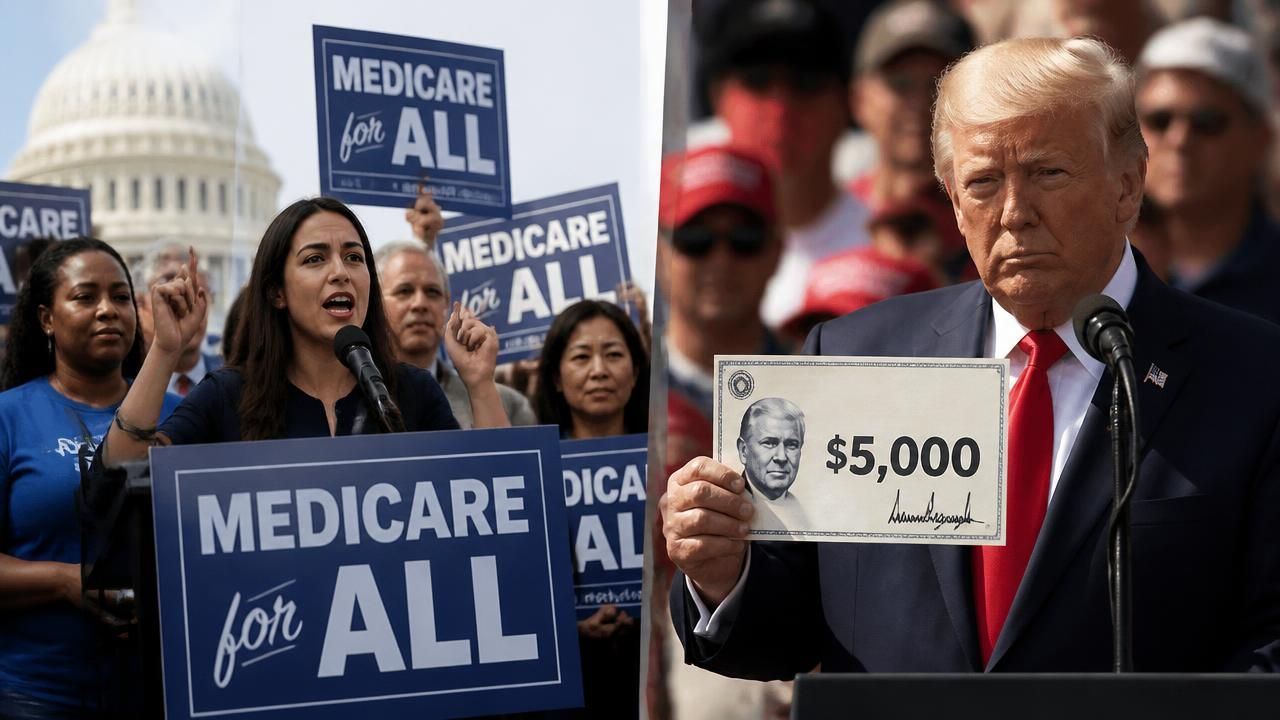
The cost of health care has become the defining domestic argument of the midterm campaign, with Democrats and Republicans offering voters sharply different prescriptions for a system that leaves millions of Americans struggling under medical bills — and, increasingly, casting ballots on it.
The clearest expression of that energy is "Medicare for All," a phrase that has migrated from the activist fringe to the stump speech. According to reporting from NPR, candidates in races across the country are talking the idea up, and roughly two out of three Americans tell pollsters they support it. But the polling captures a mood at least as much as it captures a legislative blueprint.
"The phrase speaks to a desire for radical change, though many don't really know what it is." — NPR
A slogan with many meanings
Strictly defined, Medicare for All means a single, government-run insurance program covering everyone — an expansion of the Medicare system that today serves Americans 65 and older, financed through taxes rather than premiums, and replacing private coverage for most people. That version, championed by Sen. Bernie Sanders and embraced by a growing bloc of progressive candidates, would be the largest restructuring of American health care since Medicare's creation in 1965.
In practice, the label is applied loosely. Some candidates use it to mean a true single-payer system; others use it as shorthand for a public insurance option, an expansion of Medicare eligibility, or simply a promise that no one should go bankrupt because of a hospital stay. That ambiguity is a political asset and a policy liability at the same time: it lets a broad coalition rally behind four words while deferring the hard questions of financing, timelines and what happens to the roughly 180 million Americans who currently get coverage through employers.
Broad support, shallow roots
The headline number that campaigns cite — about two in three Americans in favor — has been a staple of midterm messaging. But other surveys have consistently found that support falls sharply when voters are told the plan could eliminate private insurance or require significant tax increases. The result is a coalition that is wide but not deep, built on anxiety about premiums and deductibles rather than agreement on a model.
That anxiety is real. Even as the Affordable Care Act's coverage expansions have held, out-of-pocket costs have continued to climb for the insured, and medical debt remains a leading driver of personal bankruptcy. Voters who describe themselves as "buckling under medical bills" are not necessarily ideological converts to single-payer — they are consumers looking for relief, and they are unusually receptive to anyone promising a radical change.
Trump's counteroffer: a $5,000 pledge
Republicans, for their part, are not ceding the pocketbook argument. As reported by Yahoo Finance, President Trump re-upped a pledge to send Americans $5,000 if the GOP wins the midterms, framing it with a signature boast.
"Only I can make you this promise." — President Trump
The pledge is politically potent and procedurally vague. As reported, it did not specify who would qualify, how the payments would be financed, whether they would arrive as direct checks, tax credits or health savings contributions, or how a divided Congress would be expected to pass it. Critics describe such promises as campaign-season theater; supporters present them as a direct answer to voters who feel the system has left them behind. Either way, the two competing messages — government insurance for everyone versus cash in your pocket — are now running against each other in the same districts.
What Democrats say they would change
MSN's coverage frames the Democratic side of the debate around a package of proposed changes that would take effect if the party wins control: widening access to Medicare, adding benefits the program has never covered, and using the government's purchasing power to push prices down.
- Lowering the eligibility age so Americans in their 50s and early 60s can buy into Medicare before retirement.
- Adding dental, vision and hearing coverage to traditional Medicare, which currently excludes most of those benefits.
- Allowing Medicare to negotiate drug prices directly with manufacturers, a long-standing Democratic priority.
- Capping out-of-pocket costs and expanding subsidies for people buying coverage on the individual market.
The distinction matters. "Medicare for All" as a single-payer program would require sweeping legislation and enormous tax changes. The incremental package MSN describes could, in theory, move through a narrower Senate majority and is already closer to the mainstream of the party's caucus.
The same story, three frames
The outlets covering this debate are telling markedly different stories from the same set of facts. NPR and its member-station network, including KNPR, which carried the same report, lead with voter psychology — the gap between what the slogan promises and what voters understand it to mean. MSN leads with policy mechanics, treating the midterms as a gateway to a concrete legislative agenda. Yahoo Finance leads with the transactional pitch, positioning the president's $5,000 promise as the Republican answer to Democratic health-care messaging.
Read together, they describe a single phenomenon: health care has become the language in which American economic discontent is expressed.
Why it matters
Health care has ranked at or near the top of voters' concerns in recent cycles, and it cuts across the electorate in ways that few other issues do — suburban swing voters worried about premiums, older voters protective of Medicare, younger voters carrying student debt and medical debt simultaneously. That makes it both the Democrats' strongest turnout argument and their biggest vulnerability if Republicans can convincingly relabel single-payer as a tax increase that threatens existing coverage.
What is not yet settled is whether either promise survives contact with governing. A $5,000 payment conditional on an election result and a universal insurance program both require something the campaign trail does not supply: a Congress willing to pay for them.