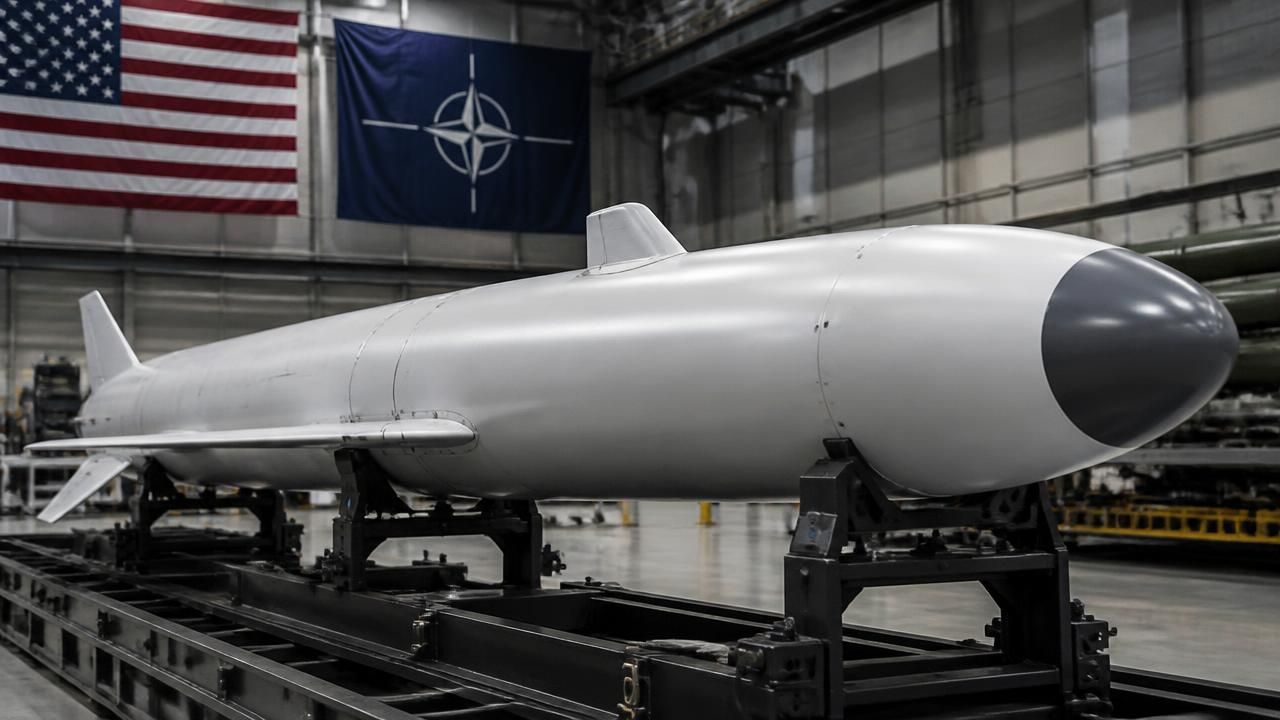
Covenant, a Silicon Valley-backed American defense startup, emerged from stealth this week with a single, pointed proposition: that the Western alliance can no longer afford to build precision-strike weapons the way it always has. The company unveiled Anthem, a heavy-payload, long-range deep-strike cruise missile, and announced plans to mass-produce it at a new factory in eastern Germany beginning next year — a move that would place a US startup at the center of Europe's effort to rebuild its depleted missile stocks.
The plans were confirmed across multiple outlets, with Reuters citing people familiar with the matter and Bloomberg reporting that Covenant President Abby Denburg had outlined the strategy in an interview from Berlin with Bloomberg's Stephen Carroll on October 7, 2026.
Anthem: a missile built for volume, not scarcity
Anthem is described as a heavy-payload, long-range precision weapon intended for what military planners call deep strike — hitting command nodes, air defenses, logistics hubs and other high-value targets far behind the front line. Covenant's core claim is not that Anthem is the most sophisticated missile available, but that it can be built cheaply and in large numbers, a design philosophy that inverts decades of Western procurement logic built around small fleets of exquisite, expensive munitions.
Covenant says its new heavy-payload, long-range missile will become key to Europe's deterrence.
That framing is a direct response to the war in Ukraine, where both Russian and Western inventories of precision-guided weapons have been consumed at rates that peacetime production lines were never designed to sustain. As NATO allies search for ways to refill their stocks, the pitch for a low-cost, mass-producible cruise missile has found a receptive audience in both Washington and European capitals.
Two factories, two continents
Covenant's manufacturing plan is explicitly transatlantic. The eastern German facility would serve European demand and place production inside the continent — a politically significant choice at a moment when European governments are anxious about dependence on US supply chains and about Washington's long-term commitment to the alliance. Separately, the company's Grand Prairie, Texas facility is expected to create roughly 300 jobs and support Anthem production for the US market.
The Germany site, according to reports, would begin production next year. Covenant has not publicly detailed capacity figures or unit costs, leaving open the question of just how cheap "low-cost" will prove to be at scale.
Backers, funding and the Silicon Valley-ization of defense
Covenant has raised more than $250 million, according to Seeking Alpha, with backing from prominent venture investors including Peter Thiel and Marc Andreessen. That roster places the company squarely within a broader wave of venture-funded defense startups — Anduril, Palantir, Shield AI and others — that have spent the past decade arguing that software-driven, commercially paced development can outrun traditional prime contractors.
For European buyers, that pedigree is both an asset and a question mark. It signals access to capital and rapid iteration; it also raises concerns about whether a young company can deliver at the industrial scale and reliability standards that national militaries require.
How outlets framed the story
Coverage of the announcement diverged in emphasis, reflecting each outlet's audience. The Financial Times led with the Thiel connection, casting Covenant as a venture-backed challenger to Europe's defense establishment. Bloomberg centered on European deterrence and the NATO resupply imperative. Yahoo Finance and Seeking Alpha framed it as an investment story — a startup raising a quarter-billion dollars and promising cheap missiles as the US "rebuilds its arsenal."
MSN-syndicated coverage split further: one headline positioned Anthem as "designed for the China fight," tying the missile to Indo-Pacific contingencies rather than European ones; another emphasized the Grand Prairie jobs figure, a domestically oriented framing that resonates with US political audiences. One Yahoo headline went further, describing Covenant as a "US-Israeli arms firm" — a characterization not echoed in other reports and one that Covenant itself has not publicly stressed.
The wider transatlantic context
Covenant's move lands alongside a broader push to expand weapons production across the Atlantic. Germany and the United States have been working to widen shared manufacturing of Patriot interceptors and strike missiles, an arrangement intended to shorten supply chains and reduce European vulnerability to US export decisions.
The German factory would sit inside that architecture — but as a private, foreign-owned plant rather than a government-to-government program, a distinction that may complicate debates in Berlin over industrial sovereignty, technology transfer and export controls. Cruise missile production is governed by the Missile Technology Control Regime and national export rules; where Anthem can ultimately be sold, and to whom, will be a matter of licensing as much as manufacturing.
What to watch
- Contract awards: Whether any NATO member or the US Department of Defense commits to a firm order before production begins.
- Unit economics: Covenant has not published per-missile cost targets, the central claim of its entire pitch.
- German approvals: Site selection, permitting and political consent in eastern Germany remain unconfirmed.
- Scale-up risk: A first-time producer moving from prototype to mass production has historically been where defense startups struggle most.
The announcement is, for now, a plan rather than a product. But it captures a shift already underway: the assumption that precision strike is a scarce, premium capability is being challenged by a generation of companies arguing it should be cheap, plentiful and built on both sides of the Atlantic.