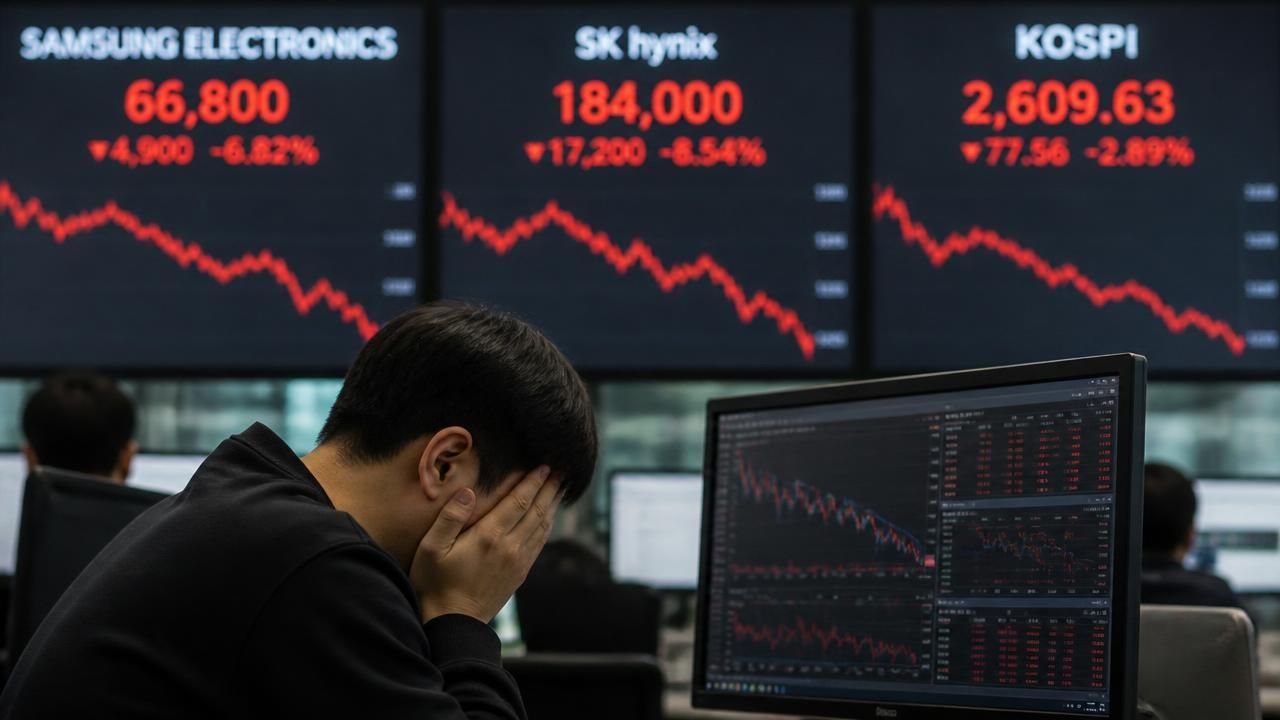
South Korean retail investors have lost an estimated 2.3 trillion won — roughly $1.7 billion — on leveraged exchange-traded products tied to the country's two semiconductor giants, Samsung Electronics and SK hynix, in a matter of months, according to figures released by a lawmaker's office and reported by Bloomberg News. The disclosure offers the first hard accounting of the damage inflicted by one of the most intense retail trading frenzies to grip Asia's fourth-largest economy.
The losses, paired with roughly $1 billion in outflows from Korea's leveraged ETF complex, mark a decisive end to a speculative episode that regulators, bankers and market veterans had warned was dangerously overheated. What began as a retail stampede into turbocharged bets on the artificial-intelligence chip boom has ended with portfolios cut in half and a regulatory crackdown now reshaping the product landscape.
Anatomy of a Mania
At the center of the story are single-stock leveraged ETFs — products that use derivatives to deliver a multiple of the daily price move of an underlying share. In South Korea, these vehicles were built almost exclusively around Samsung Electronics and SK hynix, the twin pillars of the country's export machine and the primary domestic beneficiaries of global demand for high-bandwidth memory used in AI data centers.
The appeal was straightforward. For a retail base already predisposed to active trading — Korea's "donghak ants," or retail investors, are among the most aggressive in the world — leveraged products offered a way to magnify exposure to a national champion narrative that seemed unstoppable. Money poured in through 2024 and into 2025 as chip prices rallied on AI capex spending.
Then the semiconductor trade cracked. As Morningstar reported, a broad rout in semiconductor equities left single-stock leveraged ETFs reeling, with some products losing roughly half their value. BusinessKorea noted bluntly that Samsung- and SK hynix-linked leveraged ETFs had shed about 50% of their worth. Because these products reset leverage daily, they suffer from volatility decay: in choppy or declining markets, compounding works against holders even when the underlying shares recover.
Regulators Step In
The scale of the losses forced a policy response. South Korean financial authorities moved to rein in single-stock leveraged ETFs, tightening eligibility rules and raising barriers for the riskiest products. The regulatory tightening is now visibly biting: Bloomberg reported that Korean day traders are fleeing leveraged chip ETFs as the new curbs take effect, with approximately $1 billion flowing out of the funds as fervor cools.
"The mania in South Korea's leveraged ETFs is over," Bloomberg declared, capturing a sentiment now shared across Seoul's financial district.
The pushback is part of a broader regional pattern. Authorities across Asia have grown wary of derivatives-heavy retail products that concentrate risk in a single stock or narrow sector, particularly when retail participation is funded by margin debt. Korea's experience now stands as the most expensive case study to date.
Where the Money Went
Capital exiting Korea's leveraged funds has not simply disappeared. CNBC, in a report headlined "'Absolutely crazy': Here's what South Korean stock investors are doing in U.S. markets," documented a striking pivot: bruised by losses at home, Korean retail traders are redirecting capital into U.S. equities and U.S.-listed leveraged products.
That migration has several drivers:
- Product breadth. U.S. markets offer leveraged exposure to a far wider menu of underlying assets — megacap technology, broad indices, sectors — rather than two domestic chipmakers.
- Currency and narrative. A strong dollar and the perception of deeper, more liquid markets make U.S. assets attractive to Korean savers.
- Regulatory arbitrage. As Seoul tightens domestic rules, offshore products marketed through global brokers become comparatively easier to access.
The shift worries some observers, who note that the underlying behavioral pattern — concentrated, leveraged, momentum-driven retail speculation — has not changed, only its venue. Korean investors chasing U.S. leveraged products after losses at home risk repeating the same volatility-decay math in a market where they may have less informational edge.
Three Frames, One Story
Coverage of the episode has split along revealing lines. Bloomberg's reporting leads with the sheer magnitude of the damage — the $1.7 billion figure sourced to a lawmaker's office — and the subsequent outflow from the funds, framing the story as the unwinding of a systemic retail risk. BusinessKorea emphasizes the blunt outcome for holders: leveraged ETFs on Samsung and SK hynix lost half their value. Morningstar situates the losses inside the semiconductor rout and the regulatory response, treating it as a market-structure story about how governments rein in single-stock leverage.
CNBC, meanwhile, frames the episode as an outflow story with a twist — a diaspora of Korean trading capital into U.S. markets. Each angle is accurate; together they describe a single arc: euphoria, losses, regulation, and relocation.
What Comes Next
The episode carries implications well beyond Seoul. For regulators, it strengthens the case for product-approval regimes and suitability rules around single-stock leveraged vehicles, which have proliferated globally. For asset managers, it is a reminder that daily-reset leverage is a trading instrument, not an investment vehicle — a distinction that retail buyers routinely miss. For Samsung and SK hynix, the retail exodus removes a source of marginal demand for their shares but leaves the underlying AI memory thesis intact.
The deeper question is whether Korea's retail-investor class — a formidable force in domestic markets — can be channeled toward less destructive vehicles. The $1.7 billion lesson, and the $1 billion that followed it out the door, suggests the industry and its regulators still have work to do.