Astronomers have reopened what amounts to a cosmic cold case, and the evidence they found was hiding in plain sight inside decades-old NASA Hubble Space Telescope data. The suspect: a white dwarf star catalogued as HS 0209+0832. The surprising clue: a chemical fingerprint that suggests the dead star may be orbited by a second-generation planet — a world forged not alongside its star, but from the star's own remains.
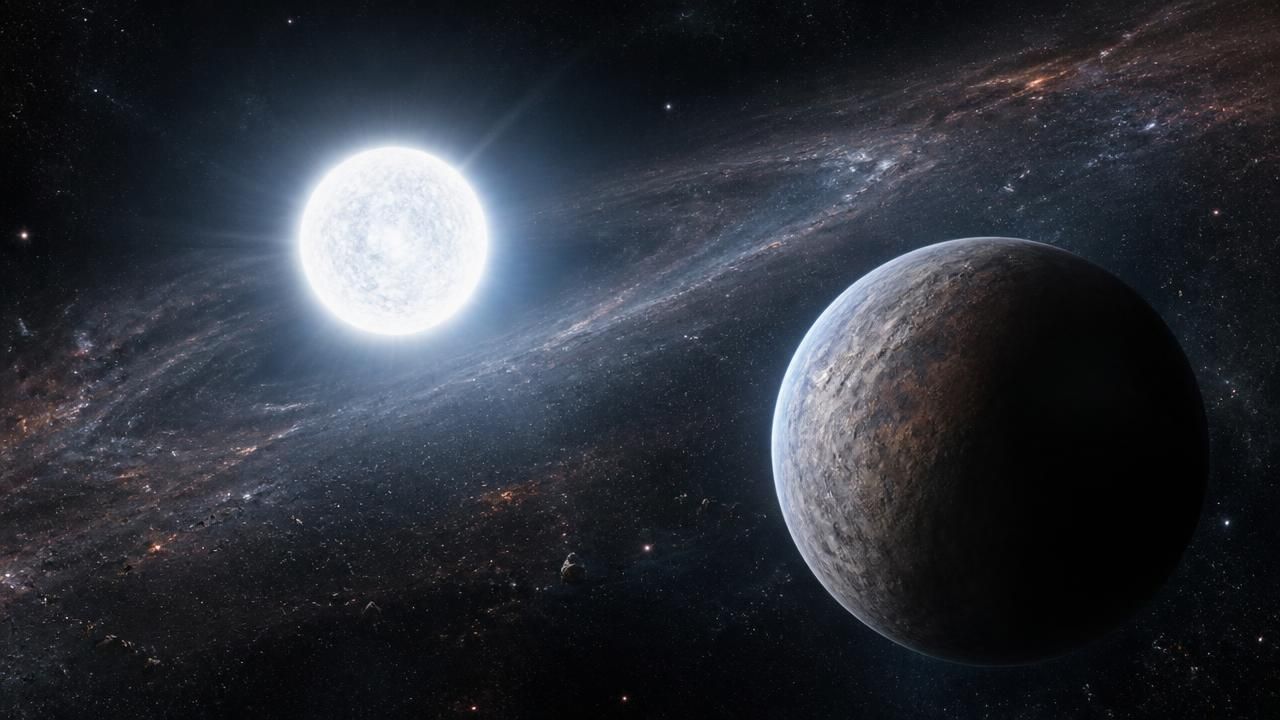
NASA and the European Space Agency announced the finding alongside an artist's concept released on Oct. 5, 2026, illustrating what such a world might look like: a planet circling the faint, dense ember of a star that once shone much like our Sun.
What a White Dwarf Is — and Why It Matters
A white dwarf is the exposed core of a star that has burned through its nuclear fuel and shed its outer envelope of gas and dust into space, leaving behind an extraordinarily dense, slowly cooling remnant roughly the size of Earth but with the mass of the Sun.
The white dwarf is the "dead" core of a star that burned through all of its nuclear fuel and lost its outer envelope of gas and dust to space. The second-generation planet formed from that cast-off gas and dust, which is why its chemical content is very different from a planet that formed as its host star was forming.
That distinction is the heart of the discovery. First-generation planets — like Earth, Jupiter, and their kin — condense from the same primordial cloud of gas and dust that gives birth to their star, so their chemistry is stamped by the star's natal environment. A second-generation planet, by contrast, coalesces from material the dying star itself manufactured and then ejected, including heavy elements cooked up through billions of years of nuclear fusion. That difference should be readable in a planet's atmospheric and bulk composition, and astronomers say the chemistry around HS 0209+0832 bears that signature.
How the Clue Was Found
Much of the detective work depended on archival rather than new observations. Hubble's ultraviolet sensitivity is uniquely suited to probing the hot, thin atmospheres of white dwarfs, where traces of heavy elements — the debris of shredded asteroids, moons, or planets — can linger for only a brief time before sinking out of view. That pollution acts as a chemical beacon for astronomers looking for planetary material.
The challenge is separating a genuine planetary system from a random infall of rocky debris. Researchers argue that the abundance pattern in this case is difficult to explain without a substantial, long-lived body — a planet — supplying the material.
Different Outlets, Different Frames
Coverage of the result diverged sharply depending on the audience. NASA and ESA framed the announcement around the planet-formation narrative, with a public-friendly artist's concept and language built for wonder. The New York Times leaned into the method rather than the object, describing the work as a case in which scientists, poring over old NASA data, turned up "a surprising new type of cosmic object" — a framing that emphasizes the growing value of data archaeology and the reinterpretation of decades-old telescope archives.
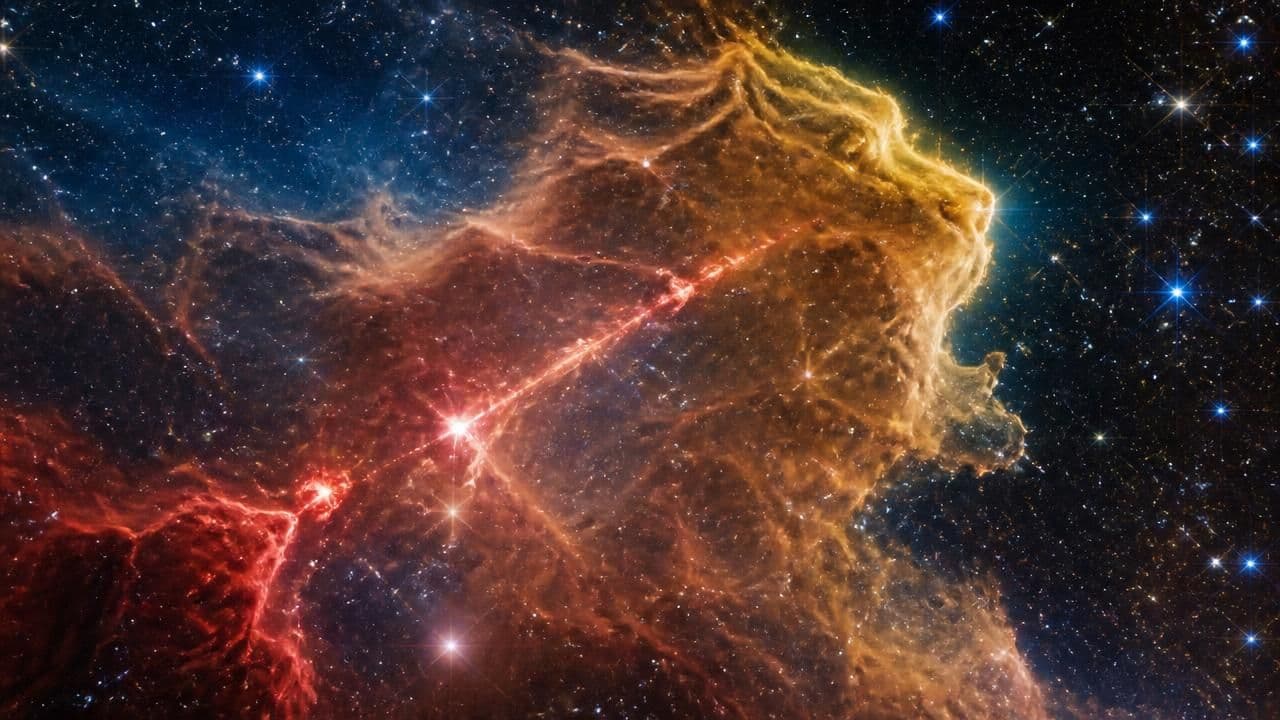
Other outlets were drawn to a visually spectacular but scientifically distinct Hubble result making the rounds in the same news cycle: imagery of a "superbubble" in a satellite galaxy of the Milky Way, a cavernous cavity carved into interstellar gas and dust by the combined stellar winds and supernova explosions of massive young stars. Photo-driven outlets, including MSN and phys.org, presented the image as a star-spangled cosmic scene, while researchers note its scientific payoff is in understanding how such bubbles trigger and regulate the birth of new generations of stars.
Looking Ahead: Roman and the Next Wave
Adding to the sense of momentum, NASA's Nancy Grace Roman Space Telescope rode a SpaceX Falcon Heavy to orbit, an infrared observatory designed to survey the sky at a scale Hubble could never manage. Roman's wide-field vision is expected to dramatically expand the census of white dwarfs, polluted stellar remnants, and exoplanets — including the exotic second-generation candidates that Hubble can only hint at.
- Hubble: precise, ultraviolet-capable spectroscopy of individual stellar remnants.
- James Webb: infrared follow-up to characterize debris disks and planetary atmospheres.
- Roman: statistical power — finding thousands of candidates rather than a handful.
Why It Matters
If confirmed, a second-generation planet would reshape how scientists think about planetary system architecture in the final stages of stellar life — and about whether worlds can form, and potentially remain habitable, around stars that are already dead. There is a personal dimension, too: in roughly five billion years, the Sun will become a white dwarf, and any planets orbiting its cooling ember would be descendants of the same process astronomers may now be glimpsing around HS 0209+0832.
The result is not yet definitive. Confirmation will require independent spectroscopy, tighter abundance modelling, and follow-up observations to rule out alternative explanations. But as a demonstration of what patient archival sleuthing can yield, the case of HS 0209+0832 — a cold case reopened with old light — may prove to be among Hubble's most provocative legacies.