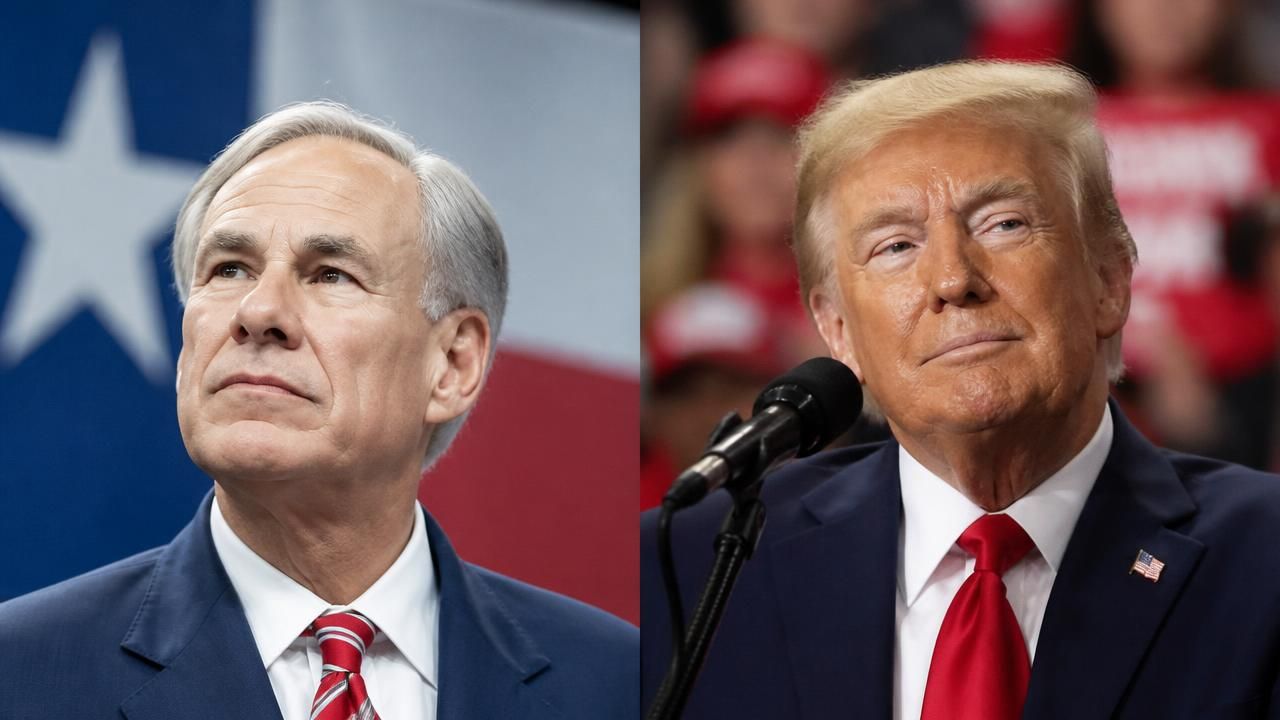
SAN ANTONIO — Texas Governor Greg Abbott will not attend a Republican rally here headlined by President Donald Trump, according to multiple outlet reports, forgoing a chance to stand beside the country's most prominent Republican as his own reelection campaign confronts a surprisingly competitive Democratic challenge.
The Wednesday event is built around boosting Attorney General Ken Paxton in his tightening Senate race against Democrat James Talarico. But in a state where Trump's endorsement has long been treated as currency, the marquee guest who is staying home has become the story.
A rally with an empty seat
Bloomberg Markets framed the decision bluntly: Abbott is declining a chance to appear with the country's highest-profile Republican at a moment when his bid for another term faces a stronger-than-expected challenge from Democrat Gina Hinojosa. Aggregator and broadcast reports, including MSN and CW39 in Houston, confirmed the rally is expected Wednesday in San Antonio, with Trump traveling to Texas to rally support for Paxton in what coverage repeatedly described as a high-stakes Senate race.
Coverage of the snub was fragmented. Several outlets — including the Detroit Free Press, USA Today and The Hill — either returned access-restricted pages or rate-limit errors, leaving audiences to piece together the story from headline fragments. Yahoo's account captured the political subtext most sharply, quoting a top MAGA lawmaker on the sidelines of the event:
“Nobody wants that photo op now.”
That line, attributed to a prominent Trump-aligned lawmaker, hints at a broader anxiety inside Republican ranks: that the president's coattails, once a guaranteed asset in Texas, may now weigh down candidates in close races rather than lift them.
Why Abbott is staying away
The governor's absence is being read in three ways.
- Brand protection. Abbott has spent more than a decade cultivating a distinct Texas-first identity. Sharing a stage with a president whose national approval ratings have oscillated puts that identity at risk in a race where swing suburban voters may decide the outcome.
- The Paxton problem. The rally is nominally for Paxton, whose long history of legal and ethical controversies makes him an awkward surrogate for any other Republican. Standing beside him, even indirectly, carries its own cost.
- Scarce time. With his own contest against Hinojosa tightening, Abbott's schedule is a finite resource. Aides have signaled a preference for retail campaigning and fundraising over nationalized spectacle.
Notably, the governor did not rule out future joint appearances, and those close to the operation have described the decision as a scheduling matter rather than a rupture — the kind of careful distance that lets a candidate claim party loyalty while avoiding the frame of a national referendum.
Two races, one ballot
The San Antonio stop sits at the intersection of two contests. The Senate race between Paxton and Talarico has drawn heavy national attention and money, with polls tightening in recent weeks. Abbott's own race, once treated as a formality in a state that has not elected a Democrat statewide since 1994, has also narrowed, lending the governor's every public appearance added weight.
Texas remains reliably Republican in presidential years — Trump carried it comfortably in both 2020 and 2024 — but the margins in down-ballot and suburban races have been eroding for a decade. That trend is what makes a rally intended to project strength instead raise questions about it.
A crowded news cycle
The Texas rally lands amid a dense stretch of Trump-related news that is likely to compete for attention and complicate the White House's messaging. In the same cycle:
- Trump announced a $54 billion Alaska LNG investment from South Korea, a major energy and finance story with implications for U.S. export capacity (NBC News).
- The president signed a Greenland-related agreement and told the United Nations he expects a deal with Iran after the midterms (Reuters live coverage).
- San Francisco sued Trump's Truth Social over paid subscriptions, with city officials alleging “unprecedented corruption” in the platform's practices (NBC Bay Area).
Each of those stories carries its own financial and political gravity. Together they form a backdrop in which the optics of a Texas rally — and who chooses to attend — matter more than usual.
How the framing differs
Outlets approached the Abbott decision from distinct angles. Bloomberg emphasized electoral strategy and the tightening governor's race. Aggregated wire and broadcast reports stressed the rally's purpose: rallying Republicans behind Paxton in a competitive Senate contest. Yahoo foregrounded internal Republican discomfort, sourcing a dismissive quote from a MAGA lawmaker. The net effect is a story that reads simultaneously as a scheduling note, a polling signal and an index of the president's standing within his own party.
What to watch
Three questions will define the next phase. First, whether Abbott's absence is a one-off or the beginning of a pattern of strategic distancing by down-ballot Republicans. Second, whether the San Antonio crowd and the rally's reception translate into measurable movement in the Paxton-Talarico race. And third, whether Democrats can convert the optics of a divided Republican tent into the fundraising and turnout gains they need to make Texas genuinely competitive.
For now, the most telling detail is the simplest: at a rally designed to showcase Republican unity in the country's largest red state, one of its most recognizable Republicans will be somewhere else.