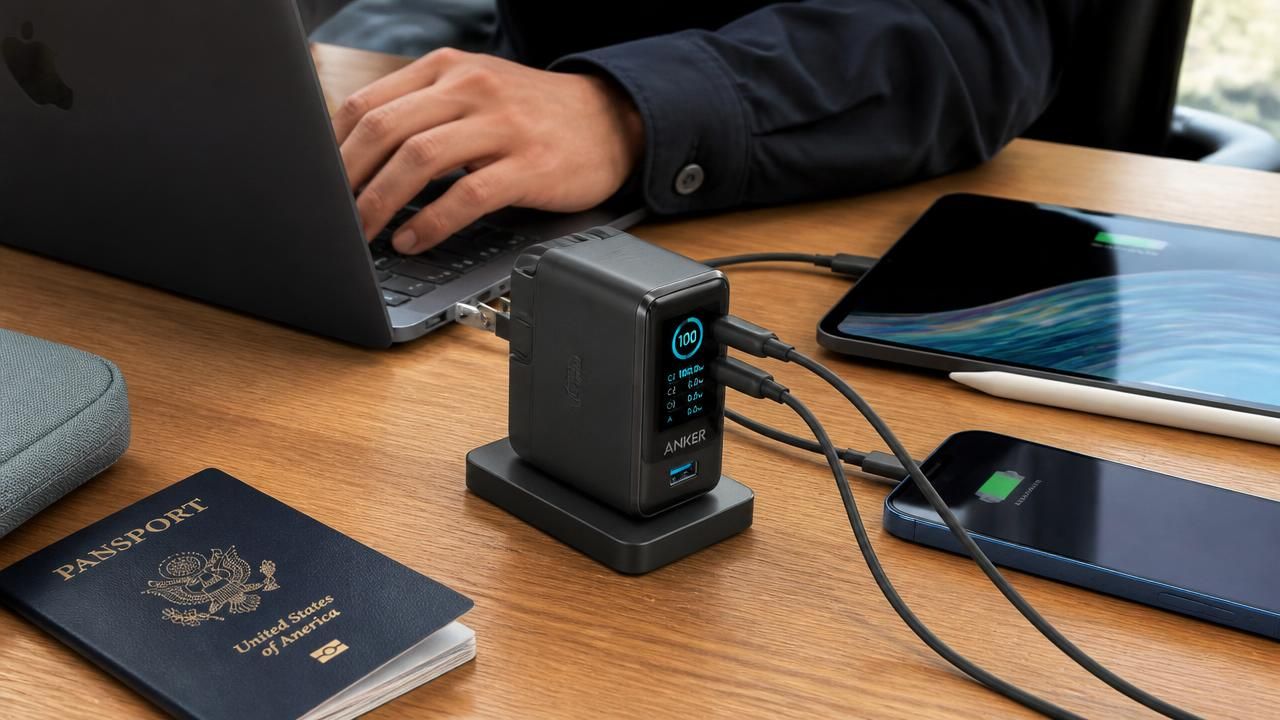
Anker's Nano 100W universal travel adapter, a folding multi-port charger built for people who move between countries and carry a lot of USB-C hardware, has fallen to $63.99 on Amazon from its usual $79.99, according to deal coverage timed to October Prime Day. The discount, first flagged by The Verge, positions the adapter as a travel-season accessory rather than a desktop staple — a small, screen-equipped brick that replaces the loose bag of plugs and cables most international travelers accumulate.
The timing matters as much as the price. Anker has spent the past several years converting a commodity category — the wall wart — into a premium, differentiated product line built on gallium nitride (GaN) semiconductors, on-device displays, and aggressive Amazon event pricing. The travel adapter is the clearest expression of that strategy yet.
What the Nano 100W Actually Does
The adapter integrates US, UK, and EU plug standards, which Anker says makes it compatible with outlets in more than 200 countries and regions. The prongs fold flat for packing. On the business end, it offers four ports: two USB-C ports capable of delivering up to 100W each when used individually, a third USB-C port for lower-draw devices, and a single USB-A port for legacy accessories.
A small exterior display shows how much power is flowing to each port — a feature that has become Anker's signature differentiator across its charger range and one that answers a real frustration for travelers juggling a laptop, phone, tablet, and earbuds from a single brick.
While it lacks an AC plug, it supplies a screen that shows how much power you are pushing to each port.
That missing AC passthrough is the adapter's most significant compromise. Travelers who need to power a non-USB device — a camera battery charger, a hair dryer, a laptop power supply with a barrel connector — will still need a separate adapter. The Nano is a USB hub for the wall, not a full replacement for a traditional travel converter.
A Lineup, Not a Product
The discount coverage sits on top of a broader product expansion that has made Anker's catalog harder to track. Notebookcheck describes the same device as a compact 4-in-1 travel adapter with a display. Kotaku's deal coverage emphasizes the smart display and touch controls, and separately highlights a bundle that includes a USB-C cable capable of charging a MacBook, iPhone, and AirPods simultaneously. PCWorld has tracked a compact 100W three-port GaN charger at its lowest price — a different configuration aimed at desk and bag use rather than international outlets.
Then there is the newest entrant. Gizmochina reports that Anker has launched a 6-in-1, 150W travel charging station roughly the size of a deck of cards, pushing the wattage ceiling well above the Nano and adding ports. For buyers, the result is a matrix of overlapping options differentiated by port count, wattage, plug adaptability, and whether a display is included — a level of segmentation that rewards research and punishes impulse.
Why Every Outlet Sounds the Same
The coverage itself is revealing. Most of the outlets that picked up the story did so through the lens of commerce rather than product review: The Verge frames the charger as a travel gadget and leads with the price, Kotaku leads with the Black Friday and Prime Day framing, and The Gadgeteer aggregates eight live Anker deals into a single shopping post. Only the launch-focused outlet, Gizmochina, treats a new Anker product as news in its own right.
That asymmetry is now standard for accessory hardware. Because chargers are inexpensive, iterative, and sold overwhelmingly through Amazon, the affiliate deal post has effectively replaced the standalone review as the primary way consumers learn a product exists. The practical consequence is that a charger's launch window and its discount window are frequently covered as the same event, with specification details compressed into a bulleted list beside a price.
What to Consider Before Buying
- Port sharing, not port addition: The 100W rating applies to a single port. Plugging in a laptop and a phone simultaneously splits the total output, so the headline number is a ceiling rather than a guarantee.
- GaN efficiency: Gallium nitride components let Anker pack higher wattage into a smaller, cooler-running body than older silicon designs, which is what makes a four-port adapter this size feasible at all.
- No AC passthrough: Anyone traveling with non-USB electronics should treat the Nano as a complement to, not a replacement for, a conventional adapter.
- Price volatility: At $63.99 the adapter sits at what deal trackers describe as its lowest recent price. Anker's event pricing cycles frequently, so the discount is likely to recur rather than disappear.
The Bigger Picture
Anker's travel-adapter push lands in a market where power delivery standards have finally converged. USB-C Power Delivery is now common across laptops, phones, tablets, and handheld consoles, which means a single compact brick can legitimately serve an entire trip's worth of devices. That convergence is what makes a 100W four-port travel adapter a viable product rather than a niche one — and it is why competitors from Belkin to UGREEN have crowded into the same space.
The open question is whether Anker can keep a premium price in a category defined by cheap alternatives. Displays, folding prongs, and GaN internals justify a markup, but only up to a point. With a 150W six-in-one station already arriving, the more likely outcome is that today's flagship travel charger becomes tomorrow's mid-tier option — and the discount cycle starts over again.