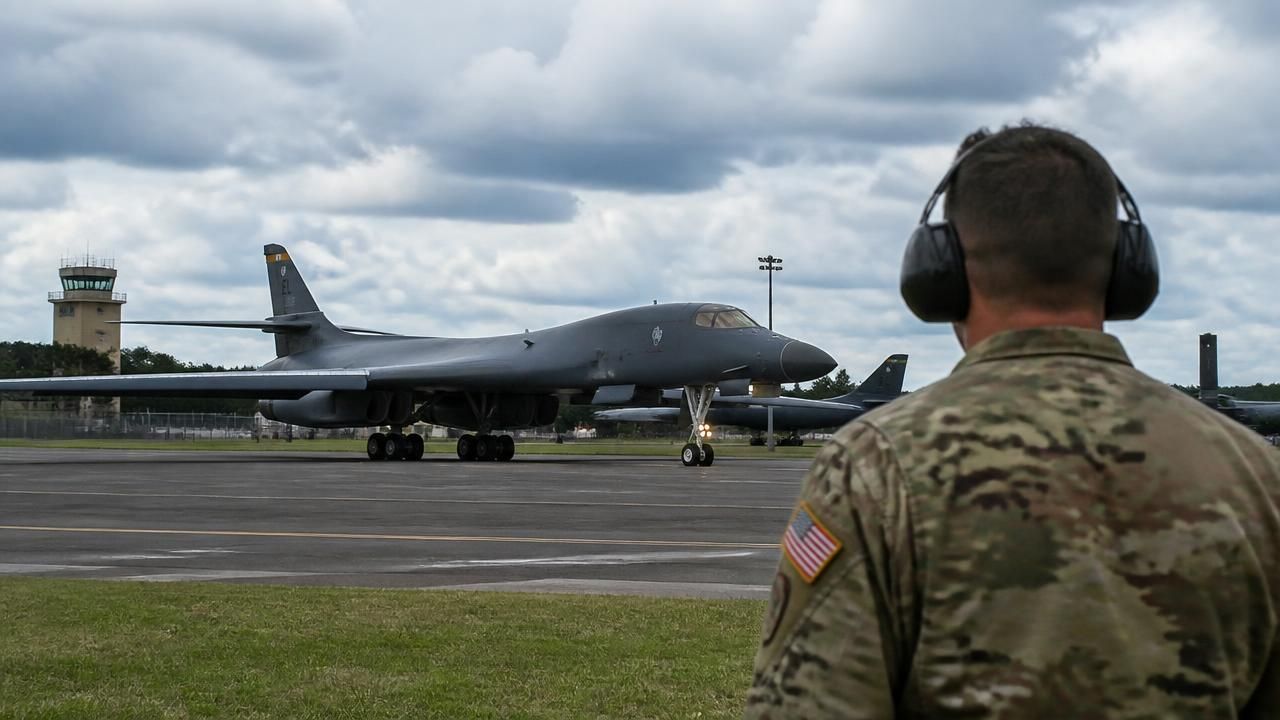
Twelve U.S. Air Force B-1 bombers were pulled out of R.A.F. Fairford in Britain because of the risk of a drone attack ordered by Iran's Islamic Revolutionary Guard Corps, according to U.S. and British officials, an extraordinary precaution that temporarily stripped one of Washington's key European staging bases of its most visible striking power.
The withdrawal, confirmed across multiple outlets including The New York Times and NBC News, marks one of the clearest public indications yet that American and allied planners are treating Iranian drone and missile capabilities as a direct threat not just to forces in the Middle East, but to installations in Western Europe.
What Officials Say Happened
According to the accounts provided by officials in both governments, the decision to relocate the B-1 fleet was driven by intelligence indicating that the I.R.G.C. — Iran's ideologically driven military branch, which oversees much of the country's proxy network and asymmetric warfare programs — had ordered an attack using unmanned aerial systems.
R.A.F. Fairford, a Royal Air Force station in Gloucestershire that hosts rotational U.S. bomber deployments, is a conspicuous target: it is publicly known, geographically fixed and has in recent years served as a launchpad for long-range B-1B Lancer missions. Officials did not detail where the aircraft were sent, what specific intelligence triggered the move, or how long the bombers are expected to remain away.
'Defenseless' — How the Coverage Split
The story was framed in sharply different ways depending on the outlet. The New York Times led on the diplomatic and military mechanics — the I.R.G.C. order, the joint U.S.-British assessment, and the sheer number of aircraft involved. NBC News emphasized the official confirmation and the nature of the threat, reporting that the drone-attack warning directly prompted the removal of the bombers.
One syndicated headline, by contrast, cut straight to the alarmist conclusion:
US bases defenseless in Iranian missile, drone strikes
That framing reflects a broader debate among defense analysts: whether static air bases — designed for Cold War-era threats and protected largely by Patriot batteries, short-range air defenses and counter-rocket systems — can realistically hold up against swarms of inexpensive drones and massed ballistic or cruise missiles. Critics of the "defenseless" characterization argue that dispersing high-value aircraft is not a sign of weakness but a standard force-protection measure, and that the withdrawal itself demonstrates the defenses and warning systems working as intended.
The Wider Shadow War
The episode lands in the middle of a years-long, low-grade confrontation between Washington and Tehran that has repeatedly threatened to escalate into direct conflict. Iran and its aligned militias have launched drone and rocket attacks against U.S. positions in Iraq and Syria; U.S. forces have struck back. The I.R.G.C. has also demonstrated the reach of its drone program in strikes on Saudi oil infrastructure and, more recently, in large-scale missile and drone barrages aimed at Israel.
European bases have increasingly been drawn into that picture. Since Russia's full-scale invasion of Ukraine, U.S. bombers have rotated through Fairford with greater regularity as a signal of transatlantic resolve, and the same public visibility that makes those deployments strategically useful also makes them targetable.
- Force protection: The move suggests commanders are prioritizing survivability of scarce, high-value aircraft over maintaining a visible forward posture.
- Signaling: Withdrawing bombers can be read either as prudent caution or as a signal of how seriously the threat is taken — a distinction adversaries will study closely.
- Alliance strain: The decision required close U.S.-U.K. coordination, and it puts renewed pressure on NATO members to invest in counter-drone and integrated air-and-missile defenses.
- Cost asymmetry: A single B-1B is valued in the hundreds of millions of dollars; the drones that threatened it cost a tiny fraction of that.
Unanswered Questions
Several key questions remain unresolved. It is unclear whether the intelligence pointed to a specific plot against Fairford, a more general I.R.G.C. directive, or a threat against U.S. assets across multiple locations. Officials have not said whether the bombers have since returned, nor whether additional defensive systems were surged to the base.
The disclosure also raises a political question in both capitals: how much the public should be told about threats to allied installations, and whether transparency about vulnerabilities encourages further probing by Iran and its proxies. For now, the episode stands as a pointed reminder that in an era of cheap, plentiful drones, even the most advanced air forces must reckon with how — and where — they park their aircraft.