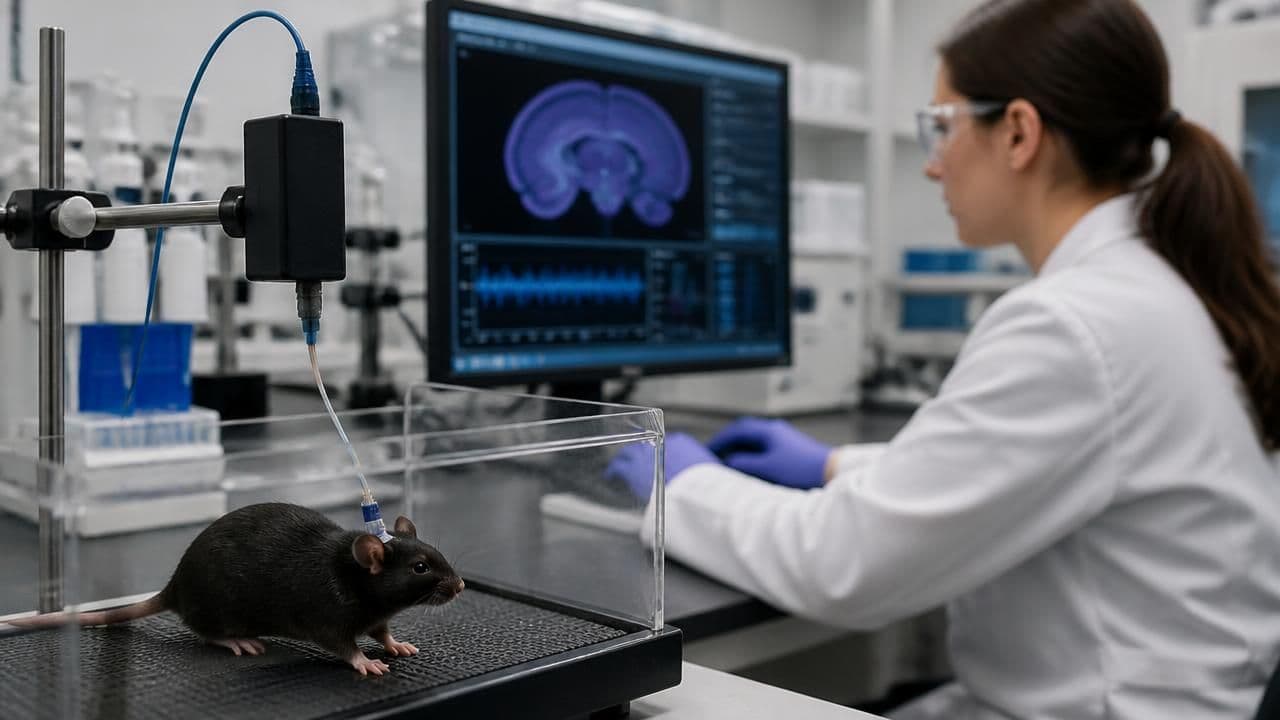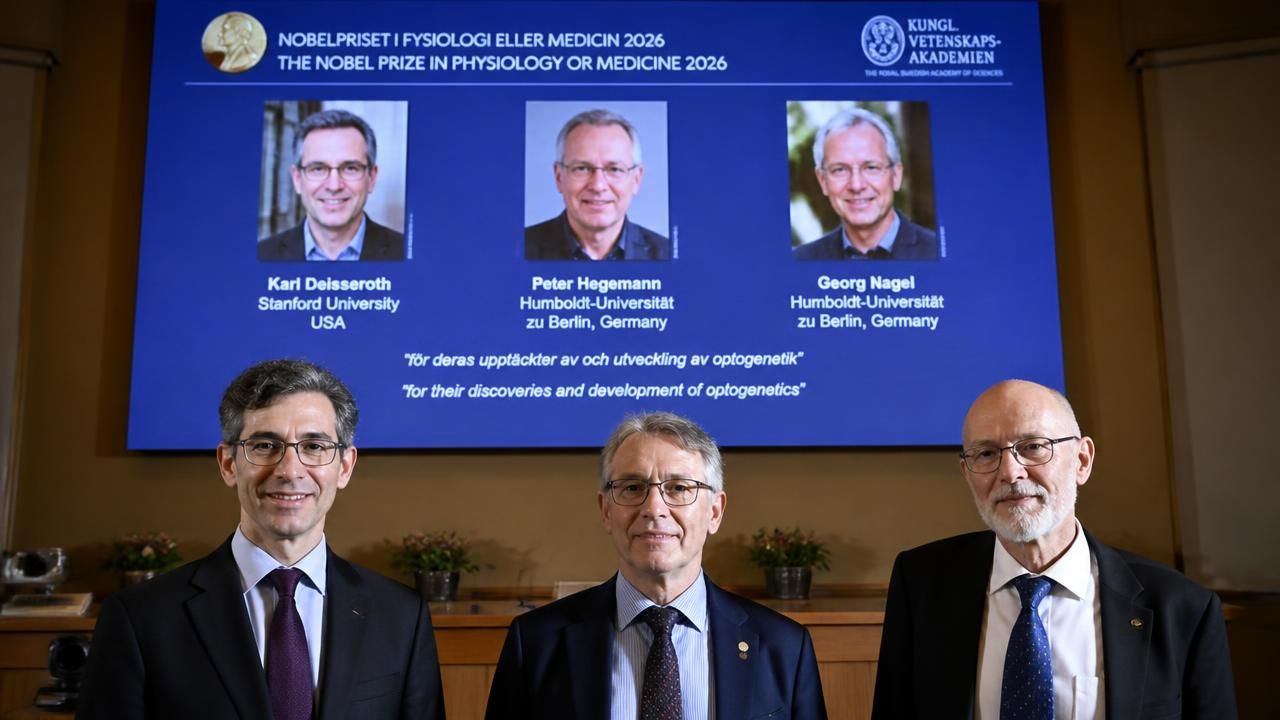
The Nobel Prize in Physiology or Medicine has been awarded to three scientists who turned light into a remote control for the brain. Karl Deisseroth, a psychiatrist and neuroscientist at Stanford University, and German biophysicists Peter Hegemann and Georg Nagel share the 2026 award for inventing and refining optogenetics — a technique that uses brief pulses of light to switch genetically targeted neurons on and off inside living tissue.
The announcement, carried by wire services and public broadcasters around the world, was framed by Nature as the discovery of a brain “switch” that lets researchers command neurons with light. Ars Technica, by contrast, placed the prize in the longer arc of neuroscience methodology: decades of work in which researchers mapped where particular genes are active in the brain, then deleted those cells to infer what they did.
That older approach had obvious limits. As Ars Technica summarized the underlying scientific rationale, the brain is flexible enough to compensate for lost cells, and removing neurons early in development can alter the wiring of everything they would have connected to. The more informative experiment, the outlet noted, would be to activate and silence neurons in an otherwise intact brain.
“It would be far more informative to activate and shut down the neurons in an otherwise intact brain.” — the scientific rationale behind optogenetics, as described by Ars Technica
From pond algae to living brains
The technology grew out of an unlikely starting point: single-celled algae that swim toward light. Hegemann and Nagel identified and characterized channelrhodopsin, a light-gated ion channel in the alga Chlamydomonas reinhardtii, showing in a landmark 2003 paper that the protein could be inserted into other cells and drive a current when illuminated. That work established the essential ingredient — a protein that converts photons directly into electrical activity.
Deisseroth supplied the other half of the equation. In 2005, working with Edward Boyden, he demonstrated that channelrhodopsin could be expressed in mammalian neurons and used to trigger precisely timed spikes of activity with millisecond-scale control. Two years later his laboratory added the ability to silence neurons as well, using light-driven inhibitory proteins such as halorhodopsin. Together the tools gave scientists two-way control: on, off, and back again, on demand.
Why it matters
Before optogenetics, researchers who wanted to know what a population of neurons did had blunt instruments. Electrodes could record activity but not manipulate it cleanly; lesions destroyed tissue permanently; pharmacological agents acted broadly and slowly. Optogenetics made causation testable. A laboratory could now ask whether activating a specific circuit produces a specific behavior — and get an answer in the same experiment.
The technique has since been used to probe the circuitry of Parkinson's disease, depression, addiction, epilepsy, anxiety and chronic pain, and to map the pathways that govern memory, feeding and sleep. Coverage from Northern Public Radio emphasized this therapeutic dimension, centering Deisseroth's own explanation of how light-based control might one day be used to correct malfunctioning brain circuits in patients with psychiatric and neurological disorders.
Optogenetics has already reached humans in at least one setting. In 2021, a man with the degenerative eye disease retinitis pigmentosa regained partial vision after receiving a gene therapy that made retinal cells light-sensitive — the first demonstration that the approach can restore function, not just reveal it, in a patient.
The obstacles between laboratory and clinic
- Gene delivery. Opsins must be introduced into specific cell types, typically with viral vectors — a step that remains difficult, and carries immune and safety risks.
- Getting light in. The skull blocks light, so deep-brain experiments require implanted fiber optics; the brain is also largely opaque and scatters illumination.
- Longevity and safety. Researchers must establish that light exposure and the foreign proteins themselves cause no lasting damage, and that expression remains stable for years.
- Circuit complexity. Switching one node affects the whole network, making interpretation harder than single-cell experiments suggest.
How the story was told
The framing of the award varied by outlet, reflecting each newsroom's audience. The wire-service headlines distributed by MSN led with the prize itself and the nationalities of the recipients — an American and two Germans — treating it as a straightforward honors story. Nature's coverage foregrounded the science, describing a brain switch that controls neurons with light. Ars Technica published the fullest technical account, tracing optogenetics from developmental gene studies to the algae proteins that made it possible. Northern Public Radio, meanwhile, approached it as a health story, asking what the technique could eventually do for people with brain disorders.
That divergence is characteristic of major science prizes, where a single announcement must serve readers ranging from working neuroscientists to patients searching for hope. The Deisseroth half of the award is unusually well suited to both: he is a practicing clinician as well as a researcher, and has consistently framed optogenetics as a route toward understanding — and eventually treating — conditions such as depression and treatment-resistant psychiatric illness.
What comes next
The prize is likely to accelerate two converging trends. The first is the migration of optogenetics from animal models into human trials, particularly in vision restoration and in epilepsy, where abnormal electrical activity is well localized. The second is the search for less invasive alternatives — including light-sensitive proteins that respond to red or infrared light, which penetrates tissue more deeply, and ultrasonic or magnetic methods that require no implanted hardware at all.
For now, the award honors a discovery that began with a microscopic organism responding to sunlight and ended by giving neuroscience its most precise tool for controlling the brain. The field it created, named in the prize citation as optogenetics, now spans thousands of laboratories and continues to expand into medicine.