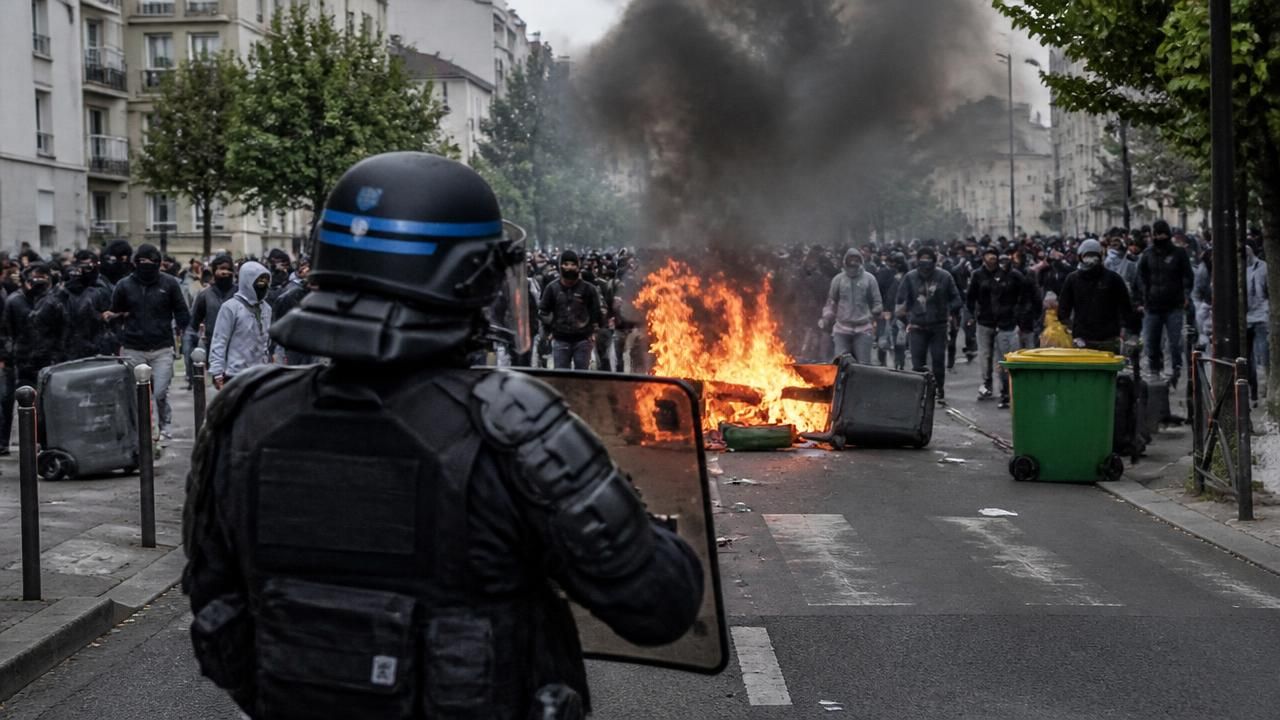
France moved to suspend classes at as many as 500 high schools on Monday as a student protest movement that began in the deprived suburbs of Paris spread nationwide, escalating into arson, blockades and running street battles between teenagers and riot police. The government's decision to close schools — described by the education minister as a measure to protect students and staff — marks one of the most serious confrontations between French youth and the state in years, and has forced the prime minister to convene an emergency crisis meeting.
The unrest has produced a bewildering and rapidly shifting set of casualty figures, with different authorities and outlets reporting arrest tallies that range from several hundred to nearly 2,000, and at least one account citing roughly 5,000 detentions nationwide. Police injuries have been put at more than 300, while the education minister said around 40 headteachers were injured. Early reporting also described hundreds of people injured overall, with thousands of protesters arrested since the movement began.
How the protests began
According to Reuters, the movement was sparked not in the center of the capital but in Paris' deprived suburban high schools, where students first walked out over conditions in their institutions and the way police treat young people from those neighborhoods. Those local grievances quickly metastasized into a national cause, drawing in students from cities across France who say their schools are underfunded, overcrowded and neglected.
Protesters have framed the dispute in terms of inequality as much as education: the gap between well-resourced schools in affluent areas and crumbling facilities in working-class and immigrant-heavy districts, and what students describe as heavy-handed policing of their communities. Subsequent rallies have explicitly linked school conditions to police response, giving the movement a broader political charge than a typical education dispute.
From school gates to street clashes
What began as sit-ins and class suspensions has turned increasingly violent. Reports describe teenagers ransacking classrooms, setting fires inside their own schools and burning barricades, while police responded with tear gas and mass arrests. The New York Times characterized the scene as one of "blockades, fireworks and tear gas," with young protesters rattling the French state. Other accounts describe fireworks being launched at officers and running clashes in city centers.
Paris' police chief publicly warned that the school protests had become too violent to manage through ordinary policing, a signal that authorities see the demonstrations as a public-order emergency rather than a contained student action.
The government's response
The education minister said hundreds of schools would suspend some or all classes on Monday, and pointed the finger at far-left infiltrators, arguing that organized activists were exploiting genuine student anger to foment disorder.
The education minister characterized the unrest as the work of far-left infiltrators, and said hundreds of schools would suspend some or all classes on Monday — a framing reported across French and international outlets.
The prime minister's decision to call a crisis meeting underscores the political stakes for a government already contending with broader social tensions. Ministers are walking a narrow line: acknowledging legitimate complaints about the education system while attributing the worst violence to outside agitators, a distinction that protest leaders reject.
Unions throw their weight behind students
France's trade unions have backed the students and called for nationwide protest, a development that significantly raises the pressure on the government. When unions and student movements align in France, as they did during the 2006 and 2010 protest waves, demonstrations tend to grow larger, last longer and become harder to contain. The Morning Star framed the story squarely around labor solidarity and school closures, a reminder that the dispute is being read in some quarters as a class conflict rather than a simple school-safety matter.
How different outlets frame it
- Reuters emphasizes the movement's origins in Paris' deprived suburbs, treating it as a story about inequality and policing.
- The New York Times offers explanatory, scene-driven coverage, cataloguing the tactics — blockades, fireworks, tear gas — and asking what the protests mean for France.
- Al Jazeera leads with the hard logistical fact: up to 500 schools shuttered as more protests are called.
- The Daily Mail and The Sun adopt a far more alarmist register, using phrases such as "riot-hit France" and highlighting students who burned down their own classrooms and attacked teachers.
- Le Monde and French-language outlets focus on the spread of the protests and the scale of the arrests.
- Newsday and MSN's aggregated coverage look ahead, framing the story around what to expect next and the government's crisis management.
That divergence matters. Where Anglo-American broadsheets stress context and consequence, tabloids stress chaos, and French-language coverage stresses scale, the underlying facts are largely the same: schools closed, streets burning, thousands detained, and a government scrambling to regain control of the narrative.
What comes next
The immediate question is whether Monday's closures will defuse the movement or inflame it. With unions now backing nationwide action and the prime minister convening emergency talks, the coming days will test whether the government can separate what it calls a fringe of violent infiltrators from the far larger body of students with genuine grievances about their schools. If it cannot, France may be entering a prolonged autumn of protest — one that, like the movements that preceded it, could outlast the issue that started it.