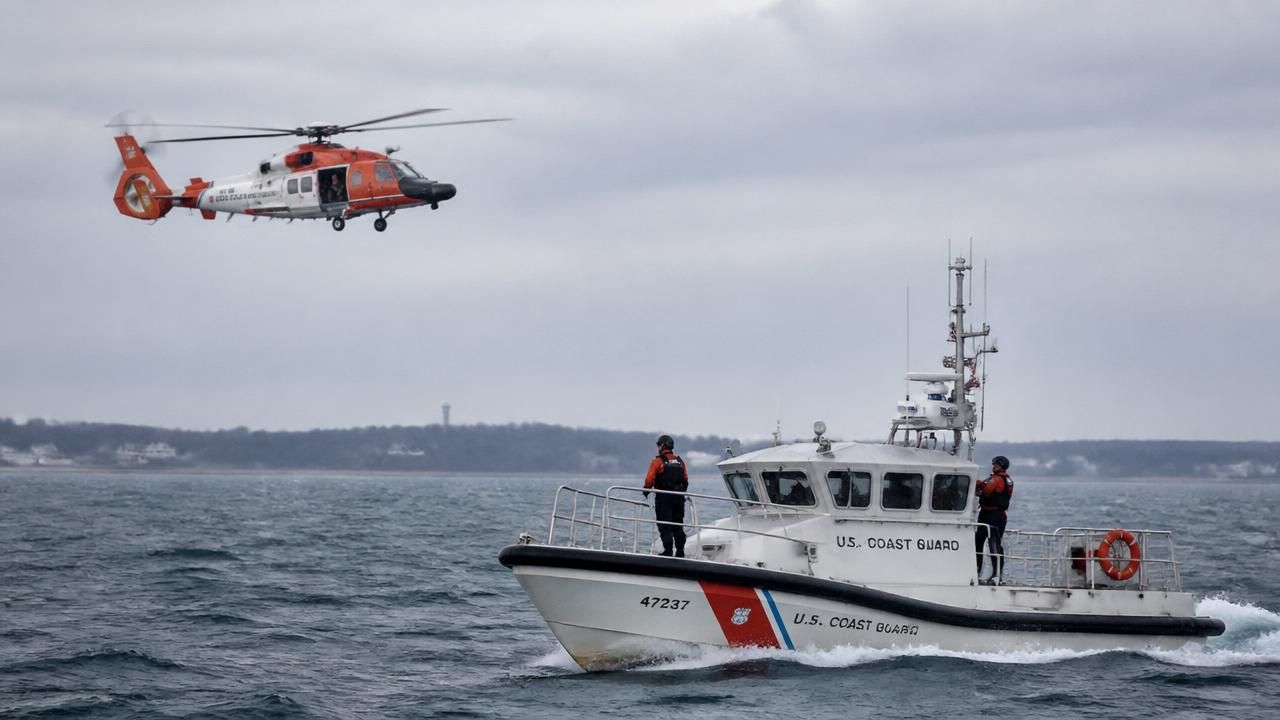
The United States Coast Guard is leading an urgent search off the coast of Massachusetts for an air ambulance jet carrying six people that vanished from radar during a medical evacuation flight from Bermuda to Boston early Saturday morning.
According to the Federal Aviation Administration, the aircraft — a Gulfstream G-100 — lost contact with air traffic controllers shortly after 1:20 a.m. local time. The FAA issued a search-and-rescue alert notice at that point, formally activating the multi-agency response that has since focused on the waters around Nantucket.
Coast Guard crews have been scouring the area by air and sea, though officials have not publicly confirmed whether any debris, oil sheen, or emergency beacon signal has been detected. The Coast Guard has not released the identities of those aboard.
What We Know About the Flight
The aircraft was operating as a medical transport — commonly known as an air ambulance — and was carrying six people at the time it went missing. Multiple reports, including those from Canadian outlets and MSN, describe the jet as being operated by an Ontario-based air ambulance service, underscoring the cross-border nature of the mission: a Canadian medical operator flying a patient or medical crew from the Atlantic island territory of Bermuda toward a major U.S. hospital hub in Boston.
Bermuda, a British Overseas Territory roughly 600 nautical miles east of the U.S. mainland, relies heavily on medical evacuation flights to reach specialized care in the United States. Boston, with its concentration of teaching hospitals, is a frequent destination for such transfers.
A Sudden Loss of Contact
Details about the final moments of the flight remain sparse and, in some accounts, conflicting. The Sun reported that the plane plunged more than 10,000 feet after departing Bermuda, while the Daily Mail teased what it described as “disturbing new audio” offering clues about the disappearance — audio that has not been independently verified or formally released by investigators.
Aviation safety analysts caution that early reports of altitude loss during an oceanic crossing are often fragmentary, drawn from Automatic Dependent Surveillance–Broadcast (ADS-B) data that can be intermittent over open water where ground-based radar coverage is limited. Over the North Atlantic, aircraft frequently rely on satellite-based tracking and position reporting rather than continuous radar contact.
“The FAA issued a search-and-rescue alert notice for a Gulfstream G-100 at about 1:20 a.m. local time on Saturday.”
— FAA spokesperson, in a statement to The Guardian
How the Search Is Being Conducted
The Coast Guard's search area spans a broad expanse of ocean south and east of Nantucket, a region known for cold water, strong currents, and variable weather — conditions that complicate both aerial reconnaissance and surface recovery operations.
- Air assets: Fixed-wing aircraft and helicopters flying grid patterns to spot debris or life rafts.
- Surface assets: Coast Guard cutters and patrol boats sweeping the likely drift zone based on currents.
- Electronic search: Monitoring for the aircraft's emergency locator transmitter, which should activate on impact.
- Coordination: The FAA's alert notice formally brings the incident into the national search-and-rescue framework.
Search-and-rescue planners use a technique called drift modeling, calculating where survivors or wreckage would travel given wind and current over elapsed time. The longer the search continues without contact, the more the search box expands — and the narrower the window for a successful rescue becomes.
Why Air Ambulances Face Elevated Risk
The disappearance of a medical transport draws particular attention because air ambulance operations occupy a uniquely demanding niche in aviation. These flights are often dispatched on short notice, at any hour, into weather that commercial carriers might avoid, because the patient's condition dictates the timetable.
In the United States, the medevac sector has been the subject of repeated safety scrutiny. Regulators and industry groups have pushed for stricter flight-risk assessment programs, better terrain awareness systems, and broader adoption of autopilot and night-vision technology. Long overwater legs like the Bermuda–Boston route add another layer of complexity, removing diversion options that land-based medevac crews take for granted.
The Gulfstream G-100, a twin-engine business jet, is a comparatively capable platform for such missions, with transoceanic range and the speed needed to shorten transport time for critically ill patients. That makes the sudden loss of contact all the more striking to aviation observers.
How the Story Is Being Framed
Coverage of the disappearance has varied widely in tone. The Guardian and NBC New York have emphasized the official, procedural dimensions — the FAA alert, the Coast Guard's search footprint, the absence of confirmed details. The New York Times framed it as a medical flight bound for Boston from Bermuda, foregrounding the human stakes of a patient-transfer mission.
Canadian outlets and aggregators, meanwhile, have stressed the aircraft's Ontario origins, reflecting domestic interest in a Canadian-flagged or Canadian-operated medical service. The Sun and the Daily Mail have leaned into the mystery angle, amplifying unconfirmed reports of a steep descent and cryptic cockpit audio. That divergence mirrors a familiar split in breaking-news coverage: institutional outlets waiting for verified information while tabloid-facing platforms chase atmospheric detail.
What Happens Next
The immediate priority remains the search. If the aircraft is located, the National Transportation Safety Board would likely open an investigation, potentially in coordination with Bermudian and Canadian authorities given the flight's international dimensions. Investigators would examine maintenance records, the crew's duty time, weather along the route, and the ADS-B and satellite tracking trail.
For now, families and colleagues of the six people aboard — and the broader medevac community — are left waiting on a stretch of ocean where, as of Saturday, neither the aircraft nor a definitive explanation had been found.