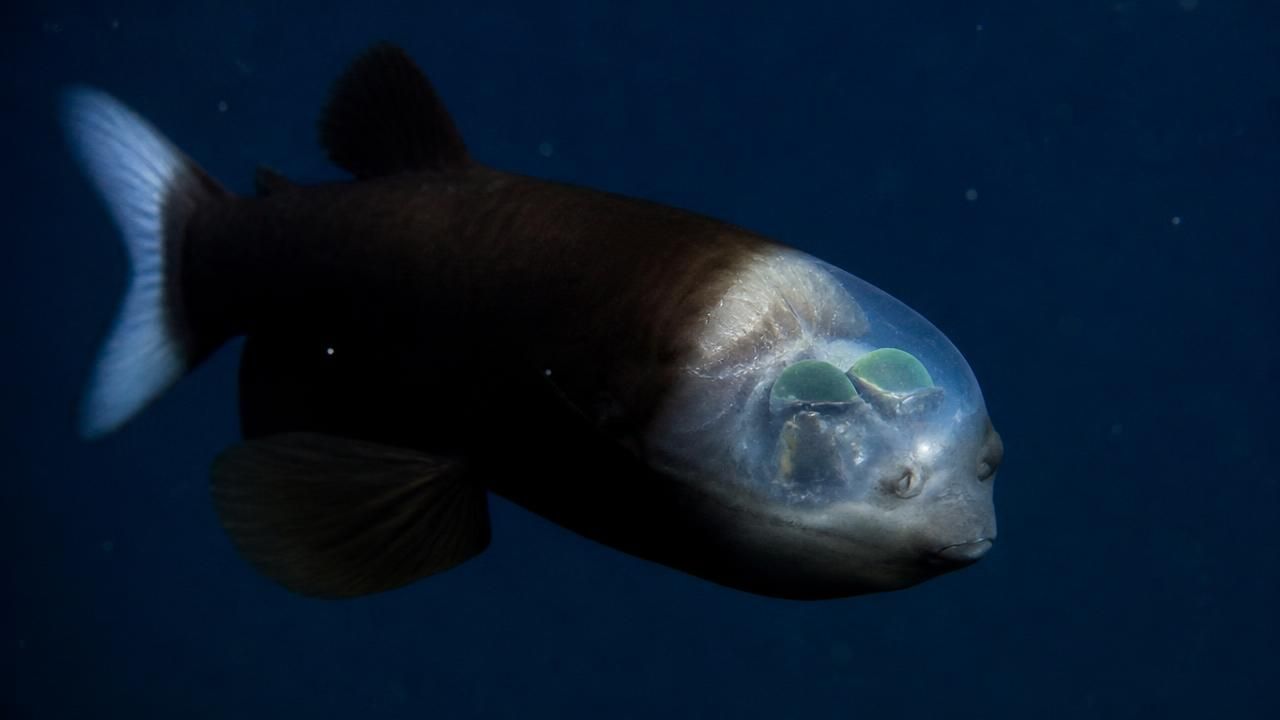
Deep-sea researchers have released stunning new 4K footage of one of the ocean's most improbable creatures: a six-inch fish with a fully transparent head and upward-pointing, rotating eyes, filmed roughly 710 meters — about 2,000 feet — beneath the surface. The barreleye fish, known to science as Macropinna microstoma, was recorded in the ocean's dim "twilight zone," a region of near-total darkness where sunlight fades into black and where some of the planet's least-understood animals live.
The footage, captured during a research expedition using remotely operated vehicle cameras, marks the first time the species has been filmed in such high resolution at depth, according to reports from Science Daily and other outlets covering the release. The imagery shows the fish suspended in open water, its dome-like forehead rendered glassy and almost invisible, revealing the vivid green tubular structures inside.
An anatomy that defies intuition
What makes the barreleye so strange is not merely that its head is transparent, but how that transparency serves its eyes. The fish's eyes are large, cylindrical and packed with light-gathering green pigment. In their default position they point straight up through the transparent dome, scanning the water column above for the silhouettes of prey against the faintest downwelling light — a strategy common among deep-sea ambush hunters.
But the eyes can also rotate. Researchers have documented the barreleye swinging its tubular eyes forward to track prey directly in front of its mouth, an unusual mechanical flexibility that effectively gives the animal a swiveling, armored periscope. The transparent shield protects those delicate structures while preserving the upward field of view — an elegant, if eerie, evolutionary compromise.
"The barreleye fish uses its upward-pointing eyes to spot prey before rotating them forward to track its next meal, all while a transparent dome protects them," researchers explained in descriptions accompanying the new footage.
Why the twilight zone matters
The 710-meter depth places the sighting squarely in the mesopelagic zone, sometimes called the ocean's twilight zone, where between roughly 200 and 1,000 meters light diminishes to almost nothing. This band is thought to hold an enormous share of the ocean's fish biomass, and it is increasingly the focus of scientific interest — both because it is poorly surveyed and because it sits in the crosshairs of discussions about deep-sea fishing and mineral extraction.
Because the twilight zone is so difficult to reach, almost everything known about its inhabitants comes from brief encounters with robotic submersibles. That makes each recorded sighting valuable: the barreleye was first described in the 1930s from specimens hauled up in nets, but for decades scientists could only speculate about how the living animal held its eyes and behaved. Net-caught animals arrived dead, often with their transparent domes collapsed.
How the animal was finally seen alive
The breakthrough came only with the rise of deep-diving remotely operated vehicles, which can film fragile animals in their own environment without the trauma of nets. Research groups operating off the California coast — most notably the Monterey Bay Aquarium Research Institute, whose submersibles have produced the best-known barreleye imagery — have spent decades logging thousands of hours of video from the deep.
- Depth: Approximately 710 meters, or roughly 2,000 feet, in the mesopelagic twilight zone.
- Size: About six inches in length.
- Signature feature: A transparent head shielding large, green, tubular eyes that can rotate from upward-looking to forward-facing.
- Significance: High-resolution footage is exceptionally rare for this species, offering researchers a behavioral record rather than a preserved specimen.
How different outlets frame the story
The coverage reflects the fish's double life as both scientific subject and internet spectacle. Science Daily led with the biology — the mechanics of the rotating eyes and the protective dome — treating the clip as a natural-history milestone. Other outlets leaned harder into the visual shock value, with headlines emphasizing the "eerie appearance" and the "bizarre" sight of a see-through skull. Several framed it as a first: the first footage of such a fish filmed in the twilight zone at this depth and resolution. The framing difference matters less than the shared effect — a reminder that the deep ocean still produces animals that look invented.
What the footage tells us — and what it doesn't
A single encounter cannot answer the major open questions. Researchers still do not know how long barreleyes live, how widely they range across the world's oceans, how they reproduce, or how the transparent tissue develops. The dome, scientists note, is not a hollow bubble but a fluid-filled structure continuous with the fish's soft anatomy, and its biochemistry remains an active area of inquiry.
What the recording does demonstrate is the value of investment in deep-sea observation. Each ROV dive costs substantial time and money, and the window for filming is short. Yet the payoff is disproportionate: a few seconds of 4K video can overturn decades of inference drawn from dead specimens.
As deep-sea industries expand and the twilight zone becomes a frontier for both science and commerce, such footage also carries a conservation message. An animal this strange, living at a depth where human activity is only just beginning, is a reminder of how much remains unobserved — and how quickly a poorly understood ecosystem can be altered before anyone has finished describing it.