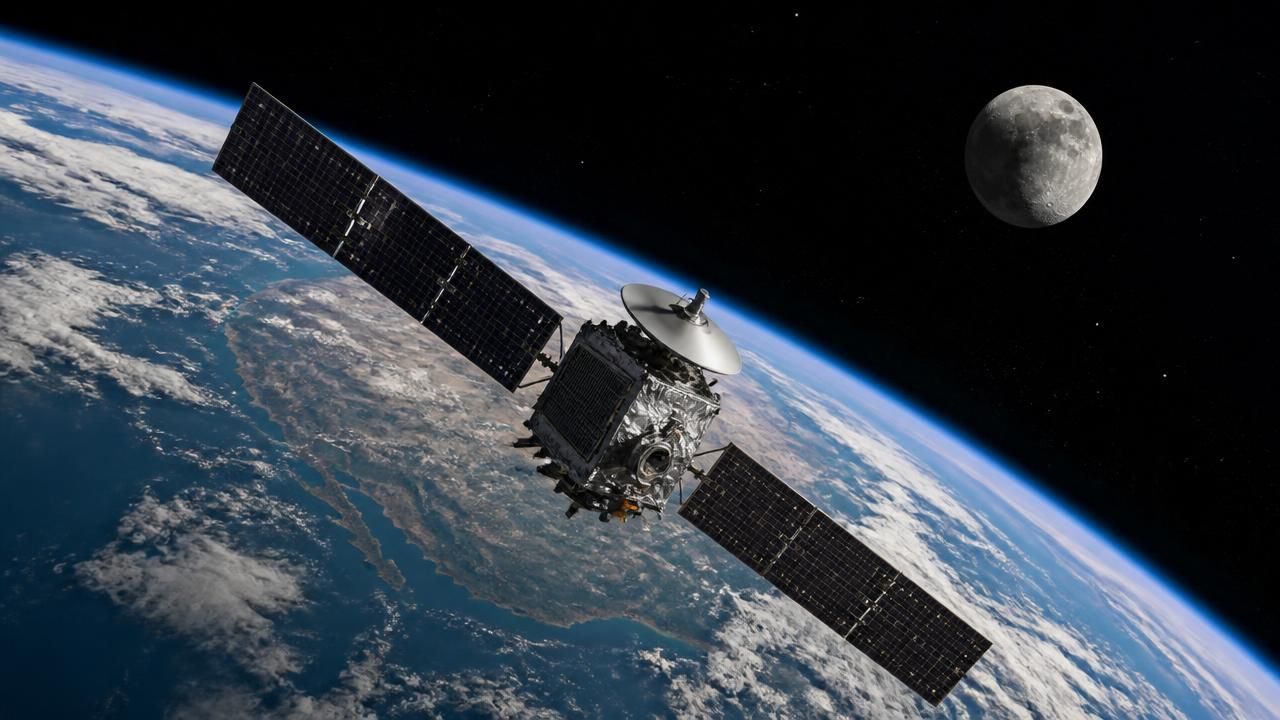
The European Space Agency's Jupiter Icy Moons Explorer — Juice — raced past Earth on September 28, harvesting a gravitational assist from its home planet to bend its long trajectory toward Jupiter without burning a significant amount of precious fuel. The maneuver reshaped the spacecraft's path by roughly 20 degrees and increased its speed by about 3.5 kilometers per second, a substantial boost that mission planners would otherwise have had to buy with propellant.
The flyby was more than a piece of orbital bookkeeping. As the spacecraft swept past, it turned its instruments back on Earth and the Moon, giving engineers and scientists a rare, close-range rehearsal for the observations Juice will eventually make at the solar system's largest planet and its icy moons.
A slingshot in the dark
The physics of a gravity assist is elegantly simple: a spacecraft steals a tiny amount of momentum from a moving planet, changing its own speed and direction relative to the Sun. For Juice, the encounter was a way to trim years and kilograms from its journey. ESA has designed the mission's cruise with a chain of planetary encounters — a Venus flyby and further Earth passes — precisely because no rocket could carry enough fuel to deliver the spacecraft directly to Jupiter.
Juice left Earth in April 2023 aboard an Ariane 5 rocket, weighing roughly six tonnes at launch, more than half of which was propellant. Getting that mass to the outer solar system requires patience and geometry rather than brute force. Each flyby is calculated years in advance, with margins tight enough that a small error could put the spacecraft on a trajectory that cannot be recovered without sacrificing science.
The September encounter therefore served two masters: navigation and validation. According to mission updates, the flyby delivered exactly the change in velocity and direction that had been modeled, confirming the spacecraft's navigation team was reading the solar system correctly.
Instruments get a dress rehearsal
A gravity assist at Earth is also a free calibration opportunity. The spacecraft's ten science instruments — including the JANUS camera system, the MAJIS visible and infrared spectrometer, the RIME radar sounder, a laser altimeter, magnetometers and particle detectors — were designed to study Jupiter's moons from orbit, but they can be pointed at targets much closer to home to verify that they work as advertised.
That is an unusually valuable test for a mission that will not reach its destination for years. By observing the Moon and Earth, teams can check pointing accuracy, spectral response and data-processing chains against worlds whose properties are already well known, helping them distinguish instrument quirks from genuine discoveries later. The stakes are high: Juice's data will not be returned in real time from Jupiter, and mistakes discovered after arrival are expensive to fix.
Juice is designed to characterize Jupiter's icy moons as both planetary objects and possible habitats — a goal that depends on every instrument working precisely as planned when the spacecraft finally arrives.
Photos, and a comet that will have to wait
The flyby also produced the most visible payoff: imagery. Scientific American reported that the Jupiter-bound spacecraft snapped photos as it swung past Earth, and the results circulated widely as the mission's monitoring cameras captured the planet and the Moon from a perspective unavailable to any ground-based observatory. For a public accustomed to spacecraft images of distant worlds, a portrait of Earth taken by a machine on its way out of the solar system carries a particular appeal.
A more intriguing — and slower — payoff concerns comet 3I/ATLAS. According to IFLScience, Juice imaged the interstellar object during its cruise, but the pictures will not be seen on Earth until 2026. The reason is bandwidth and priorities: the spacecraft's main antenna and its data storage are optimized for Jupiter operations, and images taken during cruise often sit in onboard memory until a scheduled downlink window opens. The headline promised photographs that no one will see for well over a year, a reminder that in deep-space missions the observation and the revelation are frequently separated by long stretches of silence.
How the story was told
The coverage split along familiar lines. Science Daily foregrounded the engineering and physics of the maneuver — the 20-degree course change, the 3.5 km/s boost, the fuel saved — framing the flyby as a navigational milestone. Scientific American leaned toward the human and visual dimension, leading with the photographs. Aggregators such as MSN pushed the story out with headline variations that emphasized speed and spectacle, while IFLScience found an unexpected angle by connecting the cruise to the interstellar comet and the delayed payoff of its imagery.
Taken together, the different framings reflect what a gravity assist actually is: at once a piece of orbital mechanics, a public-engagement moment, and a long-term investment whose returns are deferred by years.
The long road to Jupiter
Juice's destination remains distant. The spacecraft is scheduled to arrive at Jupiter in July 2031, where it will spend years making dozens of flybys of the icy moons Ganymede, Callisto and Europa before settling into orbit around Ganymede — a first for a spacecraft around a moon other than Earth's own. Scientists hope the mission will clarify whether these ice-covered worlds, with oceans likely hidden beneath their surfaces, could once have supported habitable conditions.
Between now and then lie more planetary encounters, further instrument checkouts, and a steadily growing distance from home. The September flyby is best understood as a well-executed step in a decade-long plan: a spacecraft borrowing a little of Earth's motion, testing its eyes on familiar ground, and then continuing outward toward a rendezvous that will not come until the 2030s.