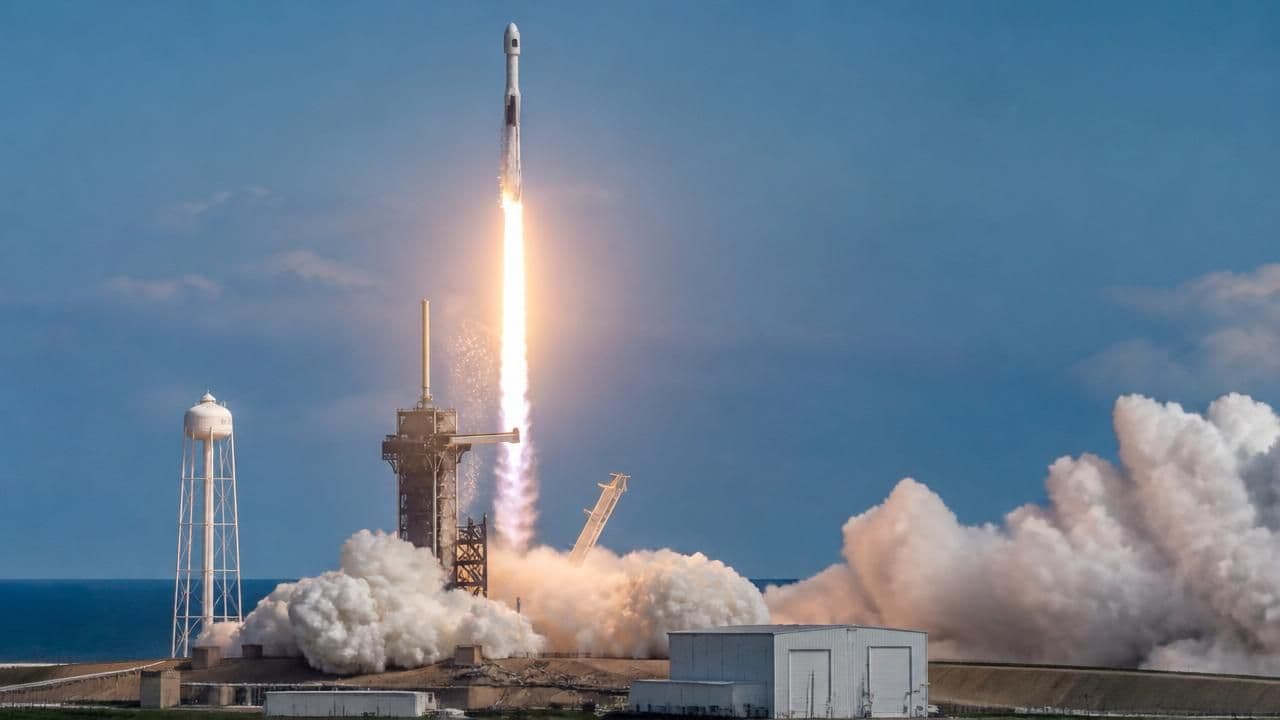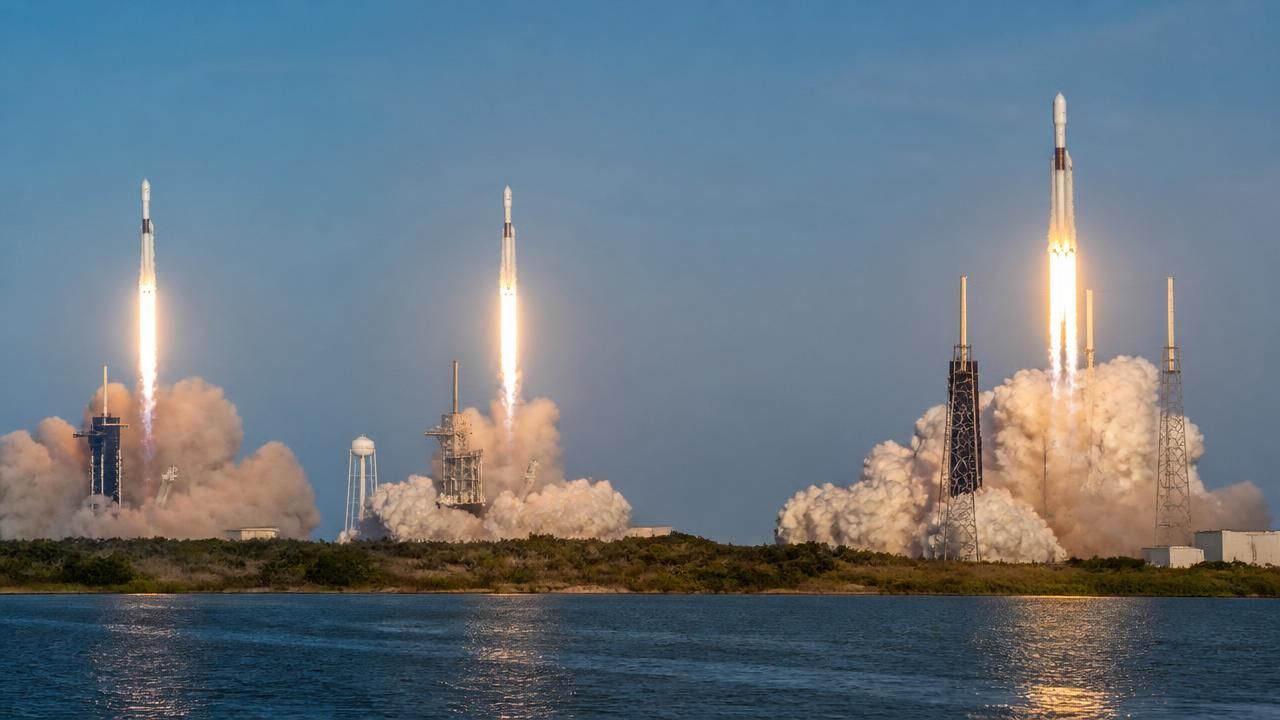
SpaceX pulled off one of the most densely packed launch sequences in its history this week, flying three rockets from three different pads in roughly 13 hours while, in a separate milestone, finally sending its giant Starship vehicle all the way to orbit. The triple-header — a crewed astronaut mission, a batch of about 130 satellites and a classified U.S. government payload riding a Falcon Heavy — capped a stretch in which the company also logged its 700th Falcon launch and set a new booster-reuse record.
The sheer volume of activity produced sharply different headlines depending on where readers looked. Aggregators and broadcast outlets led with the spectacle of the triple-header and the mystery of the secret spy payload. Specialist trade publications focused on the engineering milestones. Regional newsrooms concentrated on what the cadence means for launch sites in their backyards.
A Triple-Header Across Three Pads
The centerpiece was a run of three Falcon missions inside a single 13-hour window, a cadence that would have been unthinkable for a single provider a decade ago. One flight carried a crew of astronauts toward orbit. Another lofted a large batch of satellites — reported at roughly 130 spacecraft — in a single rideshare-style manifest. The third was a Falcon Heavy flying an undisclosed payload for a U.S. national security customer, the kind of mission whose destination and capabilities are typically never described publicly.
Because two of the three missions involved either human crews or classified hardware, the window was unusually unforgiving: any single scrub would have rippled through the schedule. That all three flew within the same day is itself a statement about launch operations, range coordination and range availability at the Cape and beyond.
Starship's Long Road to Orbit
The week's biggest technical headline, however, belonged to Starship. On Monday morning, the super-heavy rocket completed its first orbital flight, the 14th integration flight of the program. As Ars Technica's Rocket Report put it in its weekly roundup, Starship had previously traveled "99 percent of the way to orbit," held back not by propulsion or structure but by "safety concerns around the possibility of stranding the huge rocket in space."
What was most notable for SpaceX with this Starship flight was that it unlocked a massive growth potential for Starlink, with the first 26 of the network's new-generation Starlink V3 satellites successfully deployed.
That framing matters. Starship is not simply a demonstration vehicle — it is the intended delivery truck for the next generation of SpaceX's broadband constellation. The V3 satellites are larger and more capable than their predecessors, and their mass and dimensions effectively require Starship's payload bay. Reaching orbit with a batch of them marks the point where the vehicle begins converting development spending into commercial capacity.
A Reuse Record and the 700th Falcon
Away from the headline missions, SpaceX continued to rewrite the economics of reuse. UPI reported that a Falcon 9 launch set a new company record for booster reuse, the latest increment in a program that has turned first stages into repeatedly flown assets rather than expendable hardware. Spaceflight Now, meanwhile, recorded a separate milestone: the 700th flight of a Falcon rocket, which carried the final three O3b mPOWER broadband satellites to orbit for the operator SES.
Those two data points — the reuse record and the 700th Falcon — are the quieter half of the story. The triple-header is a scheduling feat; the reuse record and the Falcon total are the underlying industrial capability that makes such schedules possible. Together they explain why SpaceX can attempt a crewed mission, a rideshare and a national security launch within a single day and still keep room in the calendar.
A Widening Competitive Field
SpaceX is not the only company having a busy week. Rocket Lab, the small-launch specialist, announced a significant new contract, according to the Rocket Report. The award underscores that the launch market is no longer a single-vendor story: while SpaceX dominates cadence at the heavy end, demand for dedicated small-satellite missions continues to sustain competitors with different cost and orbit profiles.
Regional outlets also picked up the local angle. In California, outlets reported that SpaceX was eyeing two launches from the West Coast within the same week, a reminder that Vandenberg Space Force Base has become a routine part of the company's manifest rather than an occasional diversion. Some of those pages were behind paywalls or access restrictions, but the framing was consistent: this is now a local infrastructure story as much as a national space story.
What Comes Next
- Starship cadence: The orbital flight opens the door to operational Starlink V3 deployment, but the company still needs to demonstrate rapid turnaround between vehicles.
- Starlink economics: Larger V3 satellites promise more capacity per launch, which could reshape pricing in the consumer and enterprise broadband markets.
- National security demand: The classified Falcon Heavy mission signals continued reliance on commercial launch for sensitive payloads.
- Competition: Rocket Lab's new contract shows that the small-launch segment remains viable as a hedge against a single dominant provider.
The through-line across all of this week's coverage is capacity. A triple-header is a headline because it is rare; the reuse record and the 700th Falcon flight are significant because they are not. SpaceX is now operating at a scale where the extraordinary has to be scheduled in alongside the routine — and, increasingly, the two are the same thing.