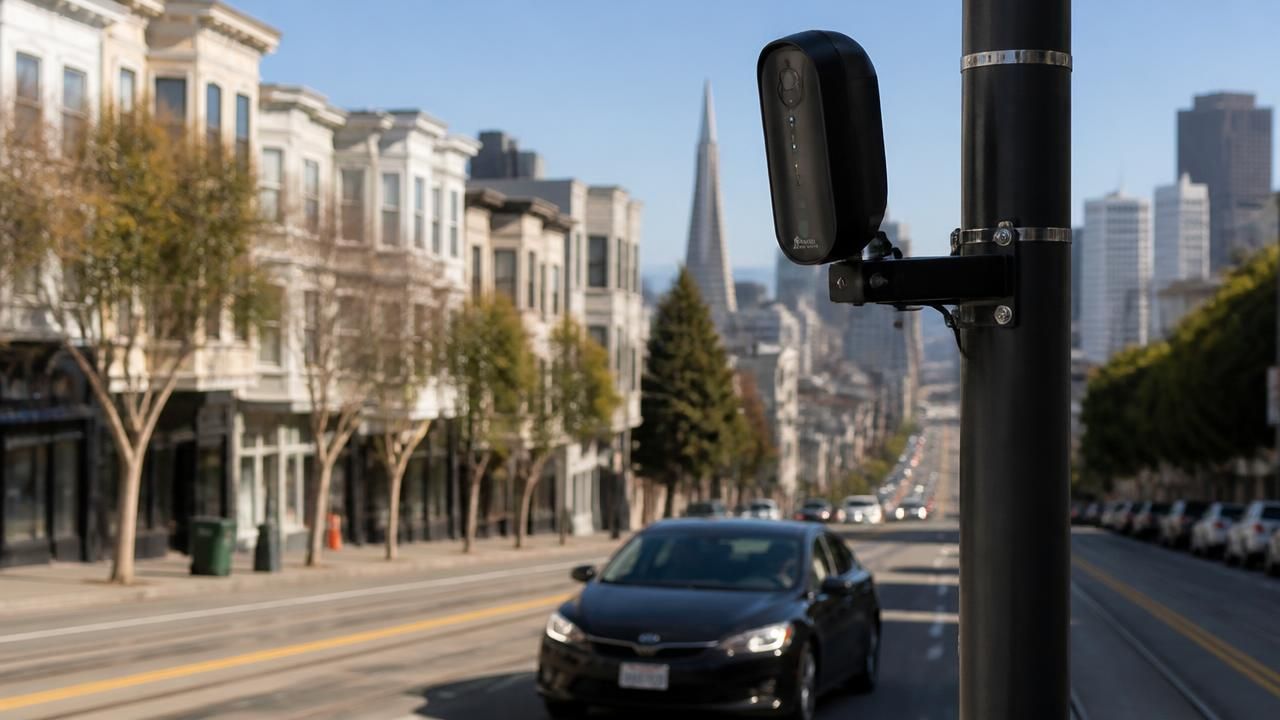
San Francisco officials are pointing to a dramatic drop in car-related crime and crediting an expanding network of AI-powered cameras made by Flock Safety. The city says the license-plate-reading dragnet has helped drive down auto thefts and break-ins. But the story is not just about crime statistics. It is also about evidence, civil liberties, and an unusual political fight that has split a wealthy family backing the surveillance push.
A city claims success
San Francisco has long struggled with car break-ins, smashed windows, and stolen vehicles, problems that damaged tourism and frustrated residents. According to local public radio stations WUNC and WVXU, car crimes in the city have dropped, and officials say Flock cameras have helped. NPR reported that San Francisco leaders say the AI-powered cameras helped drive a dramatic decline in car crime. The decline is welcome news for a city that has been battered by retail theft, open-air drug markets, and a post-pandemic recovery that has lagged other major metros.
Flock Safety is an Atlanta-based company whose cameras are used by thousands of law enforcement agencies nationwide. The devices capture license plates and vehicle characteristics, then use machine learning to compare them against hotlists of stolen cars, wanted suspects, and missing persons. When a match occurs, police receive an alert in near real time. The company says its cameras do not use facial recognition, but they do create a searchable database of vehicle movements that can be queried after the fact.
What the data does—and does not—show
The precise contribution of any single technology is difficult to isolate. Crime trends are shaped by policing tactics, economic conditions, changes in reporting, and even the weather. Auto thefts have fallen in many U.S. cities after a pandemic-era spike, and car break-ins are often crimes of opportunity that are notoriously hard to deter. Critics say Flock cameras may do little to prevent break-ins because many involved vehicles are not stolen and may not be in the system. Supporters counter that cameras help police recover stolen vehicles, identify repeat offenders, and build cases that would otherwise go cold.
“San Francisco leaders say AI-powered cameras helped drive a dramatic decline in car crime,” NPR reported, while asking how much credit Flock deserves and whether the city can keep its high-tech dragnet without sacrificing civil liberties.
The pushback
Privacy advocates have warned for years that license plate readers create a de facto mass surveillance system. Data can be shared across agencies, retained for long periods, and used for purposes far beyond car theft—including immigration enforcement, abortion investigations, and monitoring protests. In San Francisco, those concerns have collided with the city’s history of regulating surveillance. Officials have previously banned facial recognition and required oversight of new police technologies, but the expansion of Flock cameras has tested those rules.
The political conflict has taken a personal turn. Yahoo News reported that the billionaire bankrolling San Francisco’s surveillance push is getting pushback over Flock—from his Gen Z son. The younger family member has reportedly joined critics who argue that the same tools that catch car thieves can be turned against marginalized communities. The generational split is notable because it mirrors a broader divide: older donors and officials who see cameras as a pragmatic response to disorder, and younger residents who grew up with constant digital tracking and are more skeptical of police power.
Differing media frames
Local public radio coverage from WUNC and WVXU focused on the straightforward claim: car crimes have dropped, and the city says Flock cameras have helped. NPR and its member stations went further, examining the evidence and the civil-liberties trade-offs. Yahoo, by contrast, framed the story around money and family politics, highlighting the billionaire donor and his son’s dissent. Together, the coverage shows how the same set of facts can be told as a public-safety success story, a tech-ethics cautionary tale, or a drama about power and generational change.
What happens next
San Francisco is now a test case for whether AI-assisted policing can be both effective and democratically accountable. The city could expand Flock cameras further, impose stricter data-retention limits, require audits, or restrict data sharing with outside agencies. Civil-liberties groups are likely to keep pressing for transparency about how many cameras exist, who can access the data, and how long it is kept. Supporters say the cameras are a force multiplier that lets a short-staffed police department respond faster to serious crimes.
- Evidence: The drop in car crime is real, but attributing it solely to Flock requires more rigorous evaluation.
- Oversight: San Francisco’s surveillance ordinances require debate, audits, and clear rules on data use and retention.
- Politics: The billionaire-backed expansion is facing resistance not only from activists but from within the donor’s own family.
- Precedent: Other cities watching San Francisco will decide whether Flock-style cameras are a model or a warning.
The coming months will determine whether San Francisco’s high-tech dragnet becomes a permanent fixture or a temporary experiment. For residents, the question is not simply whether car crime has plunged. It is whether the tools credited with that decline can be used without turning every driver into a suspect.