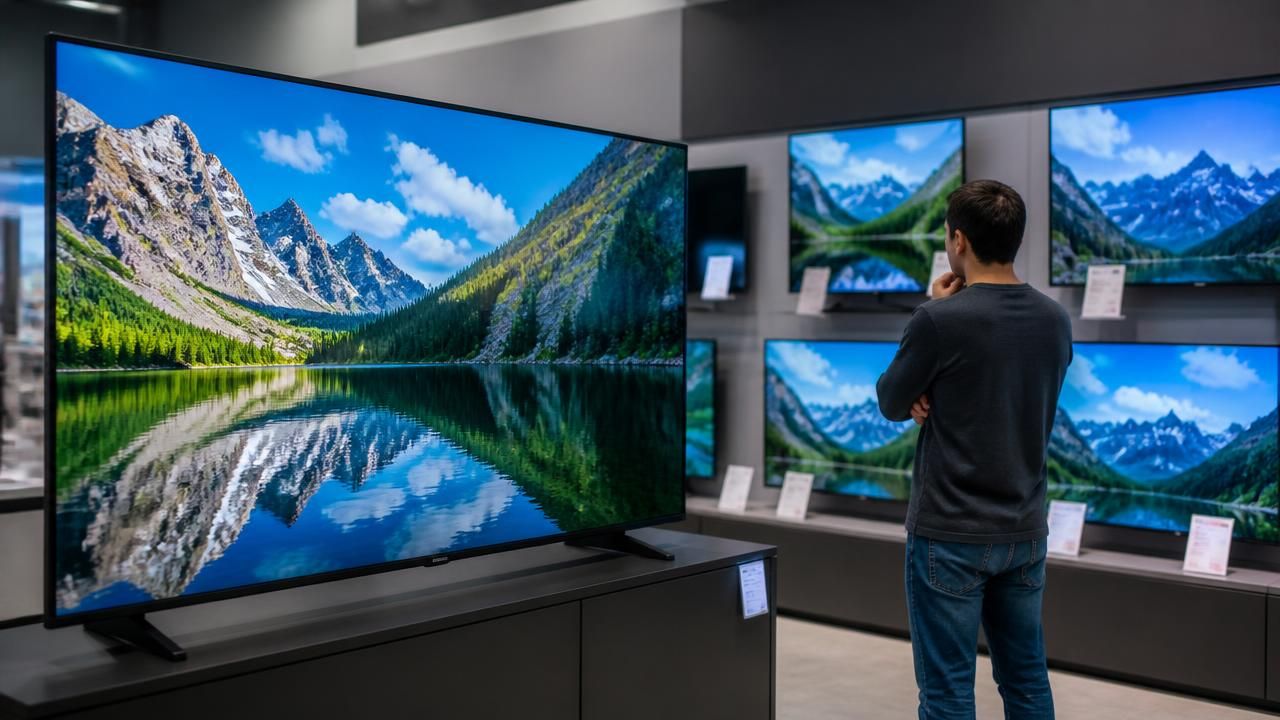
TCL has filed suit against Samsung, accusing its longtime rival of false advertising for marketing certain budget television sets as "Mini LED" displays — a term that, despite its ubiquity in showrooms and product listings, has no formal, industry-wide definition. The case, first reported by Reuters, pits two of the largest names in the global television market against each other over a labeling dispute that could reshape how display technologies are marketed to consumers.
At issue are Samsung's M-series televisions, a lineup that spans from roughly $300 for a 43-inch model up to about $2,300 for a 100-inch set. TCL argues that these sets — built on conventional LCD panels with LED backlighting — do not meet the technological bar that "Mini LED" implies, and that labeling them as such misleads shoppers comparing specifications across brands.
The Definition Problem at the Heart of the Case
Mini LED is not a protected term, nor is it governed by any standards body. In practice, it refers to LCD televisions that use an unusually large number of very small LEDs as a backlight, arranged into hundreds or thousands of local dimming zones. Because those LEDs are physically tiny, they can be packed more densely and controlled more precisely, producing deeper blacks, less blooming around bright objects, and better contrast than a conventional edge-lit or direct-lit LED set.
What makes a display a Mini LED display? It's a question that sounds like it should have a simple answer — but without agreed-upon standards, manufacturers have wide latitude to define the technology for themselves.
That ambiguity is precisely what Ars Technica highlighted in its analysis of the lawsuit, noting that TCL "may have a point" and that the M-series lineup "raises some legitimate questions about what should qualify as Mini LED." The publication framed the dispute less as a straightforward corporate grudge match and more as a symptom of a marketing ecosystem in which vendors write their own rules.
A Pattern of Loose Display Terminology
The television industry has a long history of elastic marketing language. "LED TV" — a phrase that became standard more than fifteen years ago — technically refers to LCD panels lit by light-emitting diodes, not to displays made of LEDs themselves, a distinction that confused buyers for years. The arrival of QLED branding, which describes a quantum-dot enhancement layer on an LCD panel rather than a fundamentally different display technology, compounded the confusion, particularly as it sat alongside OLED, a genuinely distinct self-emissive technology.
Mini LED occupies a similarly muddy middle ground. It is a meaningful engineering improvement over baseline LED backlighting, but it is not a category with bright-line thresholds. That leaves regulators, courts, and consumers to sort out competing claims case by case.
How the Outlets Are Framing It
- Reuters treated the story as a straight corporate legal development, leading on the false-advertising allegation itself.
- Ars Technica went analytical, asking whether the term "Mini LED" is being applied in a way that misleads shoppers and concluding that TCL's complaint has technical merit worth examining.
- Aggregators such as MSN and GSMDome emphasized the consumer-facing angle — in one framing, asking directly whether a reader's own television might be among the sets in question.
That split in emphasis reflects the dual nature of the story: it is simultaneously a commercial legal fight between two hardware giants and a practical question for anyone who has tried to decode a TV spec sheet in the last five years.
Why It Matters Beyond the Courtroom
Samsung and TCL compete aggressively at the value end of the television market, where price-sensitive buyers lean heavily on specification labels to make quick decisions. A "Mini LED" badge can justify a meaningful price premium, making the accuracy of that label commercially significant rather than merely semantic.
The case also arrives against a backdrop of intensifying competition in premium display technology, with Mini LED sets positioned as a more affordable alternative to OLED while offering better performance than standard LCDs. If courts begin scrutinizing what qualifies, manufacturers across the industry may need to tighten their marketing language — or risk similar challenges.
For consumers, the practical takeaway is that "Mini LED" alone tells you relatively little. Buyers evaluating a set should look instead at concrete, verifiable specifications: the number of local dimming zones, peak brightness in nits, contrast performance, and independent reviews that measure real-world picture quality rather than relying on a label.
What Comes Next
Neither company has signaled how it intends to resolve the matter, and it remains unclear whether the dispute will produce a settlement, a courtroom ruling, or pressure for the display industry to adopt formal definitions for terms it has spent years using loosely. What the case has already accomplished is to expose a gap between the precision implied by modern television marketing and the regulatory looseness that actually governs it — a gap that shoppers, and now litigants, are being forced to navigate one specification at a time.