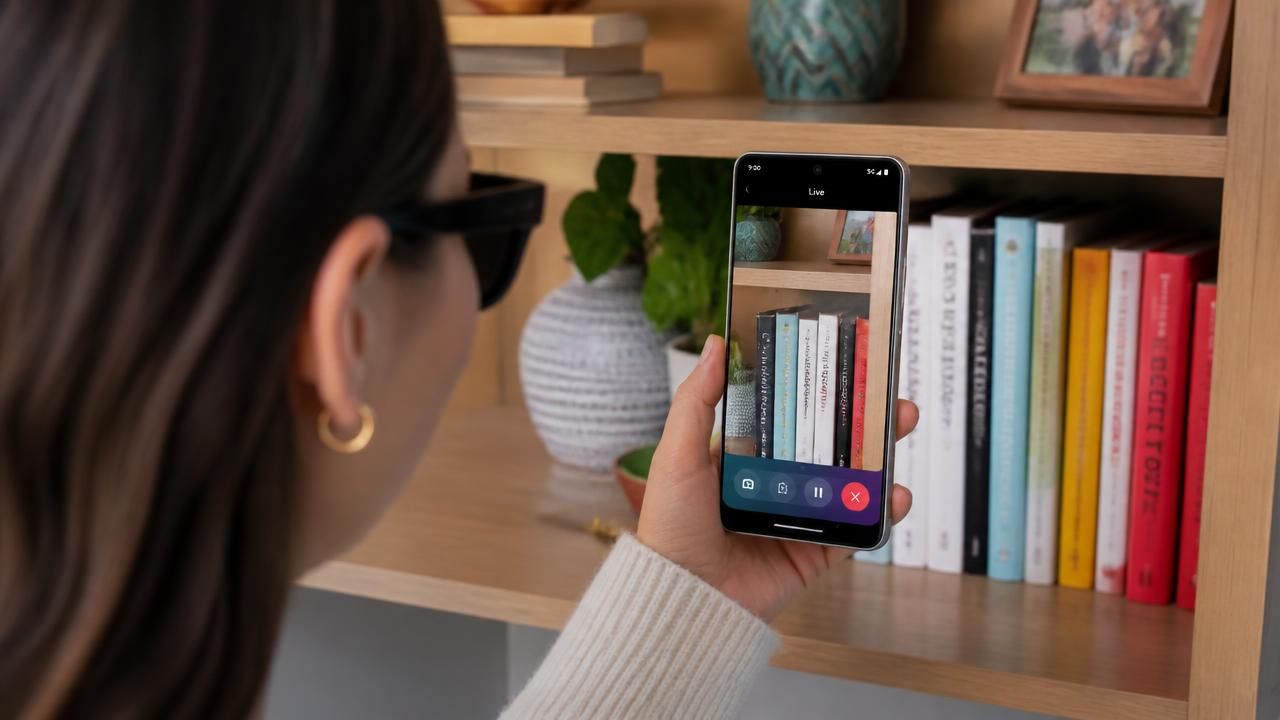
Google is rolling out a new accessibility-focused feature that lets Android users point their phone's camera at the world and hear it described back to them in real time. Called Guided Vision, the tool launched inside Gemini Live on compatible Android devices this week, according to The Verge, and arrives as part of the company's broader September Android Drop.
The feature works by having a user share their camera feed directly within Gemini Live. From there, Google's AI can read small print on a label or form, describe a room or street scene, help locate and identify specific objects, and zoom in on details of an item the user is holding. Output is delivered as spoken, real-time audio rather than text on a screen.
How Guided Vision works
Unlike conventional image-recognition tools that require a user to snap a photo and wait for a result, Guided Vision is designed as a continuous, conversational assistant. The camera feed stays live while Gemini narrates what it sees, allowing a user to ask follow-up questions — for example, asking the model to read a line of a prescription label and then explain what that medication is typically used for.
The Verge summarized the capabilities as help with "reading small text, describing your surroundings, finding or identifying objects around you, and describing details on specific objects." Google says the feature is intended for people who are blind, have low vision, or simply want assistance in a specific situation — such as a sighted user struggling with fine print on a contract or a medicine bottle.
Beyond the standalone Gemini app, coverage of the launch indicates Guided Vision is surfacing in additional Google surfaces, extending the feature beyond a single app icon on the home screen and toward deeper integration with the Android experience.
A year behind Apple, and the framing wars begin
The most pointed framing of the announcement came from Digital Trends, which headlined its coverage by noting the launch arrives "one year after Apple." Apple introduced a comparable capability through Live Recognition in VoiceOver, available on the iPhone and on Apple Vision Pro, which performs much the same function: recognizing and describing what the camera sees for users who cannot see it themselves.
That gap matters for two reasons. First, it illustrates how accessibility features are increasingly becoming competitive territory among platform holders rather than afterthoughts buried in settings menus. Second, it sets up a familiar narrative in tech coverage — Google shipping a capability that rivals already offer, and the question of whether the implementation is genuinely better or merely later.
Like the VoiceOver Live Recognition feature Apple has added to the iPhone and Vision Pro, it's designed for people who are blind, have low vision, or want assistance in specific situations.
Not every outlet led with the accessibility angle. Android-focused publications positioned Guided Vision as one of five headline features in the September Android Drop, treating it as a mainstream Gemini Live upgrade rather than strictly an assistive technology. Some coverage grouped it alongside a new motion-sickness mitigation feature, suggesting Google is pitching this drop as a bundle of practical, everyday improvements rather than a single marquee product.
Why it matters
Roughly 2.2 billion people worldwide live with some form of vision impairment, according to World Health Organization estimates, and only a fraction use dedicated assistive hardware such as smart canes or standalone reading devices. The strategic bet behind Guided Vision is that the smartphone already in a user's pocket — with its camera, connectivity, and increasingly capable on-device and cloud AI — can absorb much of that job at no additional hardware cost.
The stakes extend beyond accessibility. Features like Guided Vision are effectively public stress tests for multimodal AI: they demand low-latency vision processing, accurate scene understanding, and reliable audio output in unpredictable environments, from a dimly lit kitchen to a crowded sidewalk. Failures are not merely inconvenient — they can be a safety issue if a model misreads a medication dosage or misidentifies an obstacle.
- Availability: Guided Vision is launching in Gemini Live on compatible Android devices, with the rollout beginning this week.
- Core functions: Reading fine print, describing surroundings, identifying objects, and detailing specific items.
- Comparable tool: Apple's VoiceOver Live Recognition on iPhone and Vision Pro, shipped roughly a year earlier.
- Broader context: Part of a September Android Drop that includes at least four other features, among them motion-sickness assistance.
What to watch
Three questions will determine whether Guided Vision is remembered as a genuine accessibility milestone or a feature-launch footnote. The first is accuracy under real-world conditions — how the model handles glare, motion blur, unusual fonts, and non-English text. The second is latency: real-time description is only useful if the narration keeps pace with the user's movement. The third is device support, since "compatible Android devices" leaves open how far back the feature reaches and whether older, cheaper phones — often the ones used by people who would benefit most — are included.
For now, the launch marks another step in the quiet convergence of mainstream AI assistants and assistive technology. What was once a specialized category of software is becoming a default capability of the phone itself — and the competitive clock between Google and Apple on that front is now visibly ticking.