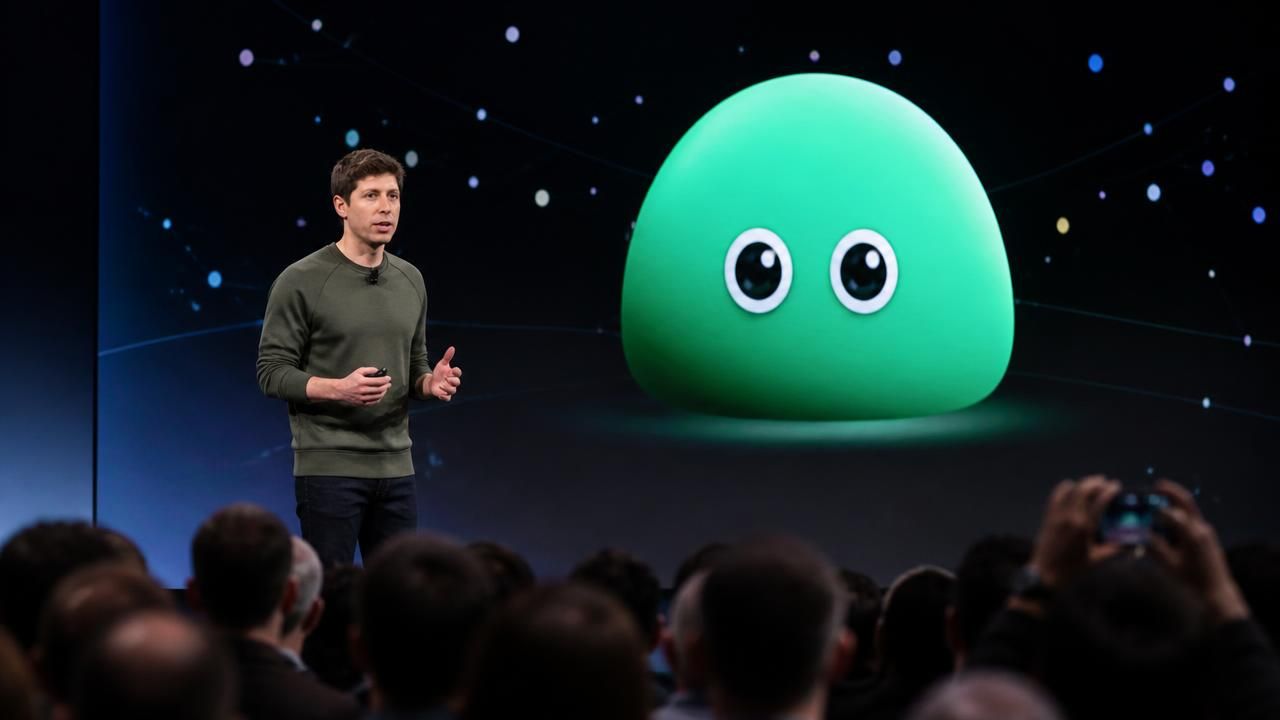
OpenAI opened its annual DevDay conference by betting that the next great platform war will be fought not over chatbots, but over companionship. Chief executive Sam Altman walked onstage to cheers and unveiled Dots, an always-on personal AI agent powered by the company's new GPT-6 Astra model — a direct strike at Meta, whose Muse agent platform has enjoyed runaway early adoption.
The announcement positions OpenAI in the red-hot market for autonomous personal agents, software that doesn't wait to be prompted but instead watches, anticipates and acts on a user's behalf. Altman described the product as a "real-deal AI" agent, adding that it was "inspired by the cool agents that we all watched in movies growing up."
Cute by design, always on by default
Like Meta's Muse, Dots leans hard into disarming cuteness. Each agent takes the form of a colorful, personalizable blob with a pair of eyes — a deliberate design choice that softens the privacy and autonomy questions raised by software that runs continuously in the background. Users can customize appearance and personality, and OpenAI demonstrated Dots doing more than scheduling and summarizing: the agents can also build metaverse-style virtual worlds, a feature that reads as a direct jab at Meta's home turf.
The distinction the company is drawing is between assistants that respond and agents that persist. Where ChatGPT waits for a query, Dots is designed to live alongside the user — a shift that executives across the industry have spent two years describing as the next phase of AI.
The free-versus-paid problem
The most consequential detail may be the one that arrives after the applause. Coverage of the launch converged on a reported price tag hovering around $500, described by financial outlets as the first genuine price tag for autonomous AI. That framing underscores the central strategic risk: Meta's Muse has scale and, crucially, the appearance of being free — subsidized by advertising and the company's existing ecosystem.
OpenAI is countering with reach of its own. Launch coverage cited roughly 1.2 billion users across the company's products and some 4,000 third-party apps expected to integrate Dots, a distribution footprint that few software platforms in history have matched. Whether that footprint converts into paid subscriptions for an always-on agent is a separate question, and one OpenAI now has to answer in public.
"The question is no longer whether agents work — it's whether anyone can make them pay for themselves."
That tension explains why the launch coverage split along predictable lines. Consumer-tech outlets framed Dots as a personality-driven counterpunch to Muse, emphasizing the blob design and the virtual-world demo. Business and market outlets led with the economics: the $500 figure, the user and app numbers, the enterprise angle. And the enterprise angle is real — OpenAI is pitching Dots as infrastructure for companies that want to deploy persistent agents across workflows, not just a cute companion for consumers.
An enterprise land grab
Positioning Dots as both a consumer toy and an enterprise platform is a familiar OpenAI maneuver, but it is also a hedge. Enterprise contracts provide predictable, high-margin revenue that consumer subscriptions rarely match, and they insulate the company against the possibility that Meta simply undercuts it on price at the consumer tier. Meta's Muse was built inside a company whose core business has never depended on charging users directly; OpenAI's does.
The competitive dynamics echo earlier platform fights. When OpenAI launched ChatGPT in 2022, it moved first and set the grammar of the category. This time it is following a rival's success, and it is doing so while carrying a price tag its competitor can credibly avoid.
The stakes for always-on AI
Persistent agents raise issues that a prompt-and-response chatbot never did. Software that watches continuously necessarily accumulates context — calendars, messages, location, habits — and the more capable the agent, the more sensitive the data it touches. Regulators in Europe and several U.S. states have already begun examining always-on AI assistants under data-protection and consumer-safety rules, and a high price point may amplify scrutiny: consumers who pay directly tend to expect direct accountability.
- What OpenAI announced: Dots, always-on personal agents running on GPT-6 Astra, with customizable blob avatars and virtual-world creation.
- Who it's aimed at: Consumers, as a counterweight to Meta's Muse, and enterprises seeking persistent workflow agents.
- The reported price: roughly $500, the first significant price tag attached to a mainstream autonomous agent.
- The platform bet: roughly 1.2 billion users and 4,000 apps cited in launch coverage.
What to watch
The decisive metric won't be applause at DevDay. It will be retention — whether users who pay for an always-on agent keep paying after the novelty fades, and whether enterprises treat Dots as a durable layer of their stack or an experiment. Meta's Muse, meanwhile, has the strategic luxury of patience; OpenAI does not.
For now, the two companies have converged on an oddly similar vision: agents with faces, personalities and an always-on presence in users' lives. The difference is how that presence gets paid for — and that, more than any demo, will determine who wins the agent era.