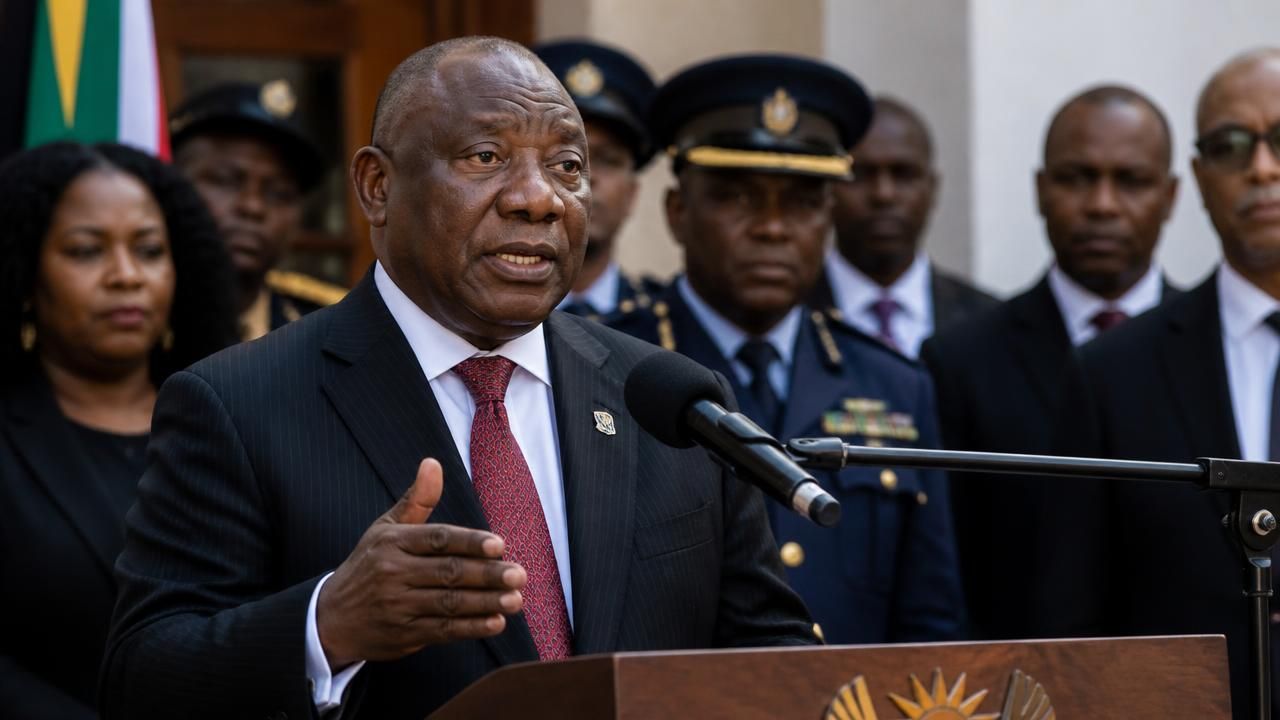
South African President Cyril Ramaphosa has appealed to men to take responsibility for the country’s gender-based violence crisis, acknowledging that the state has failed to protect women and announcing new police measures after a wave of killings that has provoked national outrage. The president’s intervention came as Springbok captain Siya Kolisi issued a raw plea to South African men — “We are the problem, we need help” — and organisers prepared for a nationwide protest on 30 September.
Ramaphosa said police would review unsolved murders, attempted murders and serious sexual offences against women and children. His office also committed to producing a funded plan to reduce the forensic backlog in such cases, with both actions to be completed within 60 days. The president praised Kolisi and Proteas cricket captain Temba Bavuma for using their platforms to confront gender-based violence, according to reports, underscoring a dual strategy: moral persuasion through trusted public figures and technical fixes through the criminal justice system.
A State Under Pressure
The announcement followed days of anger at authorities over the murders of women, which have intensified a long-running debate about impunity and police failure. The Guardian framed the president’s move as an attempt to answer public fury, noting that Ramaphosa acknowledged not enough had been done. That framing places the story primarily in the language of state accountability: reviews, deadlines, funded plans and the forensic delays that leave survivors and families without justice.
South Africa has among the highest rates of gender-based violence in the world. Femicide and sexual assault remain endemic, with advocacy groups arguing that underreporting, weak convictions and a strained forensic system combine to deny victims redress. The backlog in forensic processing is especially sensitive: without timely evidence, cases stall, suspects walk free and survivors are forced to relive trauma in a system they no longer trust.
Sixty Days to Deliver
The 60-day window is designed to force urgency, but it also sets a clear test. A review of unsolved cases is a first step; a funded plan to clear forensic backlogs requires money, personnel and political will. Critics are likely to ask whether the measures are sufficiently resourced and whether they will reach the police stations and courts where failures most often occur. The president’s acknowledgement that more should have been done is significant, but it does not by itself answer the anger on the streets.
Sports Figures Enter the Fray
A second strand of the story emerged through South Africa’s most visible sportsmen. Ramaphosa praised Siya Kolisi, the first Black captain to lift the Rugby World Cup, and Temba Bavuma, a leading cricketer, for speaking out. Kolisi’s plea was notably direct: “We are the problem, we need help.” The line reframes gender-based violence not as a women’s issue to be managed by the state alone, but as a crisis of male behaviour, socialisation and silence.
We are the problem, we need help.
That intervention matters in a country where sport occupies a uniquely powerful public space. Kolisi, in particular, carries symbolic weight as a national captain and role model. His message aligns with Ramaphosa’s call for men to speak up, but it also goes further: it admits complicity and asks for help rather than simply urging men to “do better.” The MSN reports focused on this emotional appeal, presenting the story as a moral reckoning led by admired athletes as much as a policy announcement.
Moral Appeal vs. Structural Change
The involvement of high-profile men can shift norms, but activists caution that visibility is not a substitute for accountability. Changing attitudes is essential in a society where patriarchal violence is often normalised. Yet without functioning police, courts, shelters and forensic labs, even the most powerful plea can feel hollow to survivors. The two framings — state reform and cultural change — are complementary, but they compete for public attention.
Protest and Public Anger
A third perspective comes from civil society. Organisers are preparing a nationwide action on 30 September, according to reports, as anger at the authorities continues to build. The planned protest signals that many South Africans are not satisfied with presidential statements alone. It also illustrates a widening gap between official responses and grassroots demands for justice.
- Accountability: Protesters want action against police failures and faster prosecutions.
- Resources: Campaigners say forensic backlogs and underfunded support services require emergency funding.
- Prevention: Men’s organisations and gender activists call for education, community mobilisation and early intervention.
Where the Guardian emphasises the government’s response and the pressure behind it, the MSN reports highlight the role of celebrity voices and the emotional force of Kolisi’s plea. The protest coverage adds a third frame: the crisis as a test of popular power and state legitimacy. Together, they show a story moving simultaneously through the presidency, the rugby field and the streets.
What Happens Next
The coming weeks will determine whether Ramaphosa’s measures are more than a holding statement. The police review must identify cases that have languished, and the forensic plan must be funded and implemented. The 30 September protest will show how much patience remains. If the 60-day deadline passes without visible progress, public anger is likely to deepen.
Kolisi’s words capture why the issue cannot be delegated. “We are the problem, we need help,” he said, placing responsibility on men while acknowledging that change requires support, education and accountability. Ramaphosa’s challenge is to turn that sentiment into state capacity. South Africa’s women and children cannot wait for another wave of killings to force the next round of promises.