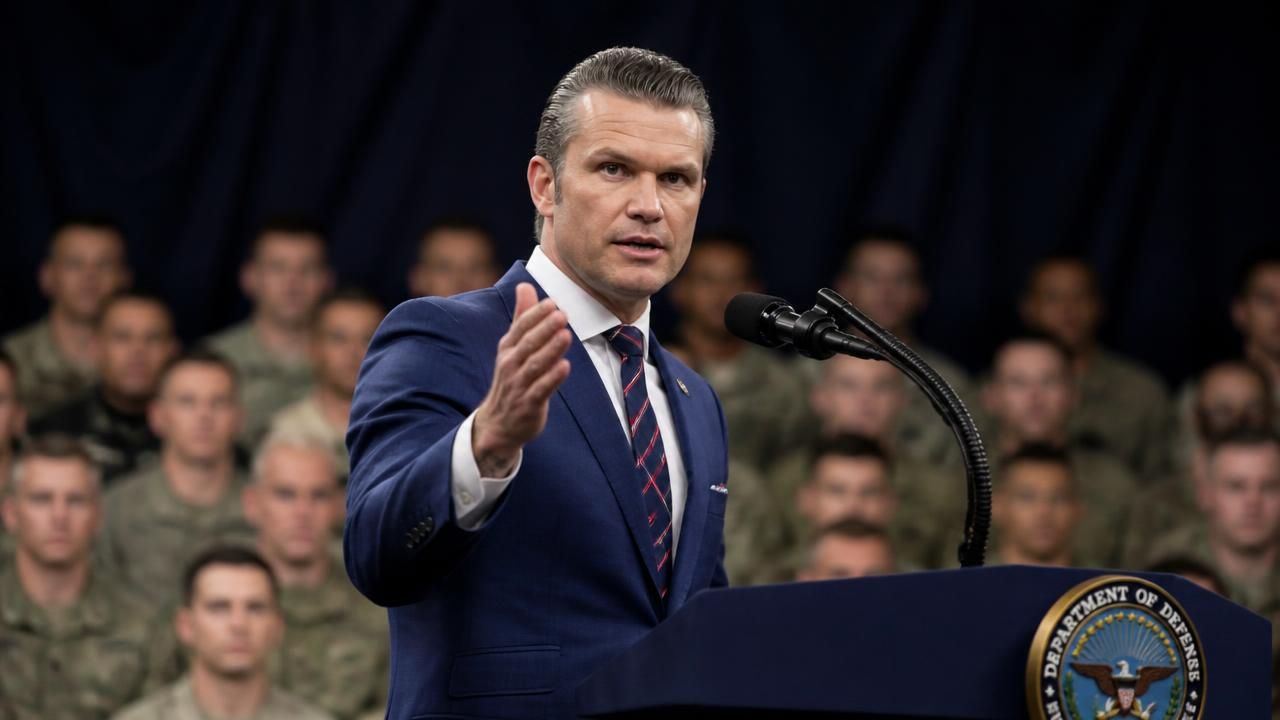
Secretary of Defense Pete Hegseth told hundreds of junior military officers and enlisted leaders on Wednesday that the Trump administration has achieved a cultural shift inside the armed forces, delivering a speech that leaned heavily on the culture-war themes that have defined his tenure at the Pentagon.
According to reporting by NPR and syndicated across public radio stations nationwide, Hegseth used the address to argue that the military's internal culture has been fundamentally reshaped under his leadership — a claim that drew immediate pushback from critics who say his preoccupation with ideological battles is coming at the expense of the institution's core mission.
A Speech Built on Flashpoints
Hegseth's remarks, delivered to an audience of junior officers and noncommissioned leaders rather than to senior commanders or civilian defense officials, were notable as much for their venue as their content. By speaking directly to the military's rising generation of leaders, the defense secretary appeared to be making a case for the durability of the changes his office has pursued — framing them not as a temporary political project but as an entrenched new standard.
"The Trump administration has achieved a cultural shift in the military," Hegseth told the assembled officers, according to accounts of the speech.
The choice of audience matters. Junior officers and enlisted leaders are the layer of the force responsible for translating policy from the Pentagon's E-Ring into daily practice — how units train, how standards are enforced, who is promoted, and what kind of climate recruits encounter. Winning their buy-in, or at least their compliance, is essential to any lasting cultural change.
A Second, Sharper Frame
But a strikingly different framing of the same story emerged from other coverage. A report distributed via Yahoo News carried the headline "Hegseth's culture war fixation disrupting Army progress, sources say," signaling that inside the service, the secretary's approach is viewed not as consolidation but as distraction.
The tension between those two accounts — transformation versus disruption — is the central fault line in how the story is being told. Outlets that carried the wire version of the speech emphasized the secretary's own claims of success, quoting his assertion of a cultural shift and presenting the address as a milestone. The dissenting coverage, attributed to unnamed sources, emphasized the opportunity costs: time, attention, and institutional energy spent on ideological disputes rather than on readiness, modernization, and the recruiting and retention problems that have dogged the Army in recent years.
Context: A Pentagon Under Redesign
Hegseth's tenure has been marked by a sustained effort to dismantle diversity, equity, and inclusion programs across the services, to revisit naming decisions for military installations, and to tighten physical fitness and appearance standards — all part of a broader argument that the military had drifted from a singular focus on lethality.
Supporters of that agenda argue that the pre-2025 status quo had allowed social policy to crowd out warfighting priorities, and that restoring a narrower sense of mission improves cohesion and recruiting. Critics — including some retired officers and defense analysts — counter that the changes have politicized an institution that depends on public trust and bipartisan support, and that constant cultural battles send a discouraging signal to service members who fall outside the administration's preferred profile.
Why It Matters
The stakes extend well beyond internal Pentagon politics. The U.S. military faces simultaneous pressure from great-power competition, persistent recruiting shortfalls in some components, and a defense industrial base strained by multiple overseas commitments. Every hour of senior leadership attention devoted to culture-war flashpoints is an hour not spent on those problems — or so the argument from the secretary's critics runs.
- The administration's position: The military has been culturally transformed, and the shift is a deliberate, accomplished objective.
- The internal dissent: Sources describe a fixation on culture war that is disrupting Army progress and draining institutional focus.
- The audience: Junior officers and enlisted leaders, whose daily decisions determine whether any cultural change actually sticks.
- The open question: Whether the changes prove durable beyond the current administration, or become another layer of political churn the force must absorb.
Competing Narratives, One Institution
The divergence in coverage itself is instructive. Where one account presents a confident secretary declaring mission accomplished, another portrays a leader whose priorities are quietly resisted and questioned by the institution he runs. Both framings can be simultaneously true: senior officials can claim success in public while career officers privately calculate the costs.
What remains unclear is how the military's rank and file will ultimately judge the period. Hegseth's speech was, in effect, an argument that history will vindicate the changes. Whether the officers in that room agree — and whether they carry that conviction into the units they lead — will determine whether Wednesday's address marked a turning point or just another chapter in an ongoing argument about what the U.S. military is for.