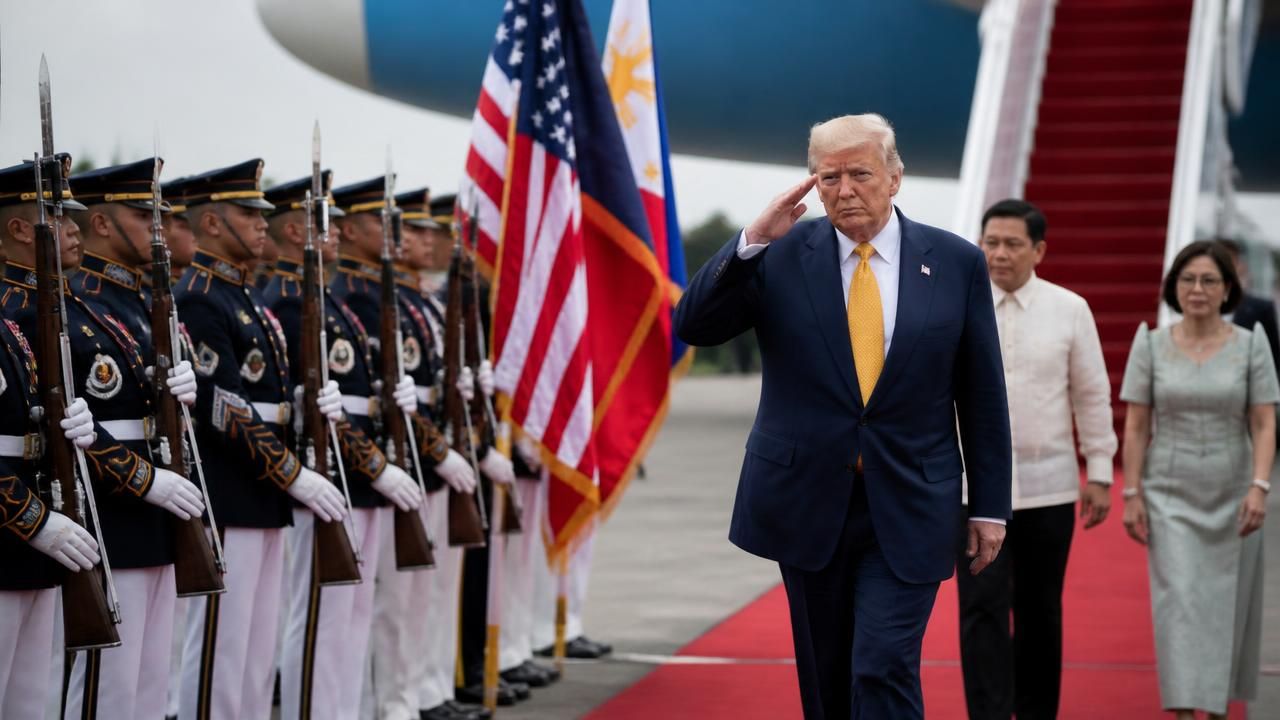
President Trump arrived in the Philippines on the opening leg of a 48-hour Asia trip that will take him from a Southeast Asian leaders’ summit in Manila to meetings with Chinese President Xi Jinping and Russian President Vladimir Putin in Shenzhen, according to live coverage from The New York Times, NBC News and MSN.
The trip is being watched simultaneously as a diplomatic sprint and a political barometer. MSN framed it as Trump’s first foreign trip after U.S. election losses, while NBC emphasized his arrival ahead of the ASEAN summit and the coming Xi and Putin meetings. The New York Times described a whirlwind schedule that begins with Southeast Asian leaders in Manila and later shifts to Shenzhen, a Chinese economic hub, for talks with Xi and Putin.
A 48-hour dash from Manila to Shenzhen
The first phase centers on the Philippines, where Trump is meeting Southeast Asian leaders and attending the ASEAN summit. NBC’s live updates said Trump arrived in the Philippines ahead of meetings with Xi and Putin, placing the Manila stop in a broader sequence of alliance diplomacy and great-power engagement. MSN’s headline said Trump flew to Manila ahead of a summit with Putin and Xi, reflecting how the trip is being packaged as a single high-stakes arc rather than a series of separate bilateral visits.
The second phase moves to Shenzhen. The New York Times identified the city as a Chinese economic hub, a detail that may matter for a trip that mixes trade, technology and security concerns. The live updates did not specify whether the Xi and Putin meetings would be joint or separate, nor did they disclose a detailed agenda. What is clear is that the schedule places two of Washington’s most consequential rivals on the same leg of the journey.
Domestic setback shadows the diplomacy
MSN’s alert added a domestic political frame: the trip is Trump’s first after U.S. election losses. That detail changes how the journey will be read at home and abroad. A president typically uses foreign travel to project strength and command attention; a trip that follows a domestic setback can invite questions about leverage, credibility and the durability of American commitments. Allies in Southeast Asia and counterparts in Beijing and Moscow will be assessing not only what Trump says in Manila and Shenzhen but also how much political capital he brings with him.
The sources do not detail which election losses MSN was referring to, nor do they describe the White House’s preferred framing. But the contrast between the triumphal imagery of summitry and the sober reality of domestic defeat is likely to shape coverage. It also explains why different outlets are emphasizing different aspects of the same itinerary: The New York Times leads with the whirlwind schedule; NBC leads with the arrival and ASEAN; MSN leads with the election context.
China and Russia on the same itinerary
The meetings with Xi and Putin are the trip’s most closely watched events. The New York Times said Trump will meet Xi and Putin in Shenzhen after starting in Manila. NBC’s live updates similarly placed the Xi and Putin meetings ahead. MSN described the Manila flight as preparation for a summit with Putin and Xi. The sequencing suggests a deliberate attempt to combine regional alliance management with direct engagement of two major powers.
Yet the live updates leave key questions unanswered. It is not clear what Trump hopes to achieve with Xi or Putin, whether the meetings will produce agreements, or how the presence of both leaders in Shenzhen will affect the optics. The choice of Shenzhen, described by The New York Times as a Chinese economic hub, may be intended to signal an economic focus, but the sources do not say so. What they do make clear is that the trip is ambitious in scope: in roughly 48 hours, Trump is scheduled to move from Southeast Asian multilateralism to bilateral meetings with China and Russia.
North Korea logistics and the limits of spectacle
Yahoo’s live coverage introduced another variable: logistical hurdles with a Trump-Kim Jong Un meeting. The sources do not confirm whether such a meeting will take place, but the mere focus on logistics underscores how much of the trip’s drama may depend on improvisation. A prospective Kim meeting would add a third leader to an already crowded diplomatic sequence, raising questions about scheduling, security and message discipline.
The hurdles are also a reminder that summit diplomacy is not only about intention. It requires aircraft, security details, advance teams and host-government coordination. When a trip is compressed into 48 hours and spans multiple capitals and leaders, small logistical problems can become politically meaningful. Yahoo’s framing suggests that the Kim question is not simply whether the meeting is desirable, but whether it can be arranged without disrupting the broader itinerary.
How the trip will be judged
The trip’s success will likely be measured on several tracks:
- In Manila, the test is whether Trump can reassure Southeast Asian allies and keep the ASEAN summit focused on shared priorities.
- In Shenzhen, the test is whether he can manage relationships with Xi and Putin without creating new uncertainty.
- At home, the test is whether the trip can reset the political narrative after election losses.
- On North Korea, the test is whether logistics can be mastered quickly enough to turn a speculative meeting into a reality.
Live coverage from the outlets suggests a story still in motion. The New York Times emphasizes the pace and itinerary; NBC emphasizes the arrival and the ASEAN setting; MSN emphasizes the domestic political backdrop; Yahoo emphasizes the logistical obstacles. Together, they describe a trip that is both a diplomatic marathon and a political gamble, with the most consequential moments still ahead in Shenzhen.