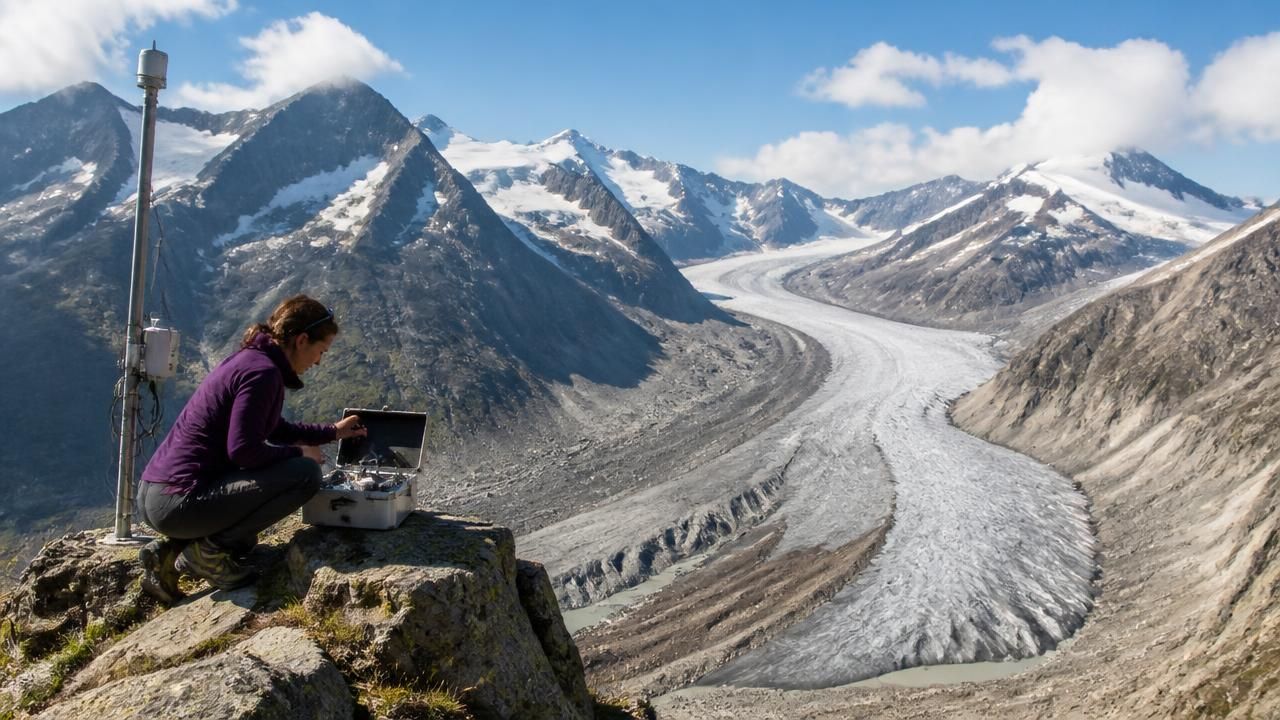
Switzerland's glaciers have suffered another devastating year, with more than 5 percent of their ice vanishing in a single melt season, according to the Swiss Academy of Natural Sciences. The figure, compiled from the academy's long-running glacier monitoring network, extends a run of extreme losses that has alarmed glaciologists, water managers and Alpine communities — and it lands as new evidence from the Arctic and an unlikely Swiss field experiment both reshape how scientists think about the pace and possible mitigation of ice loss.
Coverage of the findings spanned outlets from NPR, which emphasized the threat to European water supplies and ecosystems, to MSN, which framed the season around the record heatwave that followed an unusually dry, low-snow winter. Together the reports describe not an isolated bad year but the acceleration of a trend that is remaking mountain landscapes in real time.
A record melt season, again
The headline number — more than 5 percent of remaining glacier volume gone in one year — is striking because glaciers typically shed a fraction of that in a normal season. Losses of this magnitude were once treated as outliers; they are now recurring.
What made this year so severe was a compound event rather than a single cause:
- A thin snowpack. Winter snowfall across the Alps was well below average, leaving glaciers with less of the bright, reflective protective layer that normally shields ice from the summer sun.
- Prolonged summer heat. Repeated heatwaves pushed the zero-degree isotherm — the altitude at which air temperature hits freezing — higher up the mountainsides, exposing ice at elevations that once stayed frozen year-round.
- Darker, dirtier surfaces. Dust and soot deposited on the ice lower its albedo, causing it to absorb more solar energy and melt faster in a self-reinforcing cycle.
Why it matters far beyond the Alps
Switzerland's glaciers are often called the water towers of Europe. Their meltwater feeds the Rhine, Rhône, Po and Danube river systems, supporting drinking water supplies, agriculture, hydropower generation and industrial use across the continent. In the short term, accelerated melting can mean more summer runoff; in the long term, it means less — a shift that water managers across Europe are already planning for.
The consequences are also local and immediate. Thawing permafrost destabilizes rock faces and slopes, raising the risk of landslides and rockfalls that have forced evacuations in Alpine villages in recent years. Shrinking glaciers undercut the tourism economies built around them, including ski resorts that have resorted to blanketing glacier tongues in reflective fleece each summer to slow the melt.
The academy's monitoring network reported that more than 5 percent of Switzerland's ice disappeared in a single year — a pace that, as NPR put it, is "threatening water supplies, ecosystems and communities across Europe."
From the Alps to the Arctic
Switzerland is not an outlier. Reporting highlighted by MSN describes Greenland's Qaanaaq Glacier losing an astonishing 8.7 meters of ice thickness over the last 13 years — "and it's not alone." Separate research on polar ice, headlined around the finding that speeding glaciers have driven half a century of ice loss, underscores that these are not static bodies reacting passively to warming. As glaciers thin, they can accelerate, sliding faster toward the sea and exporting ice more efficiently — a dynamic that makes sea-level projections harder to pin down.
The Arctic and Alpine cases differ in scale and mechanism, but they point in the same direction: warming is not merely shrinking ice, it is changing how ice moves.
Can sheep save the glaciers?
Against that backdrop, one of the more unusual stories to emerge from Swiss research is a project testing whether sheep's wool can help protect glaciers. The idea is deceptively simple: wool is a natural insulator, biodegradable, locally available and, in a country with a long pastoral tradition, abundant. Scientists are testing whether wool-based coverings or mats placed on vulnerable ice surfaces can reduce melt rates the way synthetic fleece blankets have at a handful of high-profile glacier ski areas.
The experiment has drawn both curiosity and skepticism. Glaciologists note that covering a meaningful share of Switzerland's roughly 1,400 glaciers is physically and financially unthinkable; even the fleece blankets used at individual ski resorts cover only a few hectares and cost millions. The wool trial, they argue, is more valuable as a test of surface-energy physics and as a small-scale, symbolic intervention than as a scalable climate solution.
The bigger picture
The unifying message across these stories is that mitigation and adaptation are no longer separate conversations. Even under optimistic emissions scenarios, a substantial share of Alpine and polar ice is already committed to melting this century. The policy question is shifting from how to prevent loss to how to manage its consequences — for water allocation, hydropower, hazard mapping, tourism and the ecosystems that depend on cold, reliable meltwater.
What to watch next: the academy's coming measurement campaigns, which will confirm whether this year's losses compound or moderate; results from the wool trial and similar albedo experiments; and whether European water authorities accelerate planning for the low-runoff summers that glacier retreat will eventually bring.