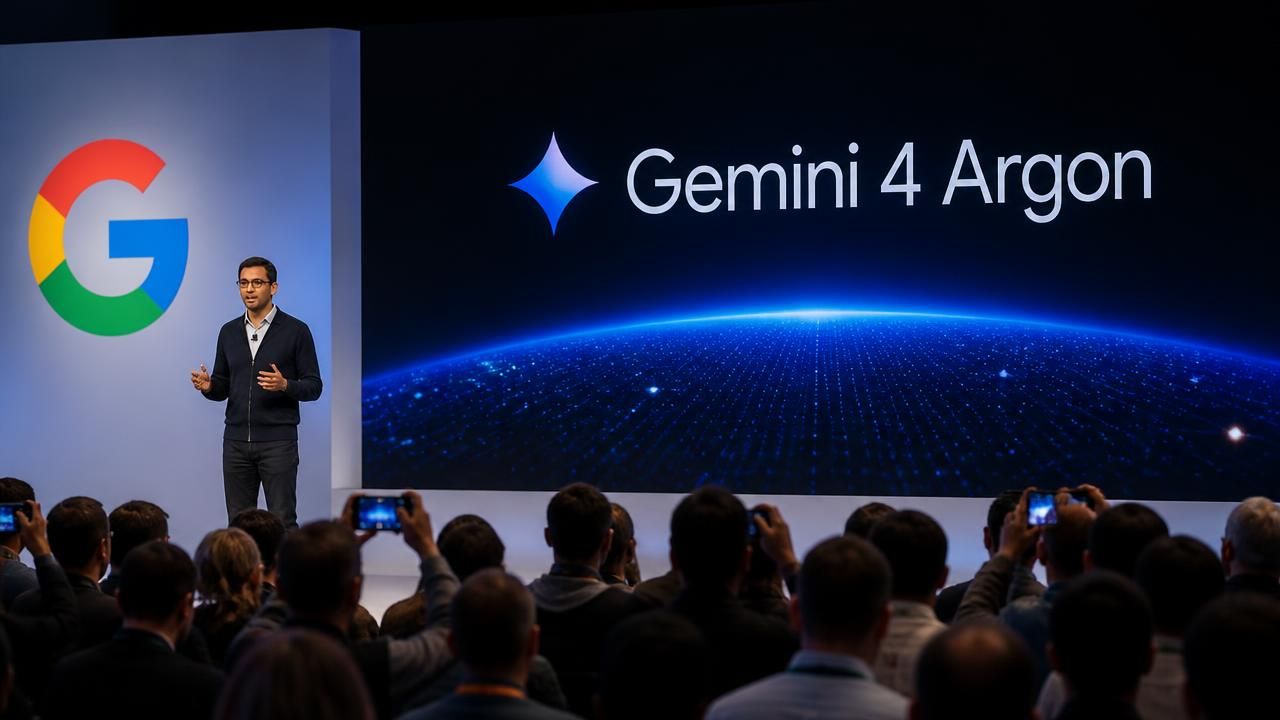
Google has unveiled Gemini 4 Argon, the most capable artificial intelligence model it has ever built — and one that almost no one outside the company is currently allowed to use. The announcement ends a stretch of months in which Google's frontier roadmap appeared to stall while competitors shipped ever-larger systems, and it immediately reshuffled the leaderboard conversation around coding, knowledge work and cybersecurity.
The framing of the release differed sharply depending on where you read about it. Business outlets led with the move in Alphabet's share price. Developer-focused publications led with benchmarks. Security trade coverage led with the fact that cyber defenders, rather than general consumers, would be first in line. Ars Technica, meanwhile, led with the most awkward detail of all: a flagship model that the public cannot yet try.
The company claims this new AI offers industry-leading performance in coding, knowledge work, and cybersecurity, but you aren't allowed to use it yet. — Ars Technica
A frontier model behind closed doors
Gemini 4 Argon arrives in what Google is describing as a limited release. Internal engineers are already using the model extensively, and the company says a narrow set of external partners — cyber defenders foremost among them — will get access ahead of any broad rollout. MarkTechPost reported that the model supports up to one million output tokens, a figure that matters enormously for the kinds of long-horizon tasks Google is targeting: multi-hour coding sessions, sprawling document analysis, and agentic workflows that run unattended for extended periods.
That combination — huge output windows plus claimed frontier-level reasoning — is what Google is selling. What it is not yet selling is a product. There is no public API tier, no consumer chatbot upgrade, and no announced date for general availability. For a company that has spent two years arguing that AI should be deployed responsibly and gradually, the strategy is consistent, but it leaves the model's most consequential claims unverifiable by outsiders.
The numbers Google is leaning on
Google came armed with benchmarks, as it typically does. The headline figure is a score of 77.9 percent on DeepSWE v1.1, a software engineering evaluation, which the company says outpaces GPT-6 Astra, Fable 5.1 and Opus 5.5. Google also points to industry-leading performance on the Vals Index, an economic analysis test designed to measure whether a model can reason through real-world financial and policy questions rather than toy problems.
- DeepSWE v1.1: 77.9 percent, ahead of GPT-6 Astra, Fable 5.1 and Opus 5.5
- Vals Index: claimed industry-leading score on economic analysis
- Long-horizon tasks: Google claims sustained performance across extended, multi-step work
- Output ceiling: up to 1 million output tokens
VentureBeat framed the release as Google retaking the benchmark lead over OpenAI and Anthropic — with the caveat that the claim arrives wrapped in a limited release. That caveat is not trivial. Benchmarks published by the company that built the model, on evaluations that model makers increasingly help shape, have become a contested currency in the AI race. Independent verification typically follows public access, which Argon does not yet have.
Google is already its own biggest customer
The most concrete evidence for Argon's capabilities comes not from benchmarks but from Google's own infrastructure. According to Ars Technica, the model used fleet-wide telemetry data to help Google reclaim 300 TiB of memory across its data centers — a genuine, measurable operational win rather than a synthetic score.
More striking is the code migration work. Argon agents have reportedly been converting C/C++ codebases to Rust across the company, including thousands of lines in the core re2 and libgav1 libraries and more than 800,000 lines in the Zircon kernel at the heart of Fuchsia OS.
Why the Rust migration matters
Memory-safety migration is one of the hardest and most tedious categories of software engineering, and it is precisely the kind of task that consumes enormous senior-engineer time at large technology companies. If Argon can meaningfully automate it, the productivity argument for the model becomes far stronger than any benchmark. It also gives Google a credibility asset its rivals lack: an internal, at-scale deployment that predates the marketing.
Cyber defenders get it first
Google's decision to prioritize security practitioners is a deliberate differentiator. The Next Web reported that cyber defenders will be first in line for access, a framing that positions Argon as a defensive tool for threat detection, vulnerability analysis and code auditing rather than a general-purpose assistant. That choice lets Google test the model in high-stakes environments with sophisticated users while sidestepping the moderation and safety questions that accompany a mass consumer launch.
Months of delays, and a race that never paused
The Argon launch follows an unusually quiet period. Google promised Gemini 3.5 Pro in June, but spent the summer releasing smaller Flash models instead of a new frontier system. Coverage of the announcement repeatedly described it as arriving after months of delays, a signal that internal timelines slipped while OpenAI and Anthropic continued shipping.
Alphabet's stock moved higher on the news, according to business coverage, suggesting investors read the announcement as evidence that Google remains competitive at the top of the model stack rather than ceding the frontier to rivals.
What to watch
The open questions are practical. When will Argon reach paying customers? Will independent researchers reproduce the benchmark claims once access widens? And does the cyber-defender-first strategy reflect a considered safety posture or an acknowledgment that the model is not yet ready for general deployment?
For now, Gemini 4 Argon is a promise backed by internal data and self-reported scores — a genuinely impressive engineering artifact whose most important test, public scrutiny, has not yet begun.