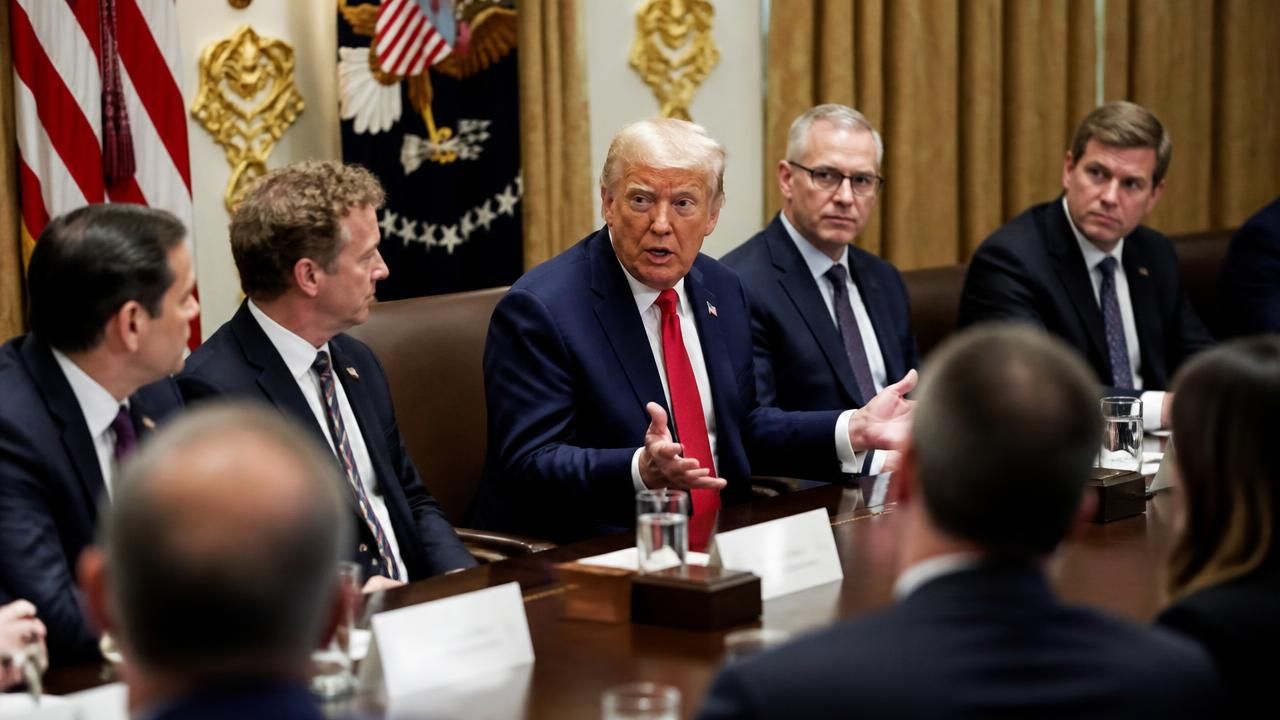
President Trump said Tuesday that he and a large group of leaders of artificial intelligence companies had signed a voluntary accord that will include internal and external reviews, according to NPR Politics and The Associated Press. The announcement followed a White House meeting between the president and top AI executives, which msn.com framed as unfolding "amid dire warnings about technology."
The president characterized the arrangement as an exercise in industry self-policing, and the phrase "self-police" became the defining language of the day's wire coverage. Yet as of Tuesday evening, the full text of the accord had not been widely circulated, and early accounts left open the most consequential questions: which companies signed, what exactly the reviews will examine, and who — if anyone — can enforce the results.
What the accord reportedly does
According to the reporting, the agreement is built around two commitments: internal reviews, conducted by the companies themselves, and external reviews, presumably carried out by outside parties. Both would operate on a voluntary basis rather than under statutory authority.
The accord will include "internal and external reviews," according to NPR's account of the president's announcement.
That structure is deliberately light-touch. Nothing in the early descriptions suggests the agreement carries civil penalties, licensing requirements, or a government approval gate for new model releases. In practice, that places the accord closer to a statement of principles than to a regulatory regime — a distinction that will shape how it is received both in Washington and in Brussels, where the European Union has been implementing its own binding AI Act.
A familiar playbook
Voluntary AI commitments are not new. In July 2023, the Biden administration announced a set of voluntary pledges from seven leading AI developers, covering pre-release safety testing, information sharing with government and civil society, and investment in cybersecurity. Those commitments were later paired with a sweeping executive order on AI, which Trump rescinded within days of taking office in January 2025.
The shift from mandatory to voluntary is the central political fact of Tuesday's announcement. The prior approach leaned on the Defense Production Act and federal procurement power to compel disclosures from large developers. The new accord appears to rely instead on reputational pressure and the companies' own willingness to be reviewed.
- 2023: Seven major AI firms sign Biden-era voluntary safety commitments.
- 2023–2024: Biden's AI executive order imposes reporting and testing requirements on frontier models.
- January 2025: Trump rescinds that order.
- Tuesday: Trump announces a new voluntary accord with AI industry leaders.
Why the warnings frame the story
The meeting occurred against a backdrop of increasingly urgent warnings about the technology — the thread msn.com chose to emphasize. Researchers and former officials have raised concerns about AI-enabled bioweapons design, large-scale disinformation and deepfakes, critical-infrastructure vulnerabilities, and labor-market disruption. Multiple expert surveys have placed extreme AI risks in the same category as pandemics and nuclear war, though such estimates are contested and the timelines are deeply uncertain.
Those warnings are precisely why the voluntary nature of the accord is contentious. If the risks are as severe as the most alarmed voices claim, an agreement that depends on corporate good faith may look inadequate. If the risks are overstated, binding rules could slow innovation the administration has said it wants to accelerate. Tuesday's announcement effectively bets on the second view while borrowing the language of the first.
Differing frames across outlets
The story was covered with subtly different emphases. The Associated Press and Times Union both led with the president's own characterization — an accord to "self-police" AI development — foregrounding the voluntary, industry-led dimension. NPR highlighted the substantive mechanics, noting that the agreement would include both internal and external reviews, a detail that suggests some outside scrutiny is contemplated. msn.com centered the stakes, leading with the White House meeting and the dire warnings surrounding the technology rather than the accord's architecture.
Together, the coverage captures three competing interpretations of the same event: a pragmatic first step, a public-relations exercise, or a dangerous abdication of regulatory responsibility.
What to watch
The accord's credibility will hinge on details that have yet to surface publicly. Among the open questions:
- Which companies signed, and whether the list includes the largest frontier labs or a broader cross-section of the industry.
- Who conducts the "external" reviews, and whether their findings will be published.
- Whether the accord creates any mechanism for consequences if a signatory fails to comply.
- How the agreement interacts with state-level AI legislation and the EU's binding rules, which apply to U.S. firms operating in Europe.
Congress, meanwhile, has repeatedly stalled on comprehensive AI legislation, leaving the executive branch and the states to fill the vacuum. For an industry that has spent two years asking for clearer rules while warning against rules it considers premature, Tuesday's accord offers something both sides can claim: a framework that looks like governance without the force of law. Whether it survives contact with the next high-profile AI failure — a major model misuse, a serious security incident, or a wave of synthetic media in an election year — is the test that will ultimately define it.