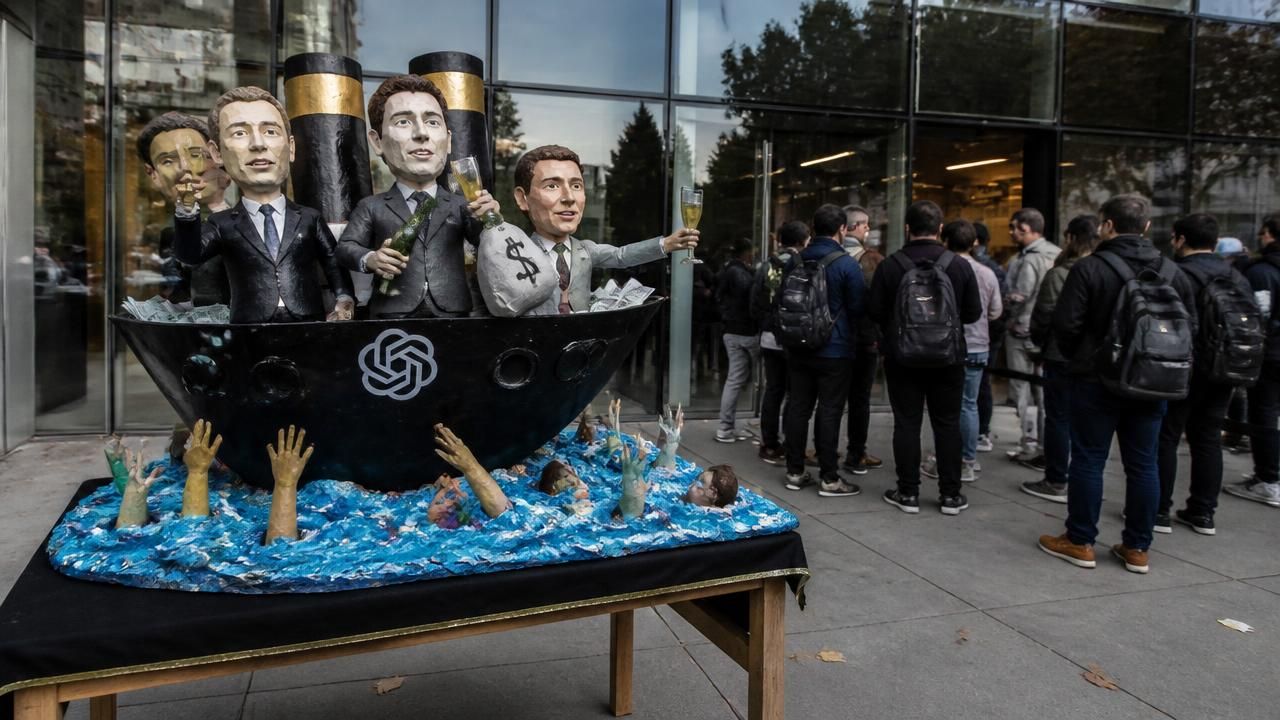
SAN FRANCISCO — Two artists from a Bay Area studio unveiled a table-sized installation Tuesday at the public entrance to an OpenAI developer event here, converting a stretch of sidewalk outside a corporate gathering into a small but sharply worded stage for the growing backlash against the artificial intelligence boom.
The piece, titled What Iceberg?, stands roughly five feet tall and was assembled over five days by members of the Berkeley-based Odd Friend Studio. According to a description of the work, the sculpture "shows OpenAI's leaders and investors escaping a sinking ship with unimaginable wealth, while everyone else is left to face the cost of AI."
One of the co-creators, a man in his late 30s who identified himself only as "Kevin," said he and his collaborators built the installation out of papier mâché, cardboard and paint — materials that evoke a school project rather than a gallery commission — mounted on a repurposed table. The result is deliberately rough-hewn: a piece meant to be encountered on the way to a conference, not behind museum glass.
A Sinking Ship on the Sidewalk
The choice of venue is as much a part of the statement as the sculpture itself. OpenAI's developer events draw engineers, founders and investors, the very constituency the artists depict scrambling for the lifeboats. By planting the work at the public entrance rather than inside the ticketed venue, the creators positioned their critique at the boundary between the industry's insular culture and the neighborhoods that host it.
"It shows OpenAI's leaders and investors escaping a sinking ship with unimaginable wealth, while everyone else is left to face the cost of AI." — description of What Iceberg?
The title carries its own barb. An iceberg is only catastrophic when it goes unseen; the implication is that the costs of rapid AI deployment — from labor displacement to energy consumption to the concentration of market power — are visible to anyone willing to look over the rail.
A Wider Protest Wave, and a New Aesthetic
The installation is the latest example of a shift in how AI critics register dissent. Where the first phase of opposition was dominated by open letters, policy filings and academic warnings, the current phase increasingly borrows from the toolkit of labor and climate activism: street theater, guerrilla art, and imagery engineered for social media circulation.
That evolution mirrors earlier technology protests. Campaigns against surveillance capitalism, gig-economy labor practices and automated decision-making all moved, over time, from conference panels to picket lines and public stunts. The 2023 Hollywood strikes, in which writers and actors made generative AI a central bargaining issue, accelerated the trend by demonstrating that AI policy could be contested in the street as well as in the courtroom.
Protests aimed at OpenAI specifically have grown steadily more inventive as the company has become the most visible symbol of the generative AI era. Because OpenAI's products are consumer-facing and its brand is widely recognized, it has absorbed a disproportionate share of public frustration that arguably extends across the entire sector.
Framing: Culture Story or Labor Story?
How the episode is characterized depends heavily on where it is told. Technology-focused outlets tend to frame such actions as a culture story — emphasizing the craftsmanship, the wit of the materials, and the personality of the makers, with the political argument delivered largely through the artists' own words.
That framing has advantages for both sides: it is engaging, it respects the artists' intent, and it avoids overstating the size of any single demonstration. But it can also soften the underlying claims, presenting a critique of economic concentration as an eccentric bit of street art.
Other traditions of coverage — labor reporting, political journalism — would be more likely to situate the sculpture within debates over automation, wage pressure, copyright and the redistribution of productivity gains. Those framings foreground questions of power rather than aesthetics.
The story also illustrates a practical problem for aggregators: the day's news feed mixed this AI protest with entirely unrelated items, including demonstrations in Berlin against a court decision overturning a five-year rent cap, campaign-trail coverage from the 2020 U.S. presidential race, an interview with an independent congressional candidate in Texas, and President Joe Biden's 2024 reelection announcement. Only the OpenAI item concerned AI. Readers encountering such feeds should treat any implied connection between them as an artifact of aggregation, not a real link.
Why It Matters
The immediate stakes of a single sculpture are modest. OpenAI has not commented publicly on the installation, and no disruption to the developer event was reported. But the piece points to a broader dynamic that industry watchers have flagged for some time: the gap between the speed of AI deployment and the public's ability to shape it.
- Regulatory pressure: Lawmakers in the United States, the European Union and elsewhere continue to debate rules governing model transparency, copyright and high-risk applications.
- Labor anxiety: Unions and professional groups have made AI provisions a standard demand in contracts, extending the dispute beyond Silicon Valley.
- Cultural salience: The technology is now familiar enough that a papier-mâché ship reads instantly as commentary — a sign of how thoroughly AI has entered public consciousness.
For the artists, the intervention is less about changing OpenAI's roadmap than about reminding passersby that the roadmap is a choice. Whether the sculpture is remembered as a clever one-day provocation or as a marker of a broader political turn in the AI debate will depend on what happens next — in courtrooms, in bargaining sessions, and on the sidewalks outside the next developer conference.