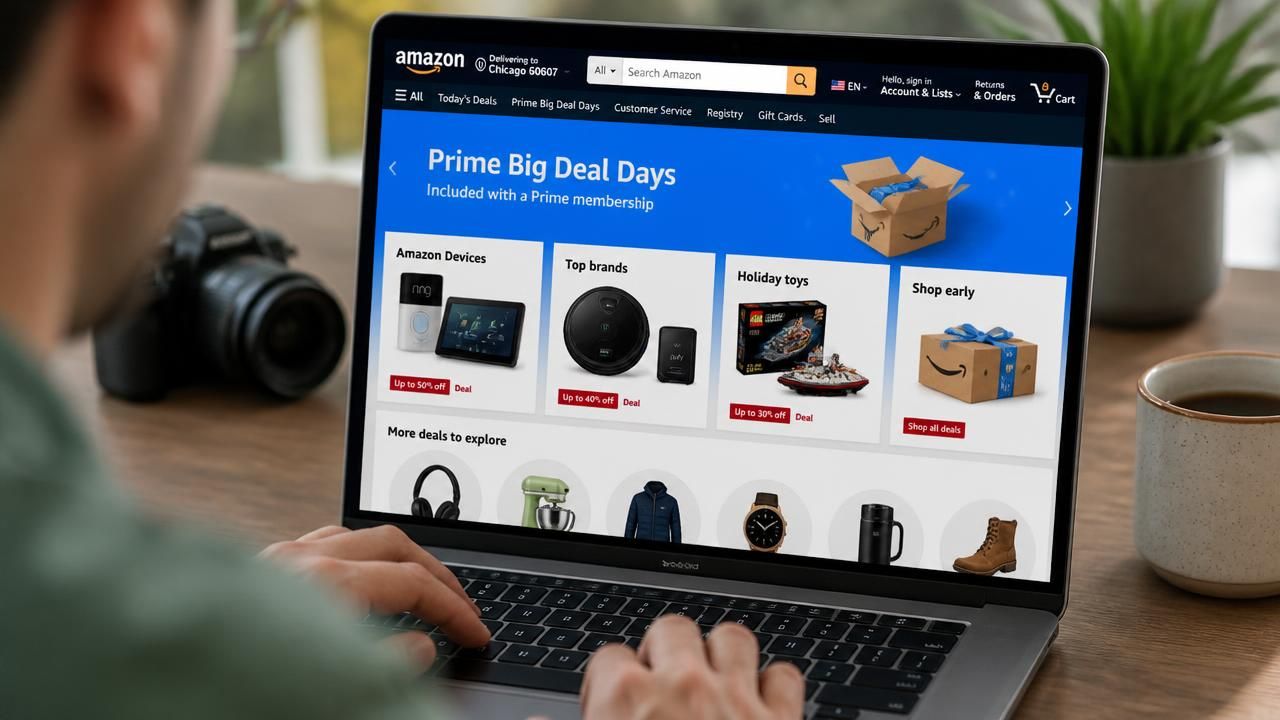
Amazon's fall shopping event — widely known as October Prime Day and officially branded Prime Big Deal Days — is set to run from 3 a.m. ET on October 6 through 3 a.m. ET on October 8, according to The Verge, which has been tracking the sale's early discounts. But the most striking feature of this year's build-up is not the event itself: it is the sheer volume of deal coverage that has already appeared weeks before the first official price cut.
From Forbes and Wired to Fox News, the New York Post, PCWorld, NBC News and Android Authority, more than a dozen major outlets have published early-deal roundups, most of them updated continuously and most of them monetized through affiliate links. The result is a pre-sale shopping season that now begins well before the sale it is promoting.
What Amazon has confirmed
The event is Amazon's second major discounting push of the year, following the traditional July Prime Day, and it lands squarely at the start of the holiday shopping calendar. Several outlets, including Forbes and Car and Driver, refer to the 2026 edition directly; Mashable and MacRumors have likewise published preview coverage under the same banner.
Timing is the central fact for shoppers. As The Verge notes, the window is narrow — roughly 48 hours — and the early discounts are explicitly positioned as a preview of what will return during Black Friday and Cyber Monday.
"October Prime Day offers a glimpse of deals that will likely be available again during Black Friday and Cyber Monday," The Verge wrote, adding that "with the holiday shopping season officially underway, you can get some of your shopping out of the way before things get busier."
The categories drawing the most attention
Across the aggregated coverage, a handful of product categories dominate.
- Amazon's own hardware. The Verge highlighted the second-generation Ring Battery Doorbell 2K at $39.99, down from $99.99 — a discount of more than half — alongside the wired Ring Floodlight Cam 2K. It cautioned that the doorbell's battery is built-in, requiring removal and USB-C charging.
- Home and floor care. The Bissell ProHeat 2X Revolution Pet Pro Plus carpet cleaner has been discounted to $209.99 from $279.99, pitched at households with pets and large carpeted areas.
- Toys and collectibles. Mashable flagged rare discounts on Lego Star Wars and Lego Pokémon sets, plus Pokémon 30th Celebration trading cards selling below market price.
- Power and portable energy. MacRumors reported early Prime Day discounts of up to 65 percent on Anker and Jackery power stations — a category that has become a fixture of Amazon's seasonal events.
- Dash cams. Car and Driver devoted a standalone piece to early dash-cam deals, a category MSN also flagged as unusually aggressive this cycle.
- Kitchen and wellness. Food and Wine reported that Amazon insiders could already shop Breville, OXO and Ninja offers, while NBC News promoted discounts of up to 80 percent spanning Medicube skincare, Lego, Casper mattresses and Bissell.
General-technology coverage has been just as broad. MSN's roundup cited live offers on Apple, Nintendo and Garmin products, while Android Authority urged readers simply not to wait.
How the coverage is being framed
The framing varies noticeably by outlet. Wired's headline — "Prime Day Deals Are Already Here. These Are the Ones I'd Buy" — emphasizes editorial filtering, presenting the writer as a curator rather than a catalogue. Digital Trends struck a similar pose with "I went hunting for early Prime Day deals. These 10 made the cut." PCWorld went further, narrowing to "10 early October Prime Day deals worth buying right now."
Consumer and general-news outlets have taken a volume approach instead. The New York Post advertised "95+ best early October Prime Day deals actually worth shopping in September," while Fox News promised "12 things worth buying," and NBC News led with a headline discount of "up to 80% off." The distinction matters: specialist publications tend to justify each recommendation, while mass-market outlets tend to lead with the size of the savings.
Not every page in the ecosystem proved readable. Several aggregators — including MSN mirror pages and some publisher deal hubs — served only headlines or blocked automated access entirely, a reminder that much of this coverage is engineered as much for search and affiliate traffic as for readers.
Why the early-deal window keeps expanding
The strategic logic is straightforward. Early promotions let Amazon capture holiday spending before competitors' Black Friday campaigns begin, and they let publishers lock in affiliate revenue weeks in advance. For shoppers, the trade-off is genuine: some early prices match or beat what will appear in November, but stock and price volatility are highest before the official start.
Industry observers consistently advise treating preview coverage as a research tool rather than a countdown. Price-tracking history, return policies and whether a product is a genuine need all matter more than the percentage printed in a headline.
What to watch next
Expect the deal volume to peak in the final 48 hours before October 6, when Amazon typically unlocks additional Lightning Deals and competing retailers — Best Buy among them, per The Verge's price comparisons — match or undercut headline offers. After October 8, attention will shift almost immediately to Black Friday, where many of the same products are expected to reappear at similar or slightly lower prices.
For now, the clearest takeaway is structural rather than commercial: the October event has completed its transformation from a supplementary sale into a full-fledged season, one with its own preview period, its own press cycle and its own cottage industry of coverage.