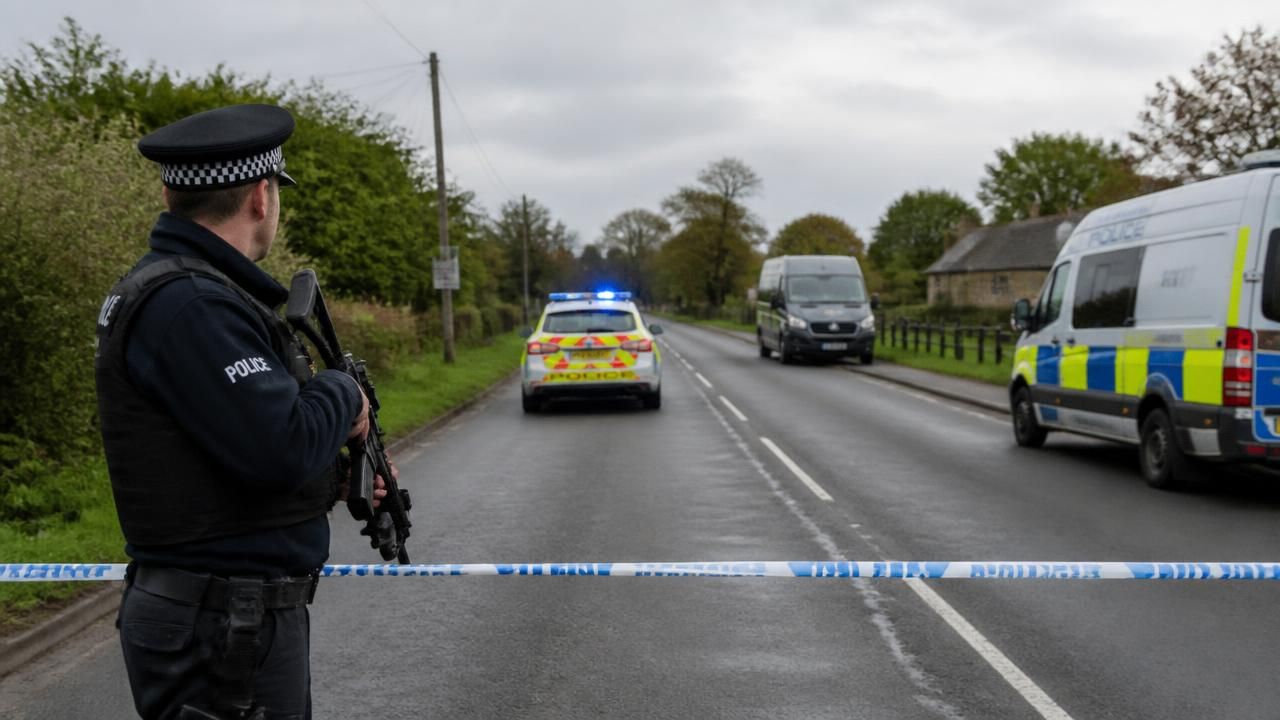
Five men were arrested on suspicion of terrorism offenses near R.A.F. Fairford, the Gloucestershire airbase that has become a launching point for U.S. bomber operations against Iran, after British authorities said they were investigating a suspected plot targeting the installation. Police declared a "major incident" and evacuated residents from homes close to the base perimeter as counterterrorism officers moved in.
The arrests were made under explosives legislation, according to multiple reports, and the case is being treated as a terrorism investigation. The quiet rural communities around the base, long accustomed to the distant roar of aircraft, were abruptly thrust into an international security drama that has raised questions about the vulnerability of Western military hubs at a moment of acute tension with Tehran.
What We Know
- Five arrests: Several men were taken into custody on suspicion of terrorism-related offenses, with explosives legislation cited as the legal basis for the detentions.
- Location: R.A.F. Fairford in Gloucestershire, southwest England, a Royal Air Force station that hosts rotational deployments of U.S. Air Force bombers.
- Evacuations: Residents in villages near the base were told to leave their homes while police conducted searches and secured the area.
- A possible Iran link: Investigators are examining whether the suspected plot has connections to Iran, according to reporting on the case, though no formal allegation has been confirmed.
- Prior warnings: Bloomberg reported that the UK had already raised security at Fairford before the incident, suggesting intelligence agencies had been tracking a heightened threat.
A Base at the Center of the Iran Campaign
R.A.F. Fairford is not an ordinary airfield. Operated by the Royal Air Force but frequently used by the United States, it has long served as a forward base for American heavy bombers and support aircraft. In recent weeks it has been associated with sorties tied to U.S. operations against Iran, giving the facility outsized strategic significance — and, security analysts say, making it a natural target for retaliation.
That dual role explains much of the alarm. "Fairford is one of the most visible forward nodes for American air power in Europe," one London-based defense analyst noted, speaking on condition of anonymity because the investigation is ongoing. "Any credible threat against it is not just a UK policing matter; it is a test of the whole Western force-protection architecture."
How the Story Unfolded
Reports emerged in a rapid sequence. British and international outlets first described a major police operation near the base, followed quickly by confirmation that multiple men had been arrested. By the time authorities acknowledged they were investigating a possible terrorist plot aimed at the base, the story had spread worldwide, amplified by the base's role in the Iran campaign.
Different outlets framed the developments differently. The New York Times emphasized the transformation of the sleepy villages around Fairford into the center of a counterterrorism operation. Al Jazeera foregrounded the terrorism dimension and the number of arrests. Stars and Stripes, which covers the U.S. military community, focused on the five suspects and the significance for American personnel stationed there. Bloomberg led with the detail that security had been stiffened before the incident — a signal that the threat was anticipated rather than a surprise. Aggregated reports on MSN variously highlighted the evacuations, the explosives-related charges, and the possible Iran connection, reflecting how quickly rumor and confirmed fact can blur in a breaking-news cycle.
The Broader Security Picture
The episode lands during a period of elevated tension across Europe and the Middle East. With the U.S. air campaign against Iran continuing, Western officials have warned for months about the risk of proxy attacks, sabotage, and assassination plots on European soil. Britain's counterterrorism apparatus, already stretched by domestic and international cases, has been operating at a higher tempo.
"The threat environment has changed. Facilities that support operations against Iran are no longer far from the front line — they are part of it."
Residents near Fairford have historically coexisted with the base, including during earlier conflicts when the station buzzed with B-52s and B-2s. But the sight of police cordons, evacuated homes, and forensic teams working along country lanes is a stark shift for a corner of the Cotswolds better known for stone cottages and market towns.
What Comes Next
Investigators are expected to continue searching properties and questioning the detainees, who under British law can be held for extended periods under terrorism provisions. Officials have not publicly confirmed a foreign state's involvement, and analysts caution that a suspected Iran link — if established — could take weeks to substantiate through intelligence channels.
The immediate practical consequences are already visible: security at Fairford and comparable U.S.-linked installations across the UK will likely be tightened further, base access restricted, and force-protection reviews accelerated. Politically, the case will feed an intensifying debate in London and Washington about how to defend forward bases that are simultaneously symbols of deterrence and magnets for retaliation.
For now, the villagers around Fairford are waiting. As one local resident put it, the base has always been part of the landscape — "we just never expected to be part of the story."