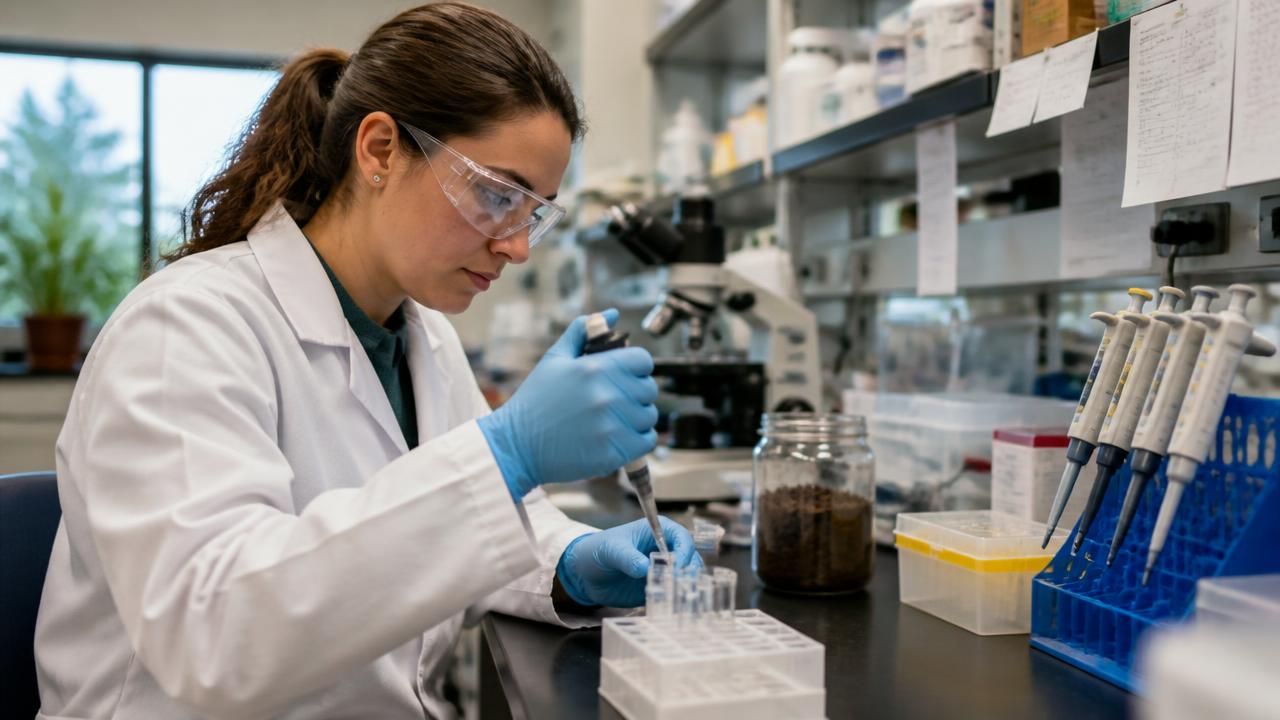
Scientists have quietly solved one of soil science's more stubborn measurement problems — and in doing so, may have handed farmers and policymakers a sharper tool for managing one of agriculture's most finite and geopolitically fraught inputs: phosphorus.
According to reporting from Science Daily, MSN and other outlets, researchers have streamlined a method for measuring DNA-bound phosphorus in soil — the fraction of the nutrient locked up inside the DNA of soil bacteria, fungi and other microorganisms. The new approach is cheaper and easier to perform than earlier techniques while preserving their accuracy, a combination that has historically proven elusive in soil chemistry, where precise assays often demand specialized labs, expensive reagents and careful handling.
The story rippled across science and syndicated news outlets under slightly different headlines — "New soil test could reveal how soil microbes help feed plants," "New soil test may help reveal how microbes make phosphorus available to plants" — but the underlying claim was consistent: making this measurement accessible could illuminate how soil life recycles a nutrient that plants cannot simply take from the air.
A Nutrient Cycle We Still Only Partly Understand
Phosphorus is essential for DNA, ATP and cell membranes, and unlike nitrogen, it has no gaseous atmospheric reservoir. Plants absorb it as dissolved phosphate, but much of the phosphorus in soil sits bound in organic forms — including microbial DNA — that roots cannot directly use. Microbes bridge that gap, mineralizing organic phosphorus into plant-available phosphate as they live, die and turn over.
Because that process has been hard to quantify, fertilizer recommendations have largely been built on chemical soil tests that ignore the biological half of the ledger. Farmers often apply phosphate fertilizer as insurance rather than as a response to measured biological supply.
The technique could reveal how soil microbes help recycle phosphorus and ultimately support more sustainable fertilizer and nutrient management, the researchers reported.
Sensors That Self-Destruct to Reveal Soil Life
A parallel line of work, reported by phys.org under the headline "Degradable sensors reveal hidden soil secrets after microbes nibble on them," points in the same direction from a different angle. These sensors are designed to break down as soil microorganisms consume them, turning the act of decomposition itself into a measurement signal rather than an obstacle.
Conventional soil sensors are inert by design; they resist the biology around them. Degradable devices invert that logic, effectively asking microbes to report on their own activity. Together with the refined DNA-phosphorus assay, the approaches suggest a field moving toward biological soil diagnostics — instruments that measure what soil life is doing, not merely what chemistry is present.
The Fertilizer Paradox
A third strand of coverage sharpened the stakes. phys.org also promoted a piece arguing that "fertilizers carry a hidden cost for soil's crucial microbes" and that "using less might pay off for farms in unexpected ways." That framing cuts against a decades-old assumption that more nutrient input reliably means more yield.
Phosphorus fertilizer is not free, either financially or ecologically. It is manufactured from mined phosphate rock, a non-renewable resource concentrated in a handful of countries, with Morocco and Western Sahara holding the largest known reserves. Excess phosphate that runs off fields drives eutrophication — algal blooms and oxygen-depleted dead zones in lakes, rivers and coastal waters. Scientists have argued that the global phosphorus cycle has already been pushed beyond its safe operating boundary.
Reducing application without losing yield therefore requires knowing how much phosphorus soil biology is already supplying. That is precisely the gap the new test targets.
pH, Nitrogen and the Competition for Nutrients
Context from a separate study, flagged by EurekAlert, adds a further layer: "Soil pH shapes nitrogen competition between wheat and microbes." The finding underscores that nutrient dynamics in soil are not a simple arithmetic of inputs and outputs but a contest — plants and microorganisms competing for the same limited pools, with soil chemistry setting the rules of engagement.
If pH shifts who wins that competition, then fertilizer regimes, liming practices and crop choice all interact with microbial communities in ways that current management guidelines may not capture. It also suggests that soil biology responds to management on timescales that a single season's soil test can miss.
How the Story Was Framed
Coverage varied by outlet. Science Daily led with the methodological breakthrough and its implications for sustainable nutrient management. MSN and Latestly emphasized discoverability — the promise of revealing hidden microbial activity. phys.org foregrounded the practical and economic tension between fertilizer use and soil health. The EurekAlert item, by contrast, was anchored in plant-microbe competition rather than measurement.
Read together, the threads describe a single shift: agriculture is gaining the instrumentation to manage soil as an ecosystem rather than a substrate.
What Comes Next
- Adoption: Whether the streamlined DNA-phosphorus test reaches commercial soil labs will determine if it changes farm practice or remains an academic tool.
- Calibration: Agronomists will need region-specific benchmarks linking microbial phosphorus pools to crop response.
- Policy: Cheaper biological testing could support nutrient-management rules aimed at reducing runoff while protecting yields.
- Equity: Lower-cost methods matter most in regions where fertilizer prices are a binding constraint on food production.
The irony is that the most valuable thing the new test measures is invisible — the metabolic hum of organisms too small to see, quietly converting unavailable phosphorus into the form that feeds the world.