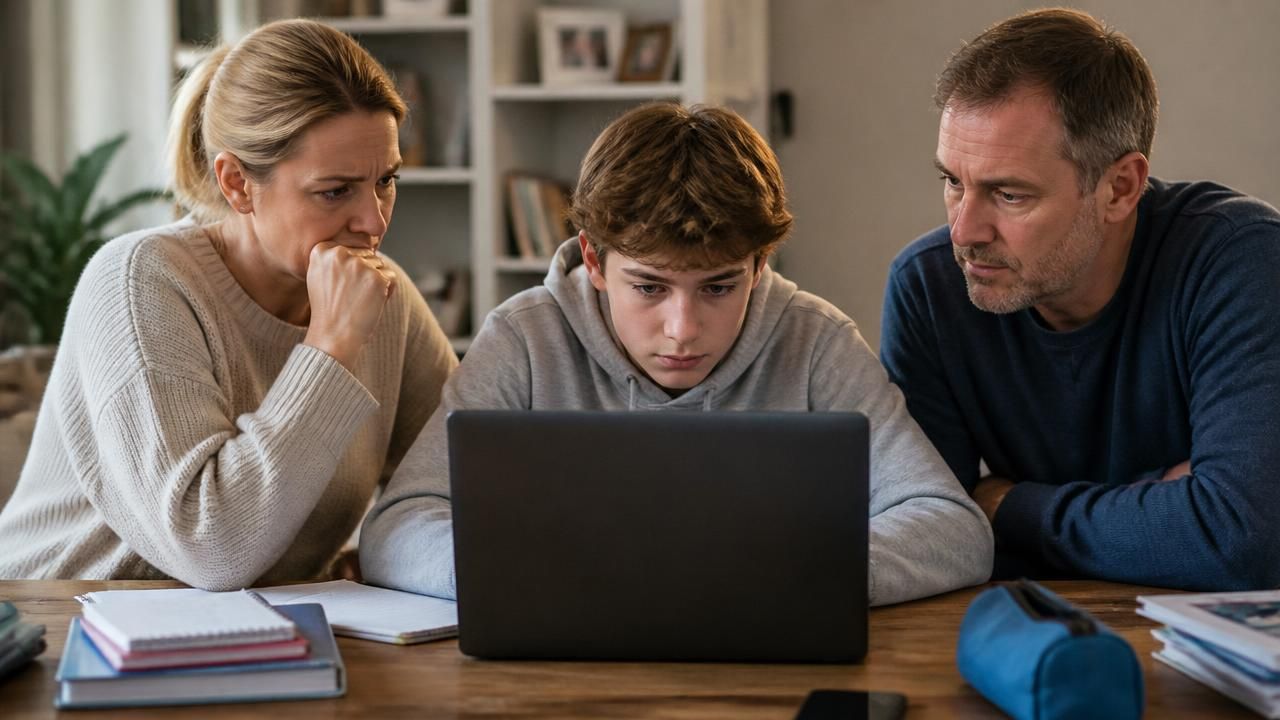
As millions of children head back to classrooms this fall, a familiar argument is resurfacing with new urgency: how much screen time is too much, and who gets to decide? Across a wave of reporting from national outlets, local newsrooms and trade publications, a single theme keeps emerging — parents are exhausted, schools are defensive, and children are caught in the middle of a debate that has become as much about politics and trust as it is about pixels.
The anxiety is not abstract. According to survey data reported by the New York Post, parents of teenagers lose roughly 48 nights of sleep a year worrying about their children's growing online presence. That statistic captures a broader mood: families feel outgunned by algorithms, peer pressure and devices that follow kids from the dinner table to the classroom.
A Generation Raising Itself Online
Much of the current coverage centers on a simple question — what actually works? NPR's reporting offers a practical, if unglamorous, answer. Parental monitoring, clear screen time boundaries and early, open conversations about online habits make children less vulnerable to the harms of social media and excessive screen use. The emphasis is on consistency over confrontation: rules set late, or enforced only during a crisis, tend to fail.
CNN struck a similar chord but framed the problem more bluntly. Many parents, it noted, haven't been enforcing the rules they say they believe in — and the story offered a roadmap for changing course now. The subtext is uncomfortable but widely shared: households often drift into permissive patterns, then panic when a child's habits spiral.
"Screen time boundaries plus early and open conversations about online habits can make kids less vulnerable."
Yet a competing strand of advice, echoed by ConsumerAffairs and child therapists quoted by Yahoo, warns that treating screens as an enemy can backfire. Child therapists have repeatedly argued that the one thing adults should do more of is talk with kids about what they're doing online rather than simply policing minutes. Shame and secrecy, they suggest, push behavior underground; curiosity keeps the channel open.
The Schoolhouse Battleground
The debate is no longer confined to living rooms. Education Week reported that schools are bracing for a growing backlash to classroom screen time — a shift that puts administrators in an awkward position after years of heavily promoting one-to-one device programs. The same publication also examined how schools can help parents manage kids' screen time at home, positioning districts as partners rather than referees.
That partnership is under strain. A widely shared New York Post report described parents disturbed by what they found on school-issued devices — students surfing the web and playing poker-like games during class time. One parent's phrase, "electronic fentanyl," was blunt to the point of hyperbole, but it reflected a real sense of betrayal: devices sold as learning tools being used for distraction, with little visibility for families.
Local outlets including WMUR and WQAD have amplified similar concerns, with experts arguing that the back-to-school window is a natural moment to reset habits. The framing is hopeful rather than accusatory — a fresh semester as a fresh start — but the underlying data on youth mental health and attention keeps the stakes high.
Guidelines, Governance and the Trust Question
Not everyone agrees on the remedy. Opinion pages such as the Columbian have argued plainly that parents need to cut back screen time themselves, modeling the behavior they want to see. Others, like the Orange County Register, push back hard on a different front: parents, they argue, shouldn't trust bureaucrats to manage their kids' digital lives. That libertarian-leaning position casts government guidelines and school mandates as overreach rather than protection.
Meanwhile, outlets such as GoErie have sought to translate evolving pediatric guidance into plain language for families, noting that recommendations have shifted as research matures — from blanket time limits toward a focus on content, context and displacement of sleep, exercise and in-person relationships.
The result is a noisy landscape with several distinct camps:
- Boundary-setters: Experts and outlets arguing for firm limits, monitoring tools and consistent enforcement.
- Conversation-first advocates: Therapists who say dialogue, not surveillance, protects kids.
- Institutional skeptics: Commentators who distrust schools and governments to mediate family tech decisions.
- Accountability seekers: Parents demanding transparency about what happens on school-issued devices.
What Parents Can Actually Do
Across the divide, a handful of practical points recur. Start early — habits formed in elementary school are harder to unwind in high school. Keep the conversation non-judgmental so children disclose problems rather than hide them. Audit school devices and ask districts what filtering and monitoring is in place. And recognize that children learn far more from what adults do than from what they prohibit.
"Stop making screen time the enemy."
That injunction, from ConsumerAffairs, may be the most useful reframe of all. Screens are now woven into education, friendship and entertainment; the goal is not elimination but balance. The coming school year will test whether families, schools and policymakers can agree on what that balance looks like — or whether the screen time wars deepen into another front in America's broader argument over who should raise our children.