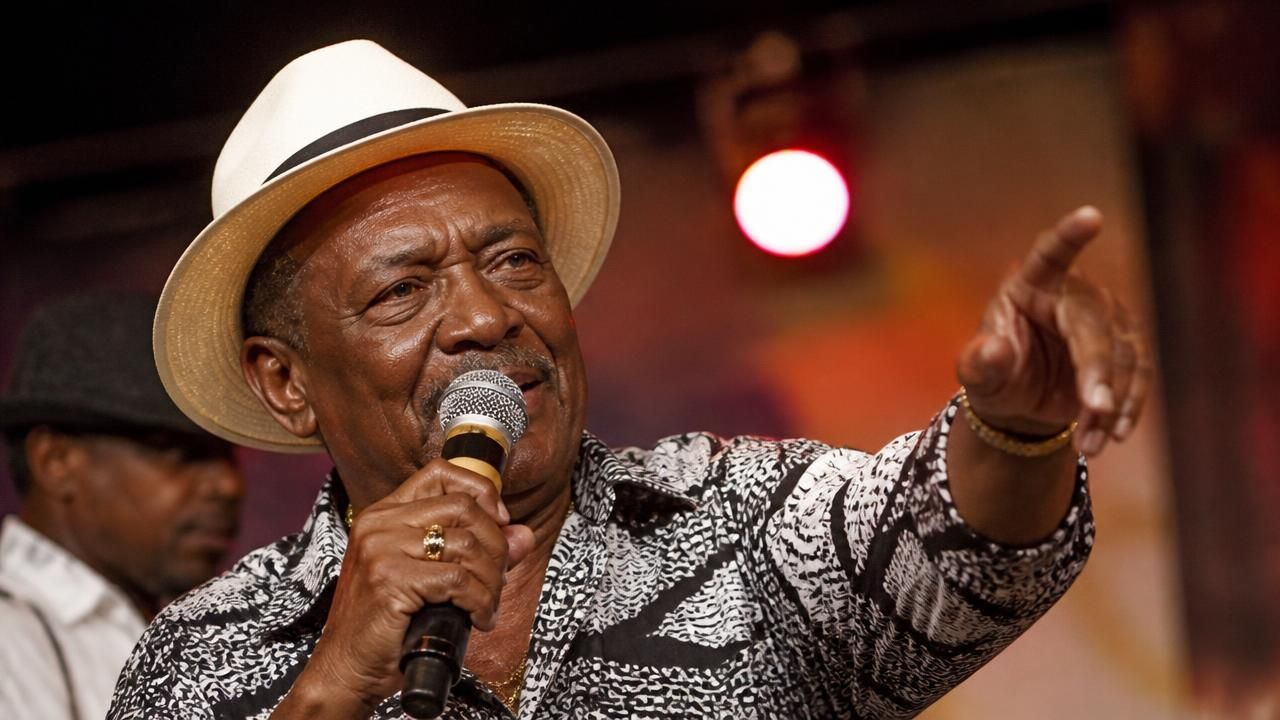
Slinger Francisco, the Trinidadian calypsonian whose biting wit, gravel-and-honey delivery and seven-decade career earned him the title “Calypso King of the World,” died on Sunday in New York surrounded by his family, relatives said in a statement. He was 91.
Known to generations simply as the Mighty Sparrow — or “Sparrow” — Francisco was the dominant figure in a genre that carried the politics, humour, scandal and gossip of the English-speaking Caribbean onto the international stage, and he remained its most quotable chronicler long after his commercial peak. Word of his death spread swiftly from Port of Spain to Brooklyn, with the Guardian, the New York Times, the Trinidad Express, St Lucia Times, Soca News, News Americas Now and the US Virgin Islands Consortium all leading with the loss.
From a Grenada village to Port of Spain
Francisco was born on 9 July 1935 in Grand Roy, a village on Grenada’s western coast, and moved to Trinidad as a small child, growing up in Port of Spain. He sang in school and church choirs before drifting into the calypso tents of the early 1950s, where he picked up the nickname “Sparrow” — a nod to his small frame and restless energy — and a reputation for a lyricism sharper than that of his elders.
His breakthrough came in 1956 with “Jean and Dinah,” a wry, unsentimental portrait of Trinidadian women and the American servicemen stationed at the Chaguaramas naval base. The song won him the Calypso King crown at Carnival and turned a young performer into a national voice overnight.
Jean and Dinah, Rosita and Clementina / Round the corner posing, bet your life is something they selling.
— “Jean and Dinah” (1956)
A catalog of calypso — and controversy
What followed was one of the most prolific runs in Caribbean music. Francisco won an unmatched string of Calypso Monarch and Road March titles, his songs decided by which tune Carnival crowds played and danced to most. Among the recordings that defined his catalogue — and the region’s — were “Ten to One Is Murder,” “Melda,” “Obeah Wedding,” “Drunkard,” “Sa Sa Yay” and “Congo Man,” the last of which was banned from Trinidadian airplay for its provocative lyrics and later became a cult favourite abroad.
Calypso in his hands was a newspaper set to music: he wrote about colonial politics, corruption, race, sex, migration and the small hypocrisies of island life, often with a punchline that made censors nervous. His hard-driving arrangements and willingness to absorb soul, jazz and African rhythms in turn helped point the way toward soca, the faster, synth-driven sound that would dominate Caribbean Carnival from the 1970s onward.
- 1956: “Jean and Dinah” wins the Calypso King title at Trinidad Carnival.
- 1960s–70s: A run of Road March and Monarch titles that made him the most decorated calypsonian of his era.
- Global reach: Sold-out concerts across North America, Europe and Africa, and a following that stretched well beyond the Caribbean diaspora.
- Later years: Settled in New York, touring into his 80s and remaining a fixture of Caribbean cultural life.
New York, and a final chapter
Francisco spent much of his later life in the United States, where the calypso audience he had helped build across the Caribbean diaspora was largest and most loyal. The family statement said he died “peacefully,” surrounded by relatives, in New York on Sunday — a quiet ending for a man whose voice had once filled Carnival stages for tens of thousands at a time.
Only last year, regional outlets in Guyana marked his 90th birthday with tributes, among them pieces recalling his reflection on a life lived at full volume: as Stabroek News reported, he said he intended to “take as much as I could handle.”
How the world is framing his loss
The obituaries reveal as much about how the Caribbean sees itself as they do about the man. The Guardian foregrounded his global epithet, calling him “the calypso king of the world,” while the New York Times framed him as a “Trinidadian titan of calypso” — a cultural heavyweight whose importance the paper placed firmly in the Caribbean tradition rather than in the pop mainstream. Trinidad’s own Express offered the starkest headline: “Mighty Sparrow dead at 91,” a home-country acknowledgment of a national institution. St Lucia Times eulogised him as an “icon” who “exits stage,” and Soca News and News Americas Now spoke to audiences for whom Sparrow was less a nostalgia act than the sound of migration, family gatherings and Carnival itself.
That divergence matters. For international audiences, Sparrow was an exotic discovery; for Caribbean people, he was the man who put their lives into verse, insisting with the title of one of his best-known songs that there was no fear in him — “Ah Fraid Nobody.”
A legacy that outlives the tents
His influence is now embedded in a region’s popular music. Contemporary soca, dancehall and even Afrobeats-era Caribbean crossover acts owe a debt to the template he set: a singer who treated popular music as legitimate social commentary, and who refused to soften his lyrics for the gatekeepers of radio and government.
As tributes flood in from Port of Spain to Toronto and London, the question his death raises is a familiar one for cultural historians — who succeeds the generation of post-independence Caribbean artists who made the world listen. The calypso tents will open again next Carnival, and someone else will be crowned. But for the better part of 70 years, there was only one Sparrow.