The global race to build artificial intelligence has largely been told through the fortunes of a handful of names: Nvidia, TSMC, ASML. But a quieter competition is unfolding one layer beneath the processor — in the high-tech base materials that hold an AI chip together and carry its signals out into the world. This week, two developments underscored how that competition is widening: Austria's AT&S opened the doors of its Malaysian plant to CNBC's Managing Asia, while Anthropic, one of the world's leading AI model developers, was reported to be assembling an in-house chip team of its own.
The unglamorous layer that AI cannot do without
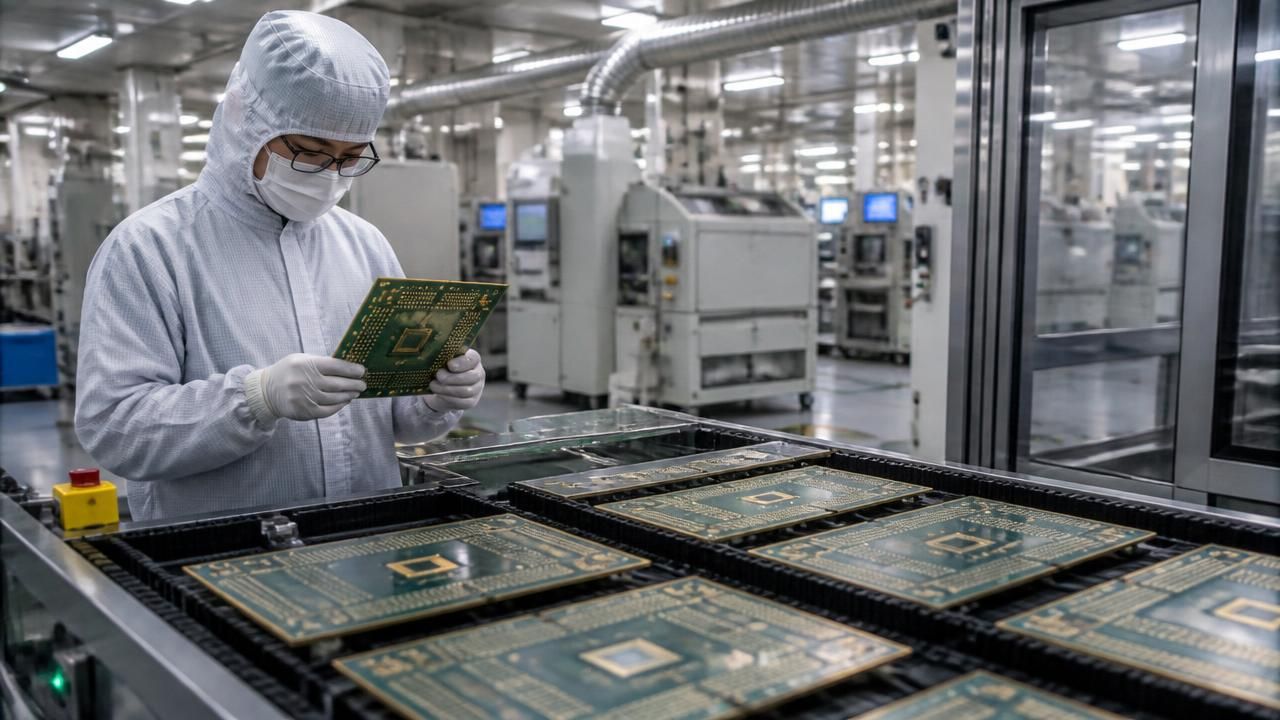
Integrated circuit (IC) substrates are the dense, multi-layered boards that sit between a silicon die and the printed circuit board. They route power and data, dissipate heat, and — critically — allow thousands of high-speed connections to flow between a processor and the rest of a system. In an era of ever-larger AI accelerators and high-bandwidth memory stacks, they have gone from a commodity component to a genuine bottleneck.
That was the central message from AT&S chief executive Michael Mertin, who walked CNBC's Christine Tan through the company's Malaysia facility. Mertin's argument, as conveyed in the segment, is straightforward: the substrate is becoming more important as AI demand grows, and manufacturers are racing to add capacity to keep pace.
IC substrates — the high-tech base layers beneath AI chips — are becoming more important as AI demand grows, and manufacturers are racing to add capacity to meet it.
— The thrust of AT&S CEO Michael Mertin's remarks to CNBC's Managing Asia
The Austrian-headquartered company is one of a small club of substrate suppliers whose ranks include Japan's Ibiden and Shinko Electric, Taiwan's Unimicron and Nan Ya PCB, and South Korea's Simmtech. For years these firms served the smartphone and PC markets. AI has changed the calculus: accelerators such as Nvidia's data-center GPUs require substrates with more layers, finer wiring, larger form factors and far tighter tolerances than consumer chips — and they require them in volumes the industry has never had to produce before.
Why Malaysia matters
AT&S's Kulim campus in Malaysia has become a symbol of the geographic diversification now sweeping the semiconductor supply chain. Governments in Washington, Brussels and Tokyo have spent the past several years pushing chipmakers to spread capacity beyond a handful of concentrated hubs, and substrate production — long dominated by Asian suppliers with heavy exposure to China and Taiwan — sits squarely in that conversation. AT&S has also invested in plants in Austria, China and South Korea, positioning itself as a supplier with a genuinely multinational footprint.
The economics are demanding. Substrate fabs are capital-intensive, take years to build and qualify, and must be validated by chip designers before a single wafer ships. Analysts have repeatedly warned that substrate capacity additions lag AI demand by design, creating periodic shortages that ripple through server supply chains and, ultimately, into the pricing of cloud computing.
Anthropic's move: from buyer to designer
If AT&S represents the supply side trying to keep up, Anthropic represents the demand side trying to stop waiting. According to Forbes, the AI safety-focused company — maker of the Claude family of models — has entered the AI chip race with an in-house chip team. The report frames the effort as the latest example of a major AI lab deciding that general-purpose hardware from merchant vendors is no longer sufficient for its needs.
The logic mirrors moves already made by Google, Amazon and Microsoft, all of which have invested heavily in custom silicon to reduce dependence on Nvidia and to tune hardware for their own workloads. Designing chips in-house offers potential gains in cost, performance-per-watt and supply security — but it also demands specialized engineering talent, long development cycles and deep relationships with foundries and, notably, with substrate suppliers.
- Cost control: Custom accelerators can lower the per-token cost of running large models at scale.
- Supply leverage: In-house teams reduce exposure to the allocation decisions of a single dominant GPU vendor.
- Workload fit: Training and inference have different hardware needs; bespoke designs can optimize for one.
- Risk: Chip programs are expensive, slow and unforgiving — many announced efforts never reach volume production.
Notably, Anthropic has not publicly detailed the scope of the effort, and it remains unclear whether the company intends to tape out a full accelerator or to focus on narrower acceleration and interconnect work. Forbes' coverage was thin on specifics, reflecting how early such programs typically are when they first surface.
A story about geopolitics as much as silicon
These two threads — the substrate maker expanding in Southeast Asia and the AI lab building its own silicon — are not merely corporate stories. They sit inside a broader realignment of global power around computing. Export controls, subsidies such as the U.S. CHIPS and Science Act and the EU Chips Act, and the concentration of advanced manufacturing in a handful of geographies have turned semiconductors into an instrument of statecraft.
The framing varies by outlet. Business coverage of the AT&S segment, as carried by CNBC and syndicated on MSN, emphasizes capacity, capex and the mechanics of supply — a producer's-eye view of the boom. Forbes' treatment of Anthropic leans toward competitive strategy: another well-funded AI lab deciding it must own more of its stack. The third thread, explored in MSN-hosted analysis, zooms out to ask how AI is reshaping balances of power between nations, where compute capacity increasingly functions as a proxy for influence.
Taken together, the picture is of an industry in which advantage is being contested at every layer — from the model weights at the top to the copper traces at the bottom. AT&S is betting that the layer most consumers will never see becomes one of the most strategically valuable. Anthropic is betting that controlling its own silicon is worth the cost. Both bets rest on the same assumption: that demand for AI compute will keep outstripping the supply chain's ability to deliver it, and that whoever adds capacity fastest, and most cleverly, will shape the decade ahead.
What remains unanswered is whether either approach produces a durable edge — or whether, as has happened before in semiconductors, today's bottleneck simply becomes tomorrow's commodity.