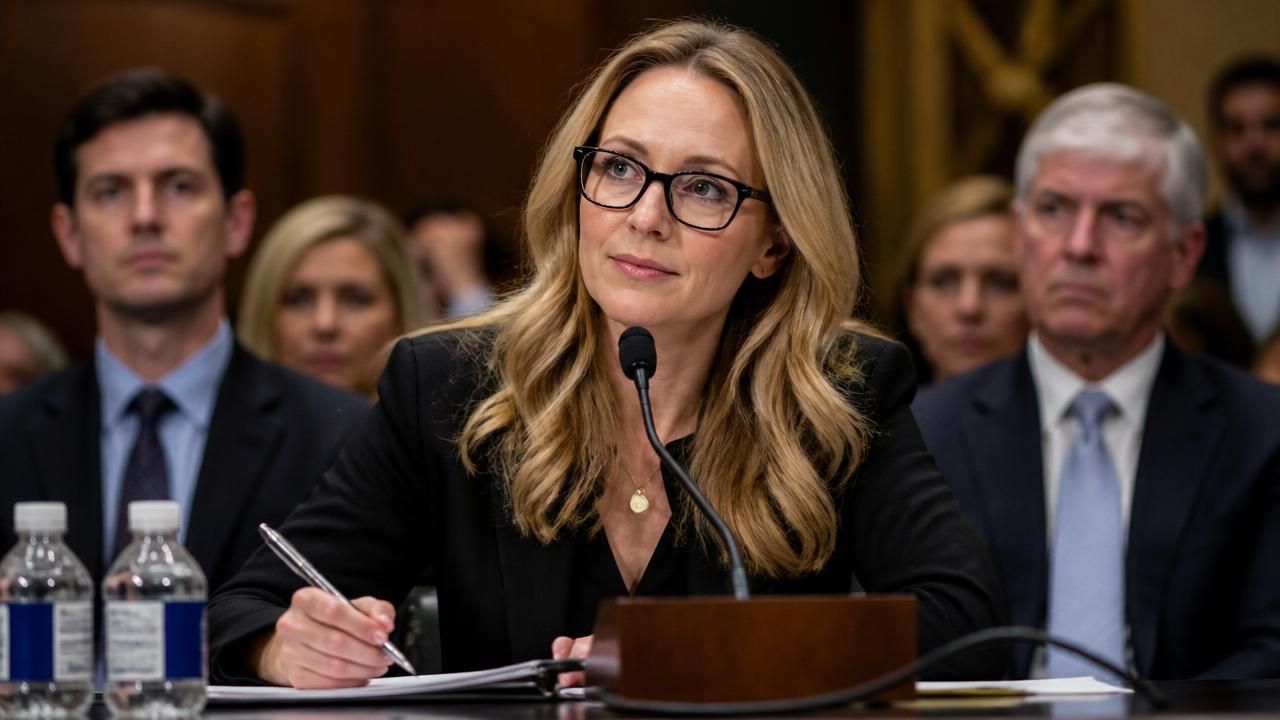
President Trump's nominee to lead the Food and Drug Administration, Dr. Heidi Overton, appeared before the Senate health committee on Thursday for a confirmation hearing that lasted nearly two hours — and, by several accounts, produced far more evasion than clarity. Overton, a physician with a doctoral degree in clinical investigation who currently serves as deputy assistant to the president for domestic policy, fielded questions on vaccines, flavored vaping products, birth control, and abortion. In case after case, she declined to commit to specific positions, even on questions that observers described as softballs.
The hearing arrives at a volatile moment for the agency. The FDA is currently reviewing the safety of mifepristone, the abortion pill, despite extensive clinical data showing it is extremely safe — a review widely seen as politically motivated. Meanwhile, the White House has signaled an interest in overhauling childhood immunization schedules, a prospect that has alarmed much of the medical establishment.
A Refusal That Became the Story
The most striking exchange of the day centered not on a drug or a vaccine, but on a single word: wrong. Asked whether she would push back if President Trump made a factually incorrect claim, Overton refused to say. The refusal became the headline for multiple outlets. MSN's framing was blunt — "Nominee sparks outrage by refusing to say whether Trump can be wrong" — while The Seattle Times led with "FDA nominee refuses to say she will push back if Trump is wrong." The Hill summarized the day more diplomatically, noting simply that the "FDA pick sidesteps tough questions."
That the question was asked at all reflects a specific moment in Overton's record. In August, she stood behind the president at a press conference during which Trump falsely described the measles, mumps, and rubella (MMR) vaccine as "quite lethal" — an assertion contradicted by decades of evidence. Trump went further, claiming that vaccine doses for infants are "like the size of a soda bottle," and calling for the MMR vaccine to be split into three separate immunizations. There is no evidence of benefit from such a split, and no such individual immunizations are currently available in the United States.
On Vaccines: Affirmation Without Commitment
Not every moment was a dodge. According to Yahoo News, Overton affirmed that both the MMR vaccine and mifepristone are safe. USA Today reported that she told lawmakers the MMR vaccine is "safe and effective." The Associated Press framed its coverage around the same concession: "FDA nominee says vaccines are safe despite Trump efforts to overhaul childhood shots."
"The MMR vaccine is safe and effective." — Dr. Heidi Overton, before the Senate health committee
Yet the affirmation sat awkwardly beside her silence on what she would do if the administration she hopes to serve advanced a contradictory policy. Ars Technica noted that she "spent nearly two hours stonewalling senators, even on softball questions," and emphasized that her refusal to say whether the president can be wrong was itself the answer. For critics, the distinction between affirming a scientific consensus and defending it is not academic. If confirmed, Overton would be responsible for the agency that regulates vaccine labeling, approvals, and safety communications — meaning her willingness to publicly stand behind that consensus matters as much as her private belief in it.
The Abortion Pill and a Broader Pattern
Overton's position on mifepristone drew similar scrutiny. She has taken a clear stance opposing abortion, and previously worked at a conservative think tank — a background that raises obvious questions about her objectivity in overseeing an FDA review of a drug she may personally oppose. She sidestepped questions about the ongoing review, according to MSN, even as she acknowledged the drug's safety.
Some outlets saw something more sweeping in her testimony. Crooks and Liars ran its coverage under the headline "Trump FDA Pick Lays Ground To Outlaw Birth Control," arguing that her evasions on contraception amount to paving a regulatory path toward restriction. Other coverage was harsher still: a Yahoo headline described her as "as shifty as a window." The range of framings — from measured (AP, USA Today) to alarmed (Crooks and Liars, MSN) to openly derisive — illustrates how little consensus exists about what, precisely, Overton committed to on Thursday.
Context: An Agency Under Pressure
The FDA has historically operated at arm's length from the political priorities of the White House, a posture intended to protect its scientific judgments from electoral pressure. That norm has been tested repeatedly in recent years, and the prospect of a nominee who declines to affirmatively distance herself from presidential misinformation has intensified concern among former agency officials and public-health researchers.
Beyond the hearing room, the broader political environment remained turbulent. The same week, a judge ordered the Trump administration to lift a ban on CNN and MS NOW reporters from the White House, and they returned to the briefing room hours later — a reminder that press-access fights and agency-confirmation battles are unfolding simultaneously. The Atlantic, weighing in on the administration's wider posture, framed the moment under a pointed headline: "MAGA Is Making the World Safe for Corruption."
What Comes Next
The Senate health committee has not yet scheduled a vote on Overton's nomination. Key questions remain unanswered: whether she supports the FDA's mifepristone review, whether she would defend the existing childhood vaccine schedule, and whether she believes the president can be wrong on matters of science. On Thursday, she declined to answer all three. For a nominee poised to lead the agency responsible for the safety of vaccines and drugs used by millions of Americans, that silence — more than anything she said — may be the most consequential part of her testimony.