Tesla's audacious pivot from electric vehicles to humanoid robots is running into the kind of friction that rarely shows up in a keynote presentation: complicated robotic hands, employees reluctant to train their own replacements, and a competitor that is quietly getting better at navigating the unknown.
According to extensive reporting by The Information, first surfaced by Ars Technica, the company is grappling with multiple technical and cultural complications as it attempts to develop general-purpose robots and scale them for mass production. The challenges land at an awkward moment for CEO Elon Musk, who has staked Tesla's future on artificial intelligence and robotics rather than the car business that made it famous.
A Factory Floor Being Rebuilt for Robots
The clearest signal of the shift is physical. Tesla's Fremont factory in California stopped producing the Model S sedan and Model X SUV as of May 2026, with the company reassigning both line workers and engineers to Optimus programs. The move effectively converts portions of an automotive assembly plant into a robotics laboratory — a transition that has unsettled parts of the workforce.
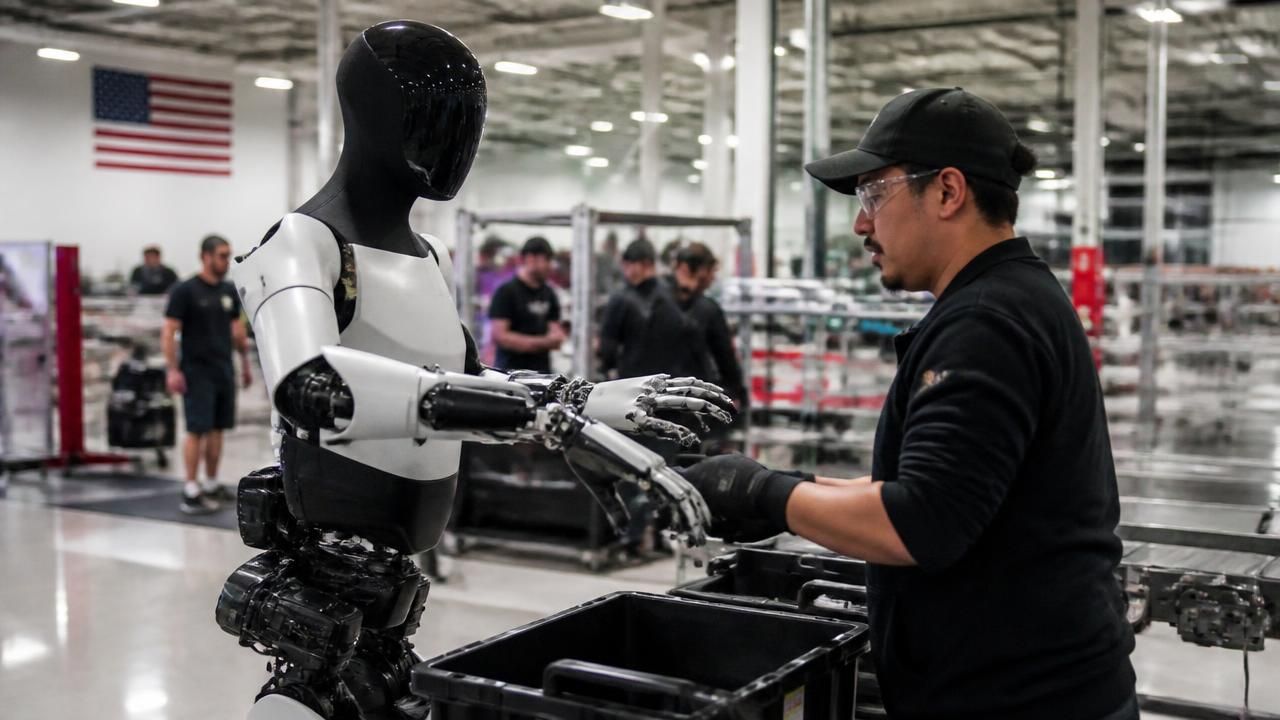
Reporting from MSN's aggregation of the coverage suggests Optimus may be learning directly from real workers at the Gigafactory, using human motion and task data to train its models. That dynamic — humans demonstrating work so machines can eventually replicate it — sits at the heart of the tension. Workers are being asked, in effect, to teach their successors.
The Hand Is the Hard Part
Technically, Tesla's biggest obstacle is one of the most mundane-sounding: the robot's hands. Building a dexterous, reliable humanoid hand capable of manipulating a wide variety of objects remains extraordinarily difficult, and it is cited as a central reason production has been slow to scale.
Musk has acknowledged the difficulty publicly. On Tesla's second-quarter 2026 earnings call, he described Optimus as potentially "the biggest product ever," while conceding that creating an autonomous humanoid capable of handling many different tasks is "one of the hardest things to solve."
"It's one of the hardest things to solve." — Elon Musk, on building a general-purpose humanoid robot
That admission is notable given Musk's long history of ambitious timelines. Ars Technica framed its coverage around the CEO's tendency to make claims that fail to materialize — a pattern that has made investors and analysts cautious about treating Optimus projections as settled fact rather than aspiration.
Employees Push Back
The human side of the equation may prove just as thorny as the mechanical one. According to The Information's reporting, some Tesla employees are balking at the work of training the robots that could eventually displace them. The sentiment is understandable: line workers whose jobs were once tied to vehicle assembly are now contributing data and demonstrations to a system explicitly designed to reduce reliance on human labor.
How Tesla manages that morale problem — through incentives, redeployment, or attrition — will shape how quickly Optimus can move from demonstration videos to genuine volume production.
Competition Sharpens the Stakes
Tesla is not operating in a vacuum. Coverage aggregated by MSN highlighted that Figure, another humanoid robotics company, is "getting better at the unknown" — a reference to the ability of its robots to handle unstructured, unpredictable tasks. That is precisely the capability Tesla needs to master if Optimus is to be more than a factory stunt.
The framing differs subtly across outlets. Ars Technica emphasizes internal dysfunction and Musk's credibility gap. The Verge characterizes the situation as "growing pains," a more neutral framing that treats the setbacks as typical of a young hardware category. MSN's aggregations focus on the learning-from-workers angle and the competitive threat from Figure. Together, they paint a portrait of a program that is neither collapsing nor cruising — but grinding through the unglamorous middle of development.
Why It Matters
Tesla's valuation has increasingly rested on its AI and robotics narrative rather than its automotive margins, which have been pressured by slowing EV demand and intensifying competition. Musk's willingness to halt production of two flagship vehicles to free up capacity for Optimus signals how seriously he intends to pursue the bet.
But general-purpose humanoid robots remain an unproven commercial category. No company has demonstrated profitable mass production at scale, and the technical hurdles — dexterity, battery life, safety, and cost — are formidable. Tesla's advantage lies in manufacturing know-how and vertical integration; its disadvantage lies in a workforce that has reason to resist the very automation it is being asked to enable.
For now, Optimus remains a promise in motion: a product Musk calls the biggest ever, built by employees who may not be entirely sure they want it to succeed.