KUALA LUMPUR — Malaysia’s jailed former prime minister Najib Razak has filed an application to stay the execution of the 15-year prison sentence and RM11.38 billion (about US$2.6 billion) fine imposed on him over the multi-billion-dollar 1MDB scandal, a move his lawyers say is needed to let him serve his remaining time under house arrest.
The application, filed with the High Court in Kuala Lumpur, comes barely a week after Najib was granted a conditional royal pardon — a development that has reignited one of the most consequential debates in Malaysian public life: whether the architect of the country’s largest financial scandal will ever spend another night behind bars.
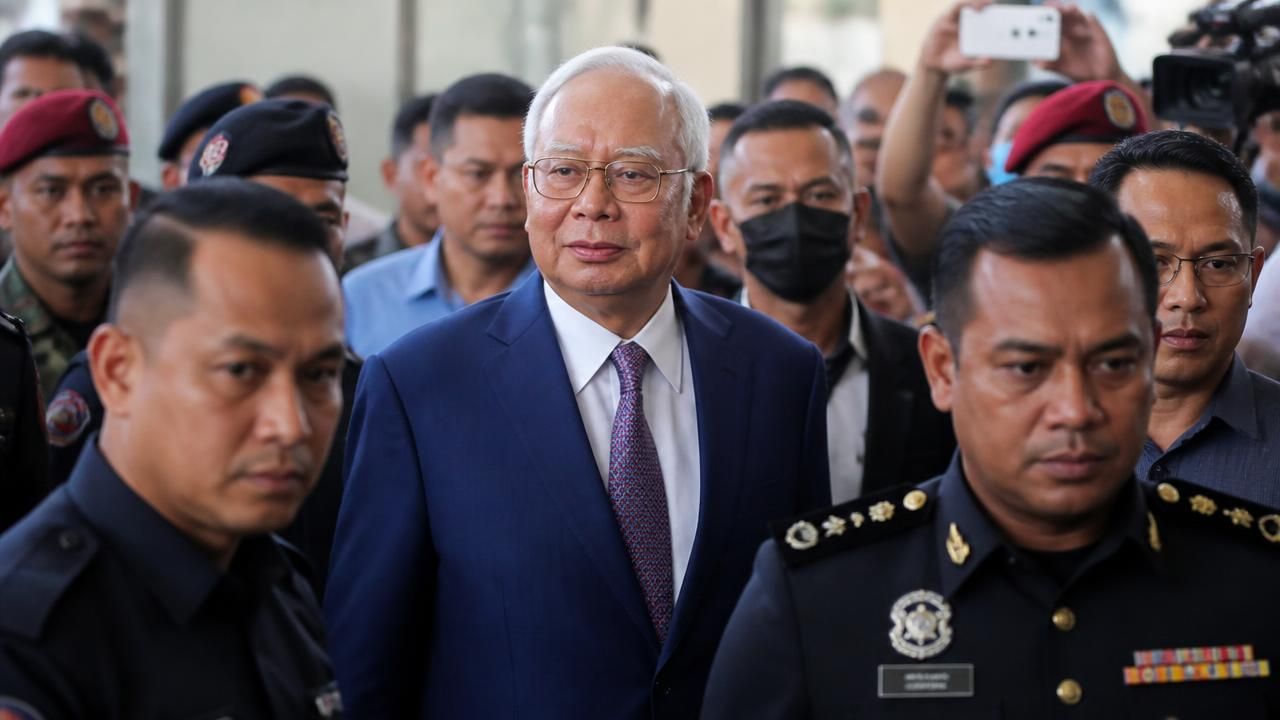
Najib arrived at the High Court complex to press the stay motion, according to local broadcasters and news portals, with supporters and a heavy security presence greeting him. A stay of execution would suspend the sentence and fine while the court considers the underlying application, effectively freezing the punishment rather than erasing it.
What Najib filed — and why it matters
At stake is the sentence handed down in last year’s 1MDB-linked conviction, in which the former premier was found guilty of abuse of power and money laundering and ordered to serve 15 years and pay a fine of RM11.38 billion. The stay application does not challenge that verdict on its merits; it asks the court to hold the sentence in abeyance so that a separate custodial arrangement — detention at home under electronic monitoring — can take effect.
- Jail term sought to be stayed: 15 years
- Fine sought to be stayed: RM11.38 billion
- Alternative sought: house arrest, following a conditional pardon granted last week
- Venue: High Court of Malaya, Kuala Lumpur
- Underlying case: the 1Malaysia Development Berhad (1MDB) state fund scandal
The legal mechanics are unusual, which is why Malaysian outlets have scrambled to explain them. Local coverage has framed the story around ten core questions: what a royal pardon can and cannot do, whether a conditional pardon can attach a mode of custody such as home detention, and what powers the Prisons Department holds to transfer an inmate out of a prison.
The pardon, the Prisons Act and the ‘Najib clause’
Under Article 42 of Malaysia’s Federal Constitution, the Yang di-Pertuan Agong exercises the pardon power on the advice of the Pardons Board for offences committed in the federal territories. Pardons can be free or conditional, and a condition may specify how the remainder of a sentence is served.
Najib had already received a partial commutation in 2024, when the Pardons Board halved his sentence in the separate SRC International case and sharply reduced its fine. The latest pardon, described as conditional, is the mechanism on which the house-arrest bid rests. The dispute over home detention first erupted after Najib claimed a royal “addendum” ordered that the rest of his term be served at home — a document the government at the time denied existed, and over which the courts have since gone back and forth on whether the matter is even justiciable.
Complicating matters, Parliament amended the Prisons Act in 2025 to permit certain prisoners to serve sentences at home under electronic monitoring, ostensibly to ease chronic overcrowding. The Malaysian Bar and rights groups condemned the change as a “Najib clause” — a bespoke legal gateway written for one man. The government has rejected that characterisation.
How the 1MDB scandal brought Najib here
Wire agencies have responded to the latest developments by resurfacing the scandal’s essentials. 1MDB was a sovereign wealth fund launched by Najib in 2009 to spur development. Instead, US investigators concluded that roughly US$4.5 billion was siphoned off through a chain of offshore entities, luxury real estate, artwork and a superyacht. The US Department of Justice called it “kleptocracy at its worst” as it pursued the largest single kleptocracy asset-recovery action in its history.
The fallout has been global: Goldman Sachs paid billions in settlements over its role in bond deals; fugitive financier Jho Low remains at large; and Najib’s wife, Rosmah Mansor, has been convicted in a separate corruption case. The Financial Times…
For Malaysia, the scandal became a defining political rupture. It helped power the opposition’s historic 2018 election win and turned Najib’s name into shorthand for impunity — a charge his defenders reject, arguing he was denied a fair process and blaming rogue subordinates.
Political fallout: a coalition at odds with itself
The loudest counterweight has come from Prime Minister Anwar Ibrahim’s own coalition. Pakatan Harapan said this week that corruption convicts must serve their sentences in full, a pointed statement given that Anwar’s unity government governs in partnership with Najib’s UMNO, long the most vocal advocate for his release.
“Any person convicted of corruption must serve the full sentence handed down by the courts.” — Pakatan Harapan’s stated position, as reported by The Edge
That tension is the story’s political core. Anwar came to power promising institutional reform, yet his coalition depends on a party whose grassroots see Najib as a martyr. Granting house arrest could shore up that alliance while shredding Anwar’s anti-corruption credentials — and vice versa. UMNO has publicly pressed for clemency, while civil society groups warn that home detention for a man convicted of looting a state fund would confirm the existence of a two-tier justice system.
How the outlets framed it
Each newsroom cut the story differently. Bloomberg led on the financial-legal manoeuvre: a jail term on hold. Malaysian portals leaned into the mechanics, publishing explainers on pardon law, prison powers and what happens next. The Edge, carried by Yahoo, foregrounded the political constraint — a governing coalition publicly insisting that graft convicts serve full terms. Reuters, meanwhile, reset the frame entirely, using the news peg to re-publish its primer on the scandal itself, an implicit acknowledgement that global audiences need the 1MDB backstory before they can grasp the house-arrest fight.
What happens next
The High Court must first decide whether to grant the stay. If it does, Najib’s immediate incarceration is suspended and the house-arrest arrangement can proceed; if it refuses, his legal team is expected to appeal, escalating the matter toward the appellate courts. The Pardons Board’s reasoning and the precise terms of the pardon — still only partially disclosed — will likely be scrutinised in any subsequent hearing.
Beyond the courtroom, the stakes are economic and reputational. Malaysia has spent a decade repairing the damage 1MDB did to the ringgit, to Bursa Malaysia and to the country’s standing with foreign investors. A perceived soft landing for Najib would test all three — and would answer, perhaps definitively, the question Malaysians have asked since 2015: in this country, does anyone truly pay for the crime?