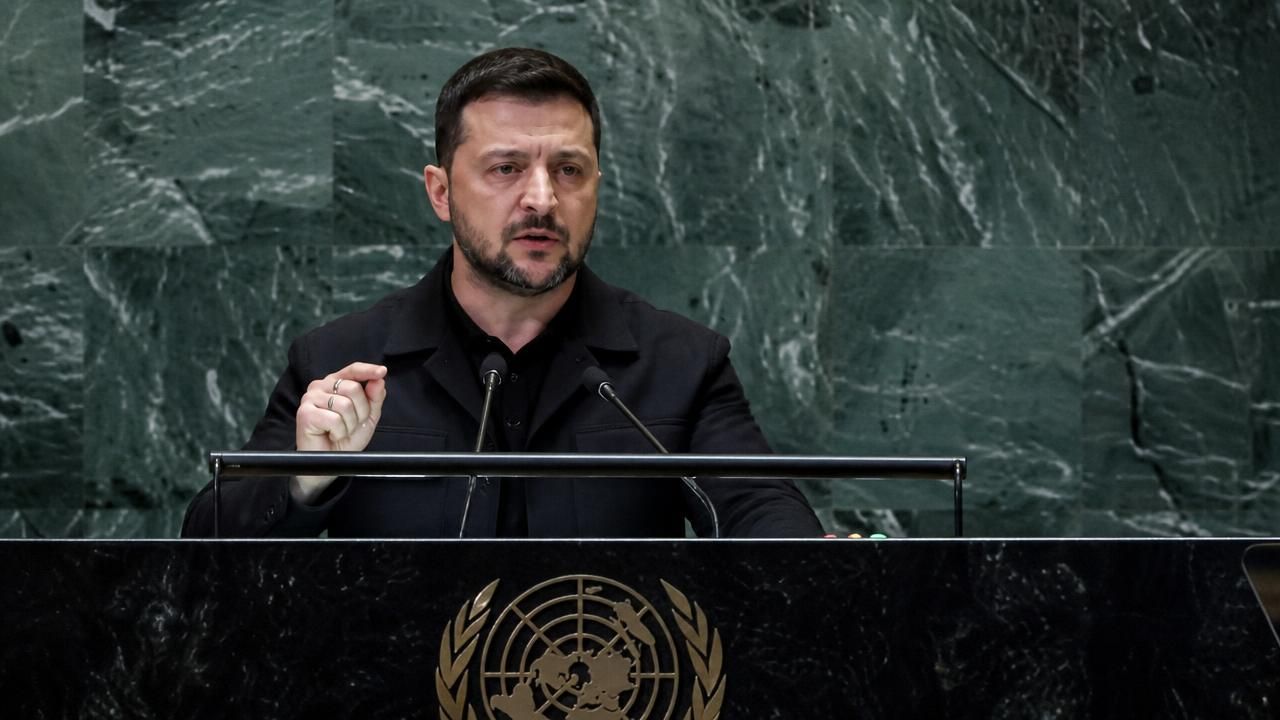
UNITED NATIONS — President Volodymyr Zelensky used his address to the United Nations on Wednesday to argue that Russia's war in Ukraine is no longer a regional conflict but a global one, pointing to soaring fuel prices, increasingly lethal drone technology and electronic interference that has made commercial aircraft effectively invisible to radar over parts of Russian airspace.
Zelensky told delegates that the costs of the war have "long since spilled beyond Ukraine's borders," and urged world leaders to act before winter deepens the crisis for both Ukrainian civilians and the broader global economy.
A Warning Aimed at Airlines — and Everyone Else
Among the most striking elements of the address was a direct caution to international carriers. According to reports flagged by MSN, Zelensky warned airlines about operating in or near Russian airspace, citing GPS jamming that renders airliners invisible to radar and raises the risk of catastrophic miscalculation. The same platform carried his broader warning that drones "will fill the skies" — a reference to the rapid proliferation of unmanned systems that have come to define the battlefield.
The interference problem is not new. Since at least 2022, aviation authorities and pilots' associations have documented persistent spoofing and jamming of satellite navigation signals near Kaliningrad, the Black Sea and northern Russia. In several incidents, aircraft have reported false position data on primary instruments, forcing crews to fall back on older navigation methods. Zelensky's framing elevates what has largely been a technical safety issue for aviation regulators into a matter of international security.
Economic Spillover: Fuel, Freight and the Coming Winter
Zelensky's economic argument rested on the war's reach into ordinary household budgets far from the front lines. Rising fuel prices, he said, are a direct consequence of attacks on energy infrastructure, sanctions, insurance costs and the rerouting of global shipping and refining capacity. With winter approaching, he warned that the combination of energy scarcity and continued strikes on Ukrainian power generation could produce a humanitarian emergency that reverberates through European markets.
"We must find steps to end this war before winter," he said, according to the account carried by The New York Times. The appeal was notable for its timing and its audience: rather than a purely military appeal for weapons, it was an argument aimed at governments whose publics are weary of war-related inflation and volatility.
How Different Outlets Framed the Same Speech
The story's presentation varied sharply by platform, a reflection of how the same set of remarks can be packaged for different audiences.
- The New York Times led with the geopolitics, describing the speech as a warning about the "growing global cost" of the war and highlighting Zelensky's call to end the fighting before winter.
- MSN's aggregator headlines led instead with the aviation angle, emphasizing GPS jamming, airliners rendered "invisible to radar" and a direct warning to airlines — a framing that turns a security speech into a travel-safety story.
- Other syndicated versions foregrounded the drone warning, casting Zelensky as the prophet of a future in which unmanned aircraft saturate civilian and military airspace alike.
The divergence is instructive. In Kyiv and Western capitals, the speech is read as a pressure campaign on wavering allies. In aviation and industry circles, it is read as a safety bulletin. In markets, it is read as a signal about energy risk heading into the winter heating season.
Drones and the Changing Character of War
Zelensky's emphasis on drones reflects a battlefield reality: cheap, mass-produced unmanned systems have become the primary instrument of attrition on both sides, and their export and proliferation are accelerating. Experts have warned for years that the technology that makes a $500 drone lethal on a battlefield can just as easily be flown into civil airspace, where defenses are designed for a different threat.
That convergence — military drone technology meeting civilian aviation — is precisely the scenario Zelensky described. It also complicates the work of regulators, who are already struggling to integrate commercial drone traffic into airspace designed for crewed aircraft.
What Comes Next
Zelensky's address is unlikely by itself to change the trajectory of the war or the calculations of allied governments. But it sets the terms for the diplomatic season ahead: renewed debate over sanctions enforcement, airspace closures, air-defense transfers and winter energy assistance.
For airlines, the practical question is whether warnings about Russian airspace translate into formal advisories or closures. For Ukraine's allies, the question is whether the economic argument — higher fuel prices, freight disruption and a winter of energy uncertainty — carries more political weight than the moral one. Zelensky, in effect, made both at once, and left it to his audience to decide which they can afford to ignore.