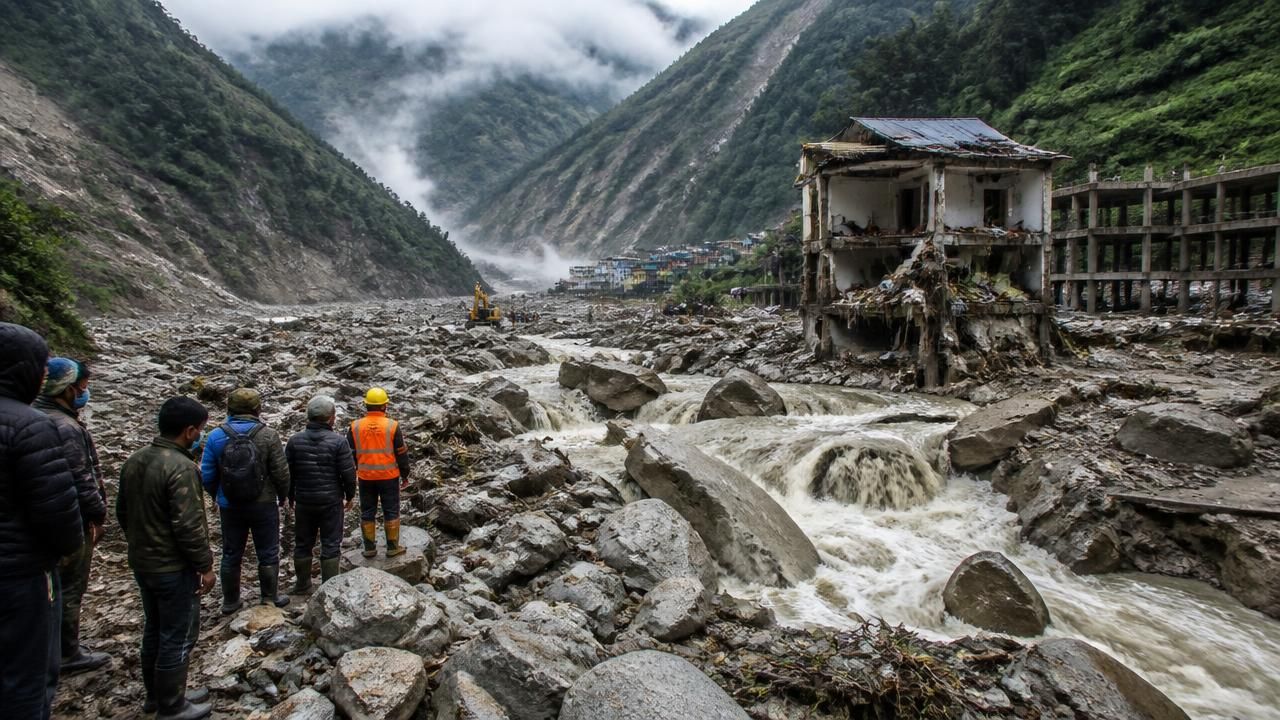
KATHMANDU — The water came without a warning. A glacier high in the Nepal Himalaya collapsed, releasing a torrent of meltwater, rock and debris that tore down mountain valleys, swept away bridges and settlements, and left a trail of destruction that officials now estimate could exceed $5 billion in damage. Survivors described the onslaught in terms that captured the sheer scale of the event: “It felt like a tsunami from the Himalayas.”
The disaster, which struck communities along the Nepal–Tibet border region, has triggered a rare convergence of concern among scientists, engineers, humanitarian organisations and financial institutions. What happened in Nepal is not simply a national tragedy, they argue — it is a warning shot fired from the fastest-warming mountain range on Earth.
A wall of water from the mountains
According to researchers quoted in Nature, the flood was triggered by a glacier collapse — a phenomenon distinct from, but closely related to, the glacial lake outburst floods (GLOFs) that have long been identified as a hazard across the High Mountains of Asia. As glaciers retreat under rising temperatures, they leave behind unstable moraine dams and fragile ice masses that can give way with little or no precursor.
Downstream, the physics of a Himalayan valley amplifies the danger. Steep gradients, narrow gorges and loose sediment turn a burst of water into a fast-moving debris flow that can gain volume and destructive power as it descends. Communities that sit on alluvial fans and riverbanks — attractive ground for farming and tourism — are frequently the first and worst hit.
Towns erased, grief mounting
The New York Times reported that along the path of the flood, whole towns were wiped out, leaving survivors to sift through mud and rubble for the missing. The newspaper’s framing emphasised intimate loss over macro statistics: mounting grief, displaced families, and the long, slow work of recovery in places that were already remote and poorly connected.
Nepal’s government has acknowledged the scale of the emergency and appealed for international assistance, signalling that the country cannot shoulder the reconstruction burden alone. Officials said damage is likely to run into the billions of dollars, with roads, hydropower infrastructure, water systems and farmland all affected.
Hydropower’s promise — and its perils
At the centre of the policy debate is Nepal’s hydropower boom. The country’s steep rivers and glacial-fed watersheds offer enormous potential for generating clean electricity, both for domestic use and for export to India and Bangladesh. But NPR reported that in the wake of the disaster, experts are asking hard questions about the risks of building dams and power plants in terrain that is becoming demonstrably less stable.
The concerns are threefold:
- Location risk: Many projects sit directly in the path of potential GLOFs or landslide-generated surges.
- Cascading failure: A single dam breach can release stored water downstream, multiplying the impact of an initial flood.
- Regulatory gaps: Environmental and safety assessments have struggled to keep pace with the speed of construction and the accelerating effects of climate change.
The same tension applies to tourism. CNBC reported that Nepal’s mountain tourism industry faces a “serious warning” after the flood, with trekking and expedition operators worried that repeated disasters could erode the confidence of the international visitors on whom thousands of livelihoods depend.
The warning gap
Perhaps the most uncomfortable question is the one posed by Al Jazeera: when the Himalayas collapse, who gets warned? In this case, many communities received no meaningful advance notice.
Scientists have long argued that technology could narrow that gap. NBC News reported that years before the Nepal floods, researchers had pitched a novel early-warning system built on seismic signals — using the ground vibrations generated by a fast-moving mass of water and debris to detect an event in progress and push alerts downstream within minutes. Phys.org highlighted complementary work on measuring snowpack and glacier mass in the Himalayas, which could improve forecasts of how much water is stored and how quickly it may be released.
The obstacles are as much political and institutional as technical. Warning systems require sensors, maintenance, data-sharing agreements with neighbouring countries, and — crucially — last-mile communication to villages that may lack reliable mobile coverage or electricity.
Echoes of Kedarnath
For many across the region, the images evoked painful memories. MSN reported that the Nepal floods revived devastating recollections of the 2013 Uttarakhand disaster in India, when torrential rains and a glacial outburst around Kedarnath killed thousands of pilgrims and residents. That catastrophe prompted calls for a safer Himalaya — calls that were, in the words of one commentary, largely unheeded.
The medical journal The Lancet framed the Nepal disaster in explicitly humanitarian terms, issuing “a call to humanity” — a reminder that the health consequences of such events extend well beyond the immediate death toll, encompassing trauma, disease outbreaks, disrupted maternal care and the collapse of basic services.
What comes next
The scientific consensus, articulated bluntly in Nature’s coverage, is that this is likely “a sign of things to come.” As the cryosphere retreats, the frequency and unpredictability of high-mountain hazards are expected to increase across Nepal, India, Pakistan, Bhutan and China.
That leaves governments with an uncomfortable set of choices. They can continue to develop hydropower and tourism — both essential to regional economies — while investing far more heavily in risk assessment, land-use planning, monitoring networks and cross-border cooperation. Or they can accept that each new valley development is a gamble against a climate that is rewriting the rules.
For the families now digging through the debris of towns that no longer exist, the debate is already settled. The Himalayas are changing, and the warning has been delivered.