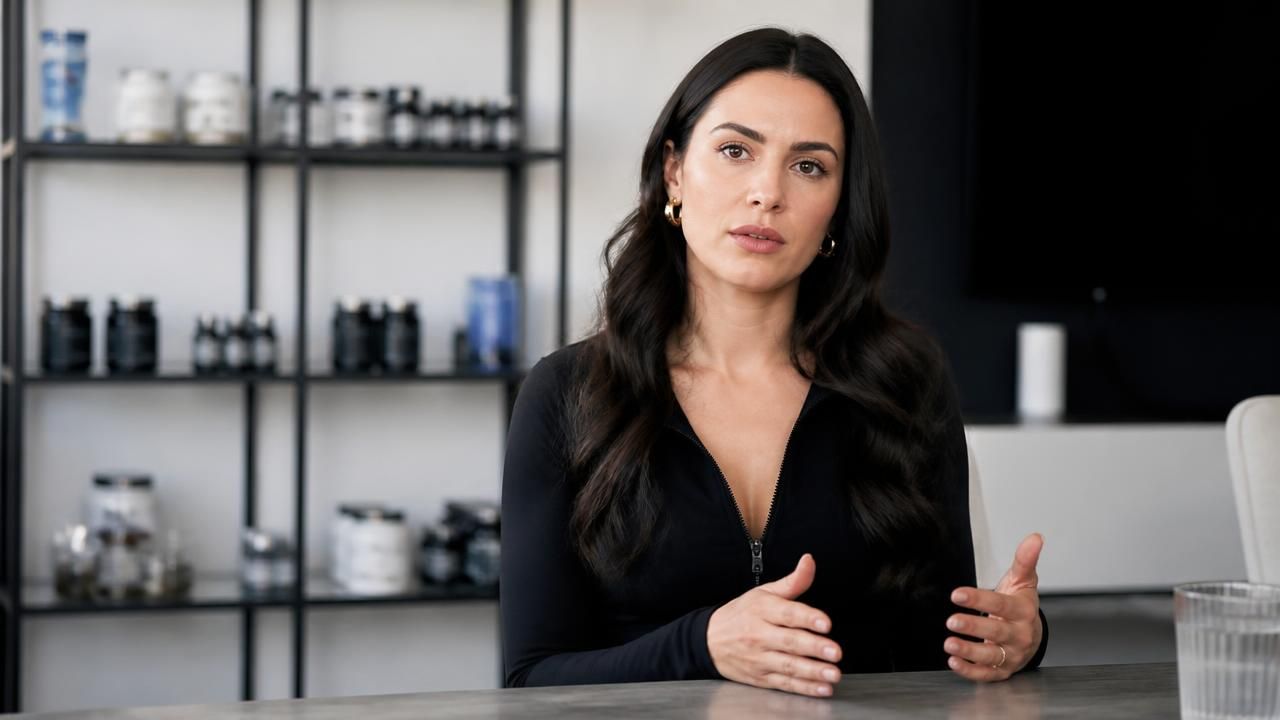
Kate Tolo has a job title most people have never heard of and a daily routine most would never survive. As the partner of Bryan Johnson — the millionaire tech founder who has spent years turning his own body into a laboratory — Tolo has become the public face of a parallel experiment: a longevity protocol built not around the male body, but around what she calls "half the population."
Australian by birth, Tolo serves as chief marketing officer of Blueprint, the company that packages Johnson's famously exhaustive health regimen into supplements, powders and protocols sold to consumers. But according to Wired, her role has moved well beyond branding. Tolo has subjected herself to a battery of tests and interventions that mirror — and in some cases exceed — those of her partner, from nocturnal monitoring of erections to deliberately exposing herself to extreme heat during her period.
Who are Bryan Johnson and Kate Tolo?
Johnson made his fortune founding Braintree, the payment processor PayPal acquired for roughly $800 million in 2013. He later poured a reported $2 million a year into Project Blueprint, a regimen of restricted eating, dozens of supplements, relentless bloodwork, full-body imaging and sleep optimization designed to slow — and, he hopes, one day reverse — aging. He has called himself "the most measured human in history" and launched a movement under the slogan "Don't Die."
Tolo has been positioned as the female counterpart to that experiment, a title she has embraced with a pointed caveat. Asked about the "female Bryan Johnson" label, the framing she and her partner have pushed is that her work is, in her words, "for women" — an attempt to correct a research landscape that has historically treated the male body as the default.
"For women" — Kate Tolo's stated rationale for building a protocol of her own rather than simply inheriting her partner's.
The regimen — and the reporting around it
Coverage of the couple's lifestyle has varied sharply by outlet. Wired, a technology and science publication, zeroed in on the methodology: Tolo's routine is framed as a data-gathering mission, an attempt to generate measurements for a demographic that biomedical research has long under-served. The specifics are striking. Nighttime monitoring of erections, a standard proxy for vascular and hormonal function in male patients, has been part of the household's measurement culture; for Tolo, the more relevant intervention is deliberate heat exposure timed to her menstrual cycle, a protocol she has described as testing how thermal stress interacts with female physiology.
Australian coverage from the ABC has emphasized a different thread: the couple's response to skeptics. The public broadcaster's reporting framed their project as a "quest for immortality" conducted under relentless mockery, with both Johnson and his Australian partner pushing back at critics who dismiss the enterprise as expensive performance art.
Meanwhile, aggregator and tabloid-driven coverage — through Yahoo and MSN — has treated the couple as a celebrity curiosity, with headlines promising "all the astonishing things" Tolo has done and reporting that she felt "relieved" after a health diagnosis involving Johnson. That diagnosis, the details of which have circulated in varying forms across outlets, was framed in that coverage as vindication of the couple's obsessive testing: a condition caught early precisely because they measure everything.
Why the story matters
Strip away the spectacle and the underlying issue is a serious one. For decades, clinical research excluded women of childbearing age from trials — a policy the U.S. National Institutes of Health only formally reversed in 1993. The legacy persists: women remain underrepresented in many drug trials, dosing is frequently extrapolated from male data, and conditions that disproportionately affect women, from endometriosis to autoimmune disease, remain chronically underfunded.
That gap is the strongest argument in Tolo's favor, and it is the one her defenders lean on. If the world's most over-instrumented household produces usable data on female cycles, thermoregulation and hormonal variation, the reasoning goes, the experiment has value beyond marketing.
The skeptics' case
Not everyone is convinced. Biochemists and gerontologists have repeatedly challenged Johnson's claims, noting that no intervention has been shown to reverse human aging, that many of his biomarkers fluctuate naturally, and that a sample size of two proves nothing. Critics also point to the economics: Blueprint sells products, and every round of publicity — a girlfriend's regimen, a health scare, a hostile headline — is also a marketing event. Charles Brenner, a biochemist at the University of Iowa, has been among the most persistent voices arguing that Johnson's public claims outrun the evidence.
There is also a cultural critique. Biohacking has long been a pursuit of the wealthy and the male, and the notion that a woman's path to optimization runs through her partner's infrastructure invites obvious questions about who sets the agenda.
A different kind of legacy
What makes the Tolo story more than tabloid fodder is the possibility that it shifts the frame. Longevity research has a sex-difference problem, and femtech — a market projected to grow into the tens of billions — is still chasing credible science. Whether Tolo's data ever appears in a peer-reviewed journal, or remains confined to newsletters and product pages, will determine whether she is a genuine research subject or a very well-measured brand ambassador.
For now, the couple's answer to critics is the same as it has always been: keep measuring, publish the results, and let the numbers argue. The rest of us — half of us, anyway — are watching to see whether the numbers ever do.