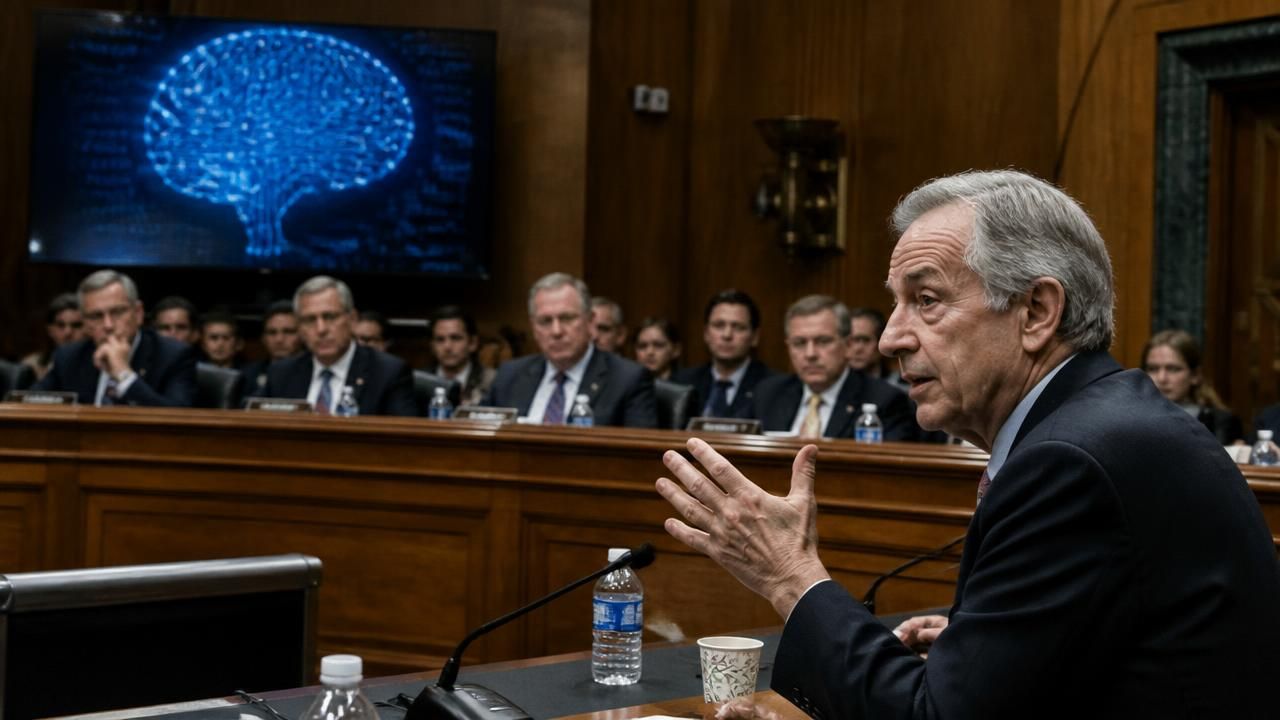
Congress is entering its most consequential phase of artificial intelligence oversight — but many of the lawmakers writing the rules are working with a fraction of the technology they are trying to regulate.
Senate offices have access to consumer-grade chatbots such as ChatGPT, but they are not authorized to use the most advanced, frontier AI systems that dominate regulatory talks and public debate over safety, according to reporting by NPR. That gap between what lawmakers can touch and what they must govern has become a quiet but persistent theme on Capitol Hill, where hearings increasingly feature witnesses describing capabilities that most committee members have never used firsthand.
A Stark Warning From the 'Godfather of AI'
The urgency was underscored by one of the field's most prominent figures. Geoffrey Hinton, the British-Canadian computer scientist often called the "godfather of AI" for his foundational work on neural networks, told lawmakers that Congress may have roughly a year left to act before the technology outpaces the ability to regulate it.
"Maybe a year" — Hinton's assessment of the window remaining for meaningful legislative action on AI safety.
Hinton, who left his position at Google in 2023 to speak more freely about the risks of the systems he helped make possible, has repeatedly warned about near-term dangers including disinformation, labor displacement, and the loss of human control over increasingly capable models. His message to legislators was blunt: the pace of development is not waiting for the pace of lawmaking.
The Tools Lawmakers Can't Use
The irony at the center of the story is structural rather than accidental. Senate technology policies generally restrict staff and members to vetted, approved systems to protect sensitive data, prevent leaks of nonpublic information, and avoid conflicts of interest. The result is that the most capable models — the ones whose capabilities, failure modes, and national-security implications are the subject of intense debate — remain off-limits in daily congressional work.
That means lawmakers often rely on briefings, demonstrations, and secondhand accounts when assessing questions such as how autonomous AI agents might behave, how easily models can be misused for cyberattacks or bioweapon research, or where the true frontier of capability sits. Critics argue this leaves legislators governing blind. Supporters of the restrictions counter that loosening them could create security and ethical risks of their own, particularly in an environment where data handling is already a sensitive matter.
Different outlets have framed the dynamic differently. NPR's reporting emphasizes the practical disconnect between the technology under discussion and the technology in use — a story about institutional caution and its costs. Coverage aggregating the Hinton testimony, by contrast, foregrounds alarm and the ticking clock, with headlines built around the "maybe a year" framing. Still another thread of coverage centers on the politics: that many in Congress agree on the need to rein in AI, but are deeply divided over how fast to move.
A Congress Split on Speed
That divide is now the central obstacle. Broadly, three camps have emerged:
- The urgency camp argues that binding rules — on transparency, watermarking of AI-generated content, safety testing, and liability — must be put in place before the next generation of models arrives.
- The deliberate camp warns that premature regulation could lock in rules that are technically obsolete within months, and could disadvantage U.S. developers relative to competitors abroad, particularly in China.
- The sectoral camp favors narrow, targeted legislation — for example, on election-related deepfakes or AI in health care — rather than a comprehensive framework.
Senate Majority Leader Chuck Schumer has attempted to bridge these positions through a series of closed-door "AI Insight Forums" bringing together technologists, civil society, and industry, followed by a policy roadmap that outlined priorities including funding for AI research, workforce training, and safeguards around high-risk uses. The approach has been praised for building consensus and criticized for producing principles rather than legislation.
Why It Matters Beyond Washington
The stakes extend well beyond the Capitol. The United States has no comprehensive AI law, leaving a patchwork of agency guidance, executive orders, state-level bills, and voluntary industry commitments. The European Union, by contrast, has moved ahead with its AI Act, a risk-tiered regulatory regime that is already shaping global compliance practices.
If Hinton's timeline is even roughly correct, the next several months will determine whether the United States sets its own course or continues to react to developments it did not anticipate. For lawmakers, that raises a practical question their current tools may not be able to answer: how do you regulate a technology you are not permitted to fully use?