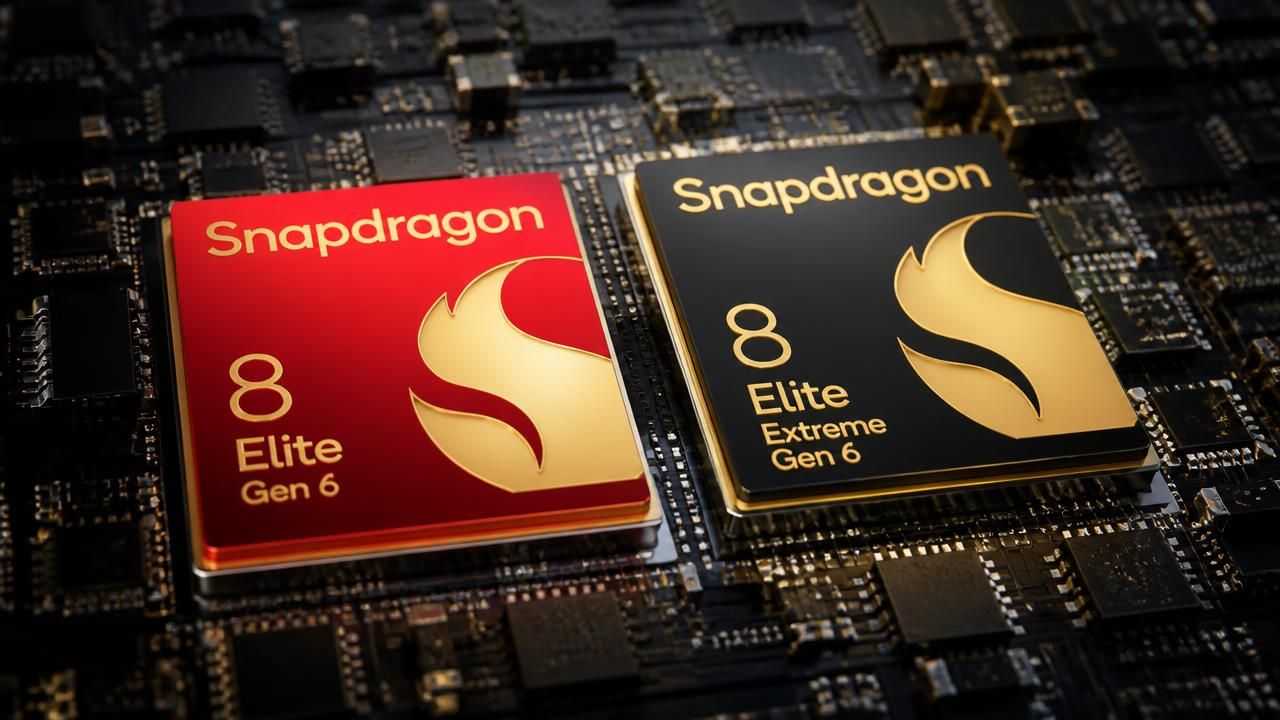
Qualcomm has taken the wraps off its next generation of flagship mobile silicon, announcing the Snapdragon 8 Elite Gen 6 — and, for the first time, a second, more powerful tier called the Snapdragon 8 Elite Extreme Gen 6. Both chips are built on a 2nm manufacturing process, marking the company's most advanced node yet for smartphones, and both are being positioned by Qualcomm as flagship-grade parts destined for the premium Android phones of 2026 and beyond.
The launch signals a shift in Qualcomm's product strategy. Where previous generations arrived as a single headline chip with regional or clock-speed variants, Gen 6 arrives as a family — one standard flagship, one "Extreme" halo part — a bifurcation that promises more performance headroom at the top while simultaneously complicating the story for consumers.
Two Chips, One Foundation
According to The Verge, the two Gen 6 parts share the overwhelming majority of their specifications. Their modems, display pipelines, security features, GPS capabilities, and memory and storage support are identical. Qualcomm has also stopped publishing detailed core-by-core breakdowns of its silicon, but the CPU configuration disclosed for both chips is the same: two prime cores clocked at up to 5GHz, paired with six performance cores.
"The spec differences are relatively minor, mostly limited to improved AI processing, video capture, and gaming performance on the Extreme model." — The Verge
That 5GHz figure is the headline number. It is an extraordinarily high clock for a smartphone CPU, and it is where the Extreme tier and the standard tier are likely to diverge most in real-world behavior, even if the paper specifications look identical.
The Video Capture Breakthrough
Perhaps the most concrete, user-visible upgrade comes on the imaging side. PetaPixel reports that the Snapdragon 8 Elite Extreme Gen 6 finally brings 8K video capture at 60 frames per second to smartphones — a first for the platform and a meaningful jump over the 8K/30 ceiling that has constrained Android flagship cinematography. For creators who shoot on phones, that doubling of frame rate translates directly into smoother motion, more flexible slow-motion grading, and better stabilization headroom.
Qualcomm is also leaning heavily on AI processing as a differentiator for the Extreme part. On-device generative models, real-time computational photography, and AI-assisted gaming upscaling are all areas where the company claims the Extreme model pulls ahead — a framing that reflects how much of the modern smartphone experience is now defined by neural processing rather than raw CPU throughput.
Performance Reality Check
Early benchmark leaks, however, suggest the 5GHz peak may be more of a burst figure than a sustained one. Notebookcheck reported that the Snapdragon 8 Elite Extreme Gen 6 hit 5GHz in an early Geekbench run but could not sustain it — a familiar pattern in mobile silicon, where thermal constraints and battery budgets inevitably claw back peak clocks within seconds.
The gap between peak and sustained performance is where the smartphone experience actually lives. Whether Qualcomm's 2nm node and revised power management can hold higher clocks for longer will be the real test — and one that only shipping devices will answer.
A Naming Problem
If the technology is impressive, the branding is anything but tidy. Android Headlines bluntly noted that "Snapdragon 8 Elite Extreme Gen 6 is real, and that's going to be a mouthful on Galaxy S27," capturing the widespread frustration among tech watchers at Qualcomm's ever-lengthening product names.
Making matters murkier, multiple outlets — including Gizmochina and Geeky-Gadgets — have referred to an "Snapdragon 8 Elite Gen 6 Pro" in coverage of Samsung's next ultra-flagship. It remains unclear whether "Pro" and "Extreme" describe the same silicon under different regional marketing, or two distinct SKUs. Qualcomm has not offered a definitive clarification, and the ambiguity has fed a steady stream of conflicting leaks.
The confusion echoes the previous generation, where Qualcomm reportedly prepared a cheaper "V series" variant of the Snapdragon 8 Elite Gen 5 aimed at budget flagships — a move Notebookcheck described as a potential lifeline for sub-premium devices. That strategy appears to be maturing into a full product ladder: Extreme at the top, standard in the middle, and lower-tier variants feeding more affordable phones.
The Galaxy S27 Question
Much of the early coverage has focused on Samsung. PhoneArena reported that the Galaxy S27 Ultra's processor "may break new performance grounds," while Geeky-Gadgets asked directly whether the Snapdragon 8 Elite Gen 6 Pro is confirmed for the device. Samsung has historically used Qualcomm's top-tier Snapdragon in its Ultra line, sometimes alongside its own Exynos silicon in other regions — a split that has become a perennial source of consumer frustration.
If Samsung adopts the Extreme or Pro tier for the S27 Ultra, it would give the device a genuine performance story to tell. Deccan Herald framed the broader launch simply: Qualcomm's upcoming Snapdragon chip is set to be "the fastest in its class."
Competitive Pressure Builds
Qualcomm's timing is not accidental. Digital Trends reported that MediaTek's next flagship chip "already has a Snapdragon problem," underlining how aggressively the Taiwanese rival has been closing the gap in recent generations. MediaTek's Dimensity line has won design sockets in high-volume Android devices by pairing competitive performance with lower costs — a threat that Qualcomm's tiered strategy is clearly designed to counter.
Apple, meanwhile, continues to set the benchmark for sustained mobile performance with its own silicon, and Qualcomm's emphasis on AI and video capture reads as an attempt to compete on features rather than pure benchmarks.
What It Means for Buyers
- More tiering, more confusion: Expect flagship phones to advertise "Extreme" or "Pro" silicon that may or may not be meaningfully different in daily use.
- Video creators win: 8K/60 capture is a genuine, tangible upgrade on the Extreme tier.
- Thermals remain the wild card: 5GHz means little if it throttles within seconds — early leaks suggest exactly that.
- Budget flagships benefit: The expanding Gen 5 and Gen 6 variant families should push capable silicon into cheaper phones.
For now, Qualcomm has set the stage: a 2nm dual-flagship lineup with an unprecedented clock ceiling and the first smartphone-class 8K/60 video pipeline. Whether that translates into a noticeably better phone — or simply a longer spec sheet — will be decided when the Galaxy S27 and its rivals reach shelves.