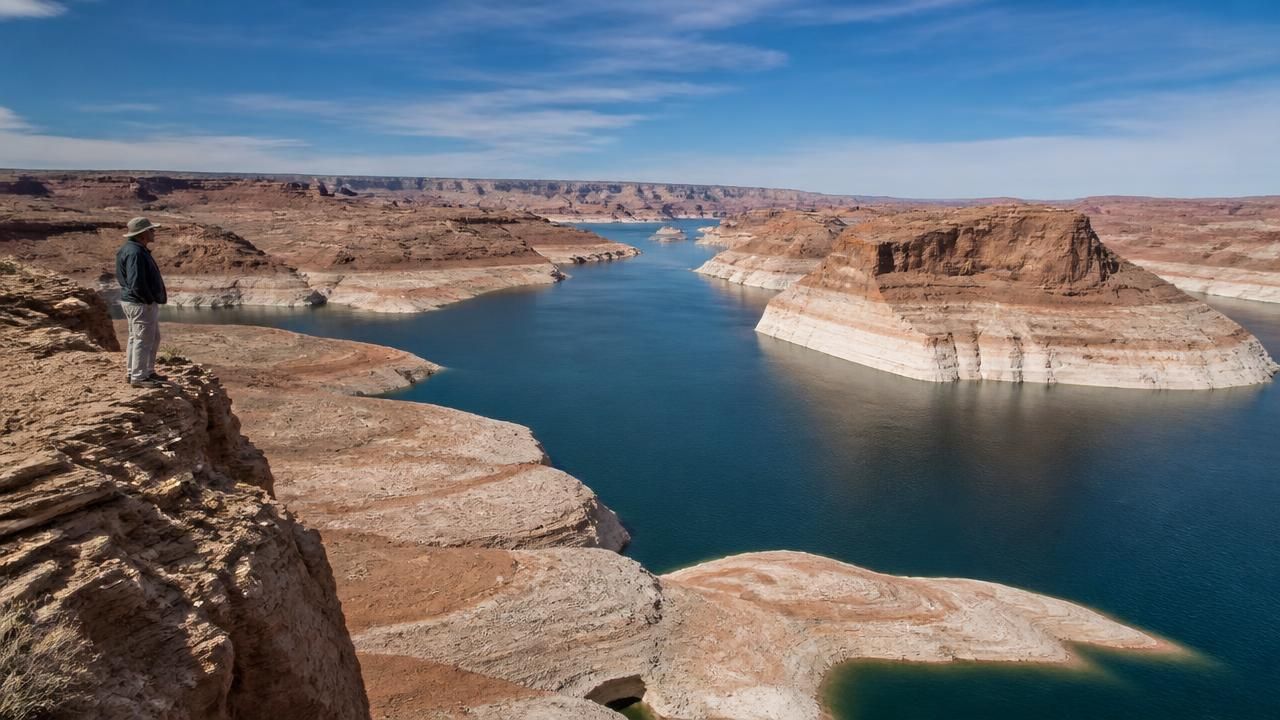
Lake Powell, the second-largest reservoir in the United States, has fallen to its lowest level on record, federal measurements show, capping an exceptionally dry and warm winter that left the Colorado River Basin with almost no mountain snowpack to melt. Lake Mead, the nation's largest reservoir, has also sunk to a record low — the first time both pillars of the Southwest's water supply have bottomed out together.
Together the two reservoirs anchor a river system that delivers water and hydroelectric power to more than 40 million people across seven U.S. states and Mexico, and irrigates millions of acres of farmland. Their simultaneous decline has pushed water managers into what one broadcaster described as entirely unfamiliar terrain.
“Uncharted territory.” — CNN's framing of the moment, as the reservoir plunged to its lowest reading since Glen Canyon Dam was completed in the 1960s.
A Basin Running on Empty
The immediate cause is meteorological. A winter that ran warm and dry across the Rocky Mountains delivered meager snowpack to the upper basin, starving the Colorado River of the spring and summer runoff that typically refills Powell and Mead. But the deeper driver is a drought that has now persisted for more than two decades — the driest stretch in the region in at least 1,200 years, according to paleoclimate reconstructions — compounded by rising temperatures that dry out soils and reduce the amount of snowmelt that ever reaches the river.
Demand has not fallen in step. The Colorado River Compact of 1922 divided the river's flows among the states during one of the wettest periods on record, allocating more water than the river now reliably carries. The result, scientists say, is a structural deficit that no single wet winter can close.
- Supply: Two decades of below-average flows have cut the river's yield substantially below its 20th-century average.
- Demand: Growing cities from Denver to Phoenix to San Diego, plus a vast agricultural sector, draw on the same shrinking supply.
- Storage: Lake Mead and Lake Powell together hold only a fraction of the water they held at the turn of the century.
Emergency Steps in Washington
Federal officials have taken extraordinary measures to stabilize Lake Powell. The Bureau of Reclamation has held back hundreds of thousands of acre-feet of water in the reservoir rather than releasing it downstream, sent additional flows into Powell from Flaming Gorge Reservoir upstream, and reduced the annual volume of water released through Glen Canyon Dam to the lower basin.
The moves are intended to keep Powell from falling below the elevation at which Glen Canyon Dam can no longer generate electricity — a threshold that officials have warned could arrive within a few years if conditions persist. They also defer, rather than resolve, the shortfall: water that stays in Powell is water that does not reach Lake Mead, Arizona, Nevada or California.
Power, Food and 40 Million People
Glen Canyon Dam's hydropower plant supplies electricity to utilities across the West, and its output is already diminished as the reservoir drops. Hydropower is among the cheapest and most flexible sources on the grid, and its loss would force utilities to buy replacement power at higher cost and, in many cases, higher emissions.
Beyond electricity, the stakes include drinking water for Phoenix, Las Vegas, Los Angeles and San Diego, and irrigation for winter vegetables and feed crops that supply much of the nation. Mexico's Colorado River delta communities also depend on the river under a 1944 treaty.
Las Vegas, which draws the vast majority of its water from Lake Mead, has invested heavily in conservation and recycling, but regional officials acknowledge that efficiency alone cannot outrun the hydrology.
How Different Outlets Told the Story
The coverage reflects the breadth of the consequences. Science-focused outlets emphasized the climatology — the warm, dry winter and the shrinking snowpack signal. National broadcasters and wire services led with the record itself and the phrase “unprecedented,” while CNN leaned into the sense of a system past its design limits.
Regional and public-radio outlets framed the news through the lens of drought and demand, arguing that the crisis is as much about how water is allocated and consumed as about how little rain fell. Western papers, including the Las Vegas Review-Journal, foregrounded the threat to water and electricity for millions of residents in the fastest-growing metropolitan areas in the country. International and diaspora-focused outlets, such as India West, widened the aperture to the national risk to water supplies, underscoring how a regional drought has become a national story.
What Comes Next
Attention now turns to negotiations among the seven basin states over steep, voluntary cutbacks, and to the federal government's reexamination of the operating rules that govern the two reservoirs. Scientists and water managers broadly agree on the trajectory: warmer temperatures mean less water, regardless of whether any given year is wet or dry.
What remains contested is who gives up how much, and how quickly. The record lows at Powell and Mead have made that question urgent rather than theoretical — a milestone, as one researcher put it, that the system was never designed to reach.