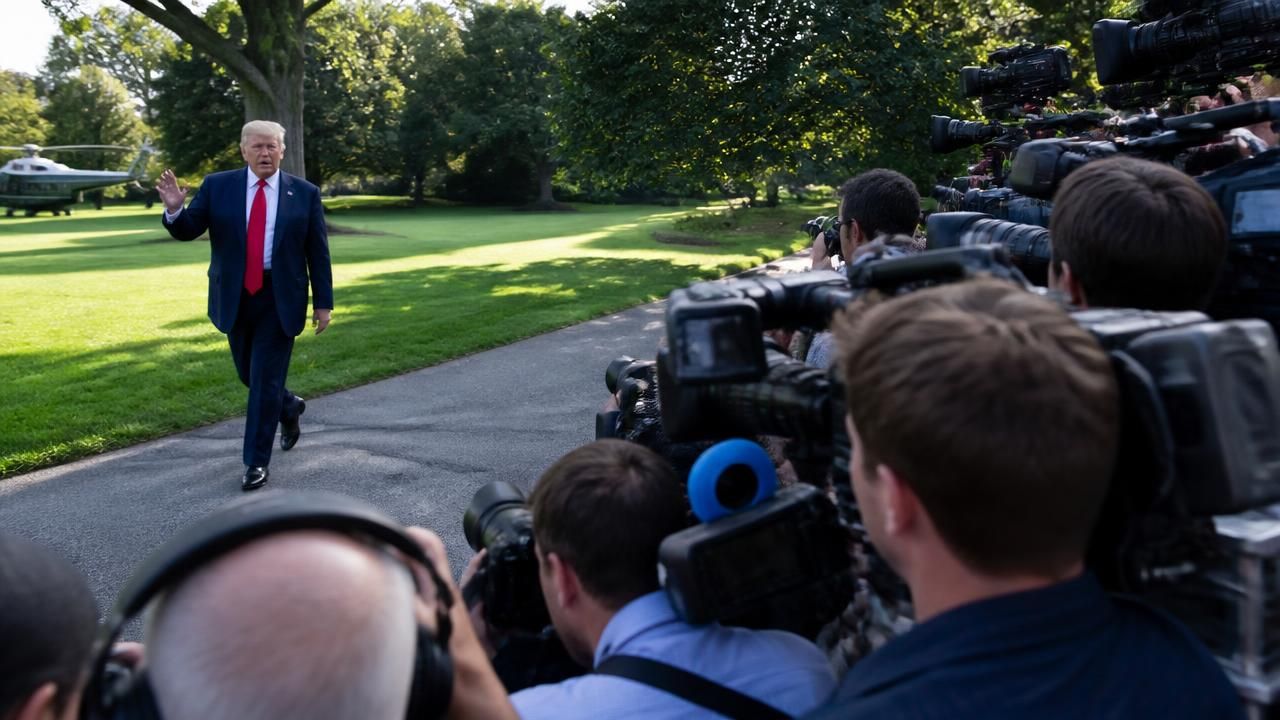
Major television networks that belong to the White House press pool have stopped covering President Trump's public events in protest after his administration barred three news organizations from attending them, according to reporting by The New York Times. The standoff, which the Times framed as an escalation in a long-running conflict between the president and the national press corps, now appears headed for the courts.
According to the Times, the president ordered the three outlets excluded from White House events because he objected to their coverage. The network members of the pool — the rotating group of broadcast and print journalists who travel with the president, occupy workspace in the West Wing and share their material with the wider press corps — responded collectively rather than individually, declaring that they would not cover Trump's public appearances while the ban remains in effect.
As the Times' chief White House correspondent, Peter Baker, describes it: the president banned three news outlets over coverage he disliked, and the major television networks in the White House press pool answered by refusing to cover his public events while the matter works its way through the courts.
A Collective Response, Not a Solo Protest
The significance of the decision lies in its collective nature. The White House press pool exists precisely so that a small group of reporters can represent the entire press corps, sharing pools of video, audio and quotations with outlets that cannot be in the room. When the largest broadcasters in that pool withdraw, the practical effect is not merely that three banned outlets lose access — it is that the president's public events lose their principal conduit to the American television audience.
That is a materially different tactic from the denunciations, op-eds and legal threats that typically follow a dispute over credentials. A pool boycott converts a fight over individual newsrooms into a dispute over whether the presidency can be covered on television at all, and it forces outlets that might otherwise stay quiet to choose a side.
Historical Background
Clashes between presidents and the press are as old as the briefing room. The Nixon administration fought television networks over coverage of Vietnam and Watergate; the Reagan and Clinton White Houses sparred with reporters over access and leaks; the first Trump administration revoked the credentials of individual correspondents. But formal, blanket exclusion of named news organizations from presidential events is rarer, and rarer still is a coordinated refusal by pool members to show up at all.
The proximate legal question is likely to be whether the White House, which controls access to its own grounds and events, can pick and choose among journalists on the basis of the content of their coverage. Courts have generally given the executive branch wide latitude over who enters the White House complex, but they have also recognized that the First Amendment limits the government's ability to punish or reward speech by granting or withholding access — especially when the justification offered is displeasure with coverage itself.
How the Story Is Being Framed
The Times places the episode squarely in a narrative about presidential power and press freedom, centered on its chief White House correspondent's explanation of how the pool works and why the networks acted as they did. That framing emphasizes institutional mechanics: credentials, pool rotations, court timelines, and the question of whether a president may use access as a lever against coverage.
The picture is murkier elsewhere in the news cycle. Several wire-style items circulating alongside the story — including dispatches attributed to Wikinews — were inaccessible at the time of publication, returning automated access-restriction notices rather than text. Those notices, which instruct readers to set a user-agent and respect a robot policy, are a technical artifact of web publishing, but they are an uncomfortable echo of the story itself: information about who gets to see and report what is increasingly mediated, gated and contested.
That contrast matters for readers encountering the story in fragments. One feed offers a detailed, sourced account of a press-access fight; others offer only headlines stripped of context. The result is a news environment in which the fundamentals — who is banned, who is boycotting, what the courts will do — are easy to misread.
What It Means Going Forward
- For the networks: The boycott carries commercial risk. Skipping presidential events means ceding rolling coverage to competitors, and the policy may prove difficult to sustain if the legal process drags on for months.
- For the White House: Losing pool television coverage narrows the reach of presidential messaging and hands the administration's critics a durable talking point about press freedom.
- For the banned outlets: Their reinstatement has effectively become the test case for how far the executive branch can go in selecting its own press corps.
- For the public: The practical consequence is a presidency covered through still photographs, written pool reports and social media rather than the live television imagery that has defined White House coverage for more than half a century.
The standoff now rests on a legal question with few clean precedents: whether a president may exclude journalists because he dislikes what they publish, and whether the rest of the press corps is obliged to fill the gap. The networks have answered the second question. The first is now up to the courts.