Apple on Tuesday quietly refreshed its desktop lineup, unveiling a new Mac mini powered by the M6 chip alongside a Mac Studio running the M5 Ultra—a pair of releases the company announced with none of the stagecraft that typically accompanies a hardware launch. The surprise drop, first reported across Apple-focused outlets and later confirmed by Forbes, Wired, and Fast Company, centers on two numbers: a meaningful jump in performance, and a starting price that has never been higher for Apple's smallest desktop.
Same Shell, New Silicon
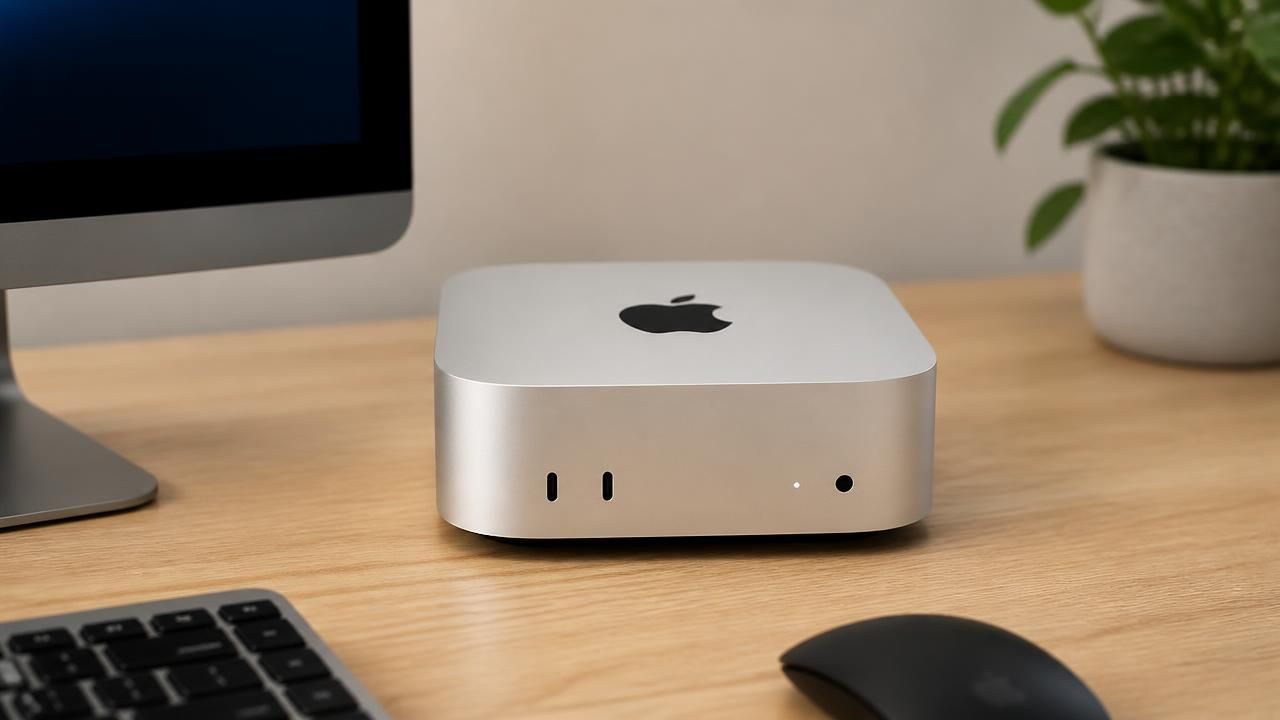
The industrial design is unchanged from the previous generation—the same squared-off aluminum chassis that debuted with the M4 model. What's new is everything inside. The M6 Mac mini and the M5 Ultra Mac Studio both ship with what Wired characterized as "AI-ready" chips, a framing that reflects Apple's escalating emphasis on on-device machine learning as a core selling point rather than a background feature.
The M5 Ultra in the Mac Studio represents the top of Apple's silicon stack, aimed at video editors, 3D artists, and developers running local models. The M6 Mac mini, by contrast, is the volume product—the machine Apple has long pitched as the cheapest way into the Mac ecosystem.
The Price Is the Story
That pitch just got more expensive. The new Mac mini starts at $899 for a configuration with 16GB of RAM and 256GB of storage. That is a $300 increase over the $599 M4 Mac mini introduced in 2024 for identical memory and storage specifications.
"These play-it-safe updates aren't very exciting, but they're also usually all upside—you get a year or two's worth of technological improvements for the same price you would have paid for the older version yesterday. Unfortunately, 2026's unprecedented memory crunch has upended that standard operating procedure."
— Ars Technica
Ars Technica was blunt in its assessment: the M6 impresses, but "the price hike is rough." AppleInsider called it a "record-high starting price," while Macworld and MSN both led with the increase, noting that Apple's price hikes are continuing rather than abating. Fast Company framed the release as unexpected—Apple "just unexpectedly released a new M6 Mac mini—and raised prices again."
Why Now: The Memory Crunch
The hike is not arbitrary. A global shortage of DRAM and memory modules has driven component costs sharply upward through 2025 and into 2026, squeezing margins across the entire PC industry. For Apple, which buys memory in enormous volumes, the crunch is manageable but not invisible—and the company has chosen to pass a substantial portion of that cost to consumers rather than absorb it.
The 16GB/256GB baseline is telling. Sixteen gigabytes has become the functional floor for a machine Apple markets as AI-capable, and the company has declined to raise storage to 512GB at the entry tier despite years of criticism. Buyers who want more headroom will pay considerably more, since Apple's build-to-order memory and storage upgrades remain among the most expensive in the industry.
M6 vs. M4: What You Actually Get
AppleInsider published a direct comparison of the M6 and M4 minis, positioning both as "compact powerhouses." The generational gap is real—two years of architectural refinement, improved neural engine throughput, better power efficiency, and faster unified memory bandwidth. For users coming from an Intel Mac or an M1 machine, the leap is substantial. For anyone who bought an M4 mini in 2024 or 2025, the case for upgrading is considerably weaker.
- Performance: The M6 delivers meaningful gains in CPU, GPU, and especially on-device AI workloads versus the M4.
- Design: Unchanged. Same footprint, same ports layout, same cooling approach.
- Price: $899 entry versus $599 for the comparable M4 configuration—a 50% increase.
- Positioning: The M5 Ultra Mac Studio sits above it as the professional-tier option.
Retail Reaction and the Discount War
Almost immediately, third-party retailers began competing on price. MacDailyNews reported that Amazon moved to cut prices on pre-orders for both the M6 Mac mini and the M5 Pro Mac mini—an early signal that the elevated list price may not hold at street level. Amazon discounting Apple hardware at launch is common, but the speed and aggressiveness of the cuts suggest retailers see the $899 figure as a ceiling that consumers will resist.
That dynamic creates an awkward split screen: Apple raising its official pricing while its largest retail partner quietly undercuts it. It also gives buyers a reason to wait a few weeks rather than order direct.
The Broader Framing
Different outlets told versions of the same story with different emphasis. Wired led with capability—new chips, AI readiness, the technical story. Forbes and Fast Company led with surprise and the novelty of an unannounced launch. Ars Technica, Macworld, and AppleInsider led with price, treating the $300 increase as the defining fact of the release.
That divergence matters because it reflects a genuine tension in the product. The M6 Mac mini is, by most technical measures, the best small desktop Apple has built. It is also the most expensive entry point the Mac mini line has ever had, at a moment when consumers are unusually sensitive to cost.
What It Means
Apple has spent a decade positioning the Mac mini as the affordable on-ramp to macOS. A $899 starting price erodes that identity, and it arrives just as Windows PC makers face their own memory-driven increases—meaning the entire budget desktop category is getting more expensive at once.
For now, the calculus is straightforward. If you need a compact, AI-capable Mac and you're coming from an older machine, the M6 mini delivers. If you already own an M4, the price of progress has roughly doubled. And if you're patient, Amazon's pre-order discounts suggest the market may yet push back on Apple's new number.