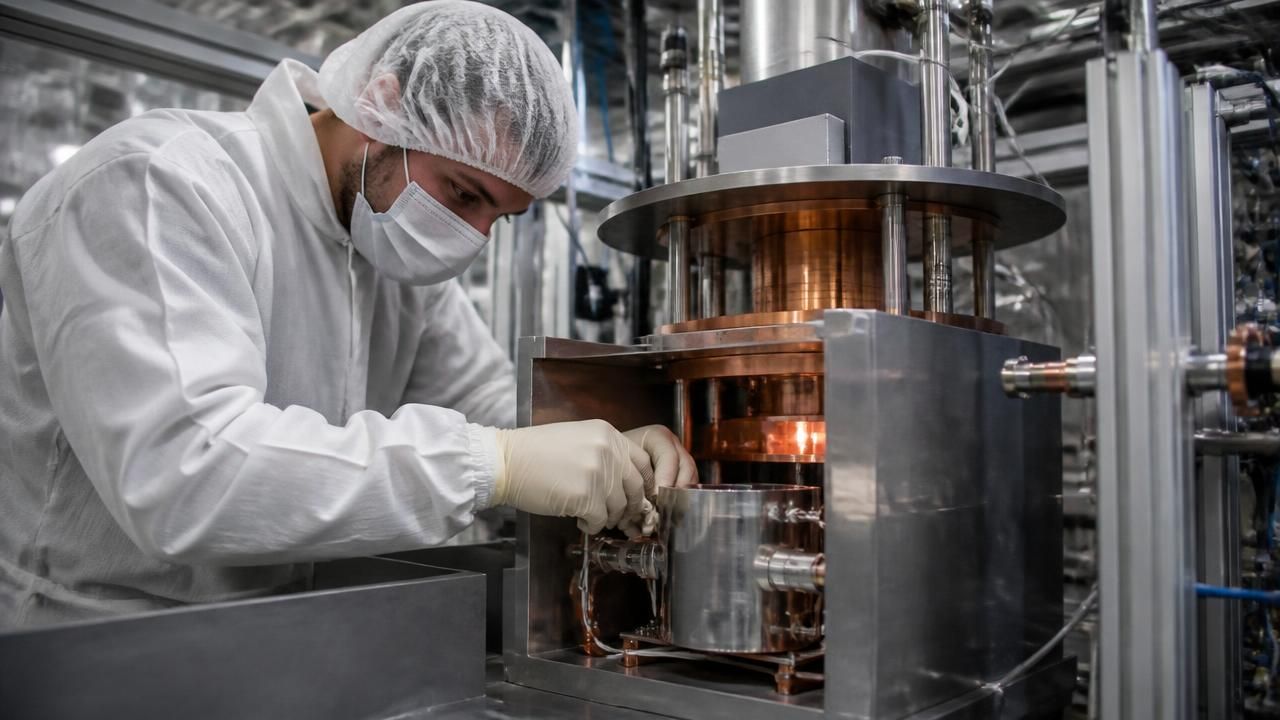
One of physics' most durable thought experiments has collided with one of its most sensitive detectors — and gravity, at least in its simplest proposed form, appears to have been let off the hook.
Reporting from deep inside Italy's Gran Sasso massif, researchers say they have conducted one of the toughest experimental tests yet of a decades-old idea that gravity is what destroys quantum superpositions. After 62 days of measurements with a heavily shielded germanium detector, the team found no sign of the faint radiation signal their theory predicted. The null result, reported by Science Daily and amplified by science outlets including Phys.org, RealClearScience and Knowridge, constrains a class of models that have intrigued physicists since the 1980s.
The riddle of the vanishing superposition
The puzzle is familiar from undergraduate lectures. Quantum mechanics allows a particle to occupy a superposition of two states — two positions, two energies, two spins — and to remain that way indefinitely. Yet the everyday world contains no cats that are simultaneously alive and dead, no teapots in two places at once. Something, somewhere, converts quantum weirdness into classical certainty. Physicists call the process decoherence, and for most practical purposes it is well understood: interactions with surrounding air molecules, photons and thermal vibrations leak quantum information into the environment, washing superpositions away with stunning speed.
But a subset of theorists has argued that environment alone cannot be the whole story. Their claim, developed by Lajos Diósi and separately by Roger Penrose, is that gravity itself does the job. If a mass is placed in a superposition of two locations, then — according to this view — spacetime itself must be in a superposition of two shapes, a state of affairs the theory cannot coherently describe. The superposition should therefore collapse spontaneously, and in collapsing it should release a tiny burst of radiation.
"One can even set up quite ridiculous cases," Erwin Schrödinger wrote in 1935, introducing the cat that has haunted physics ever since.
A mountain as a shield
To test the idea, the researchers needed two things in short supply: extraordinary quiet and a detector capable of hearing a whisper. They found both beneath Gran Sasso, where roughly 1,400 metres of rock — the same overburden that shelters neutrino and dark-matter experiments — screens out the cosmic rays that would otherwise swamp a delicate measurement.
The instrument was a high-purity germanium detector, originally built for rare-event particle physics, wrapped in layers of copper and lead shielding that make it one of the least radioactive environments available anywhere on Earth. In such a setting, any excess emission of X-ray photons would be attributable to the spontaneous radiation the collapse models predict. Over 62 days of continuous running, the detector saw nothing beyond the expected background.
The consequence is a firm exclusion: the Diósi–Penrose model is ruled out for collapse-length parameters below roughly 10-10 metres, a range that includes the parameter-free version of the theory in which the relevant scale is set by the size of a nucleon. In other words, the most elegant and least adjustable form of the idea does not survive contact with the mountain.
How the story was framed
The coverage itself is instructive. Science Daily led with the theoretical stakes, emphasising the laboratory and the detector. Phys.org framed the result in the language of the field — "underground experiment rules out gravity model for quantum decoherence" — treating it as a constraint on model space. Knowridge and RealClearScience leaned into the popular hook: what really kills Schrödinger's cat? The discrepancy is not a contradiction so much as a difference of audience. Headline writers anthropomorphise the cat because it sells; physicists talk about spontaneous radiation emission because that is what can be measured.
What all accounts agree on is what the experiment does not do. It does not demolish the broader intuition that gravity plays some role in quantum collapse, and it says nothing about competing frameworks such as continuous spontaneous localisation, which is already tightly constrained by other means. Nor does it overturn standard environmental decoherence, which comfortably explains why macroscopic objects behave classically.
Where the search goes next
The result narrows the field rather than closing it. Researchers are pursuing a range of alternative tests: atom interferometers that place ever-larger molecules in superposition, optomechanical devices that cool nanoscale oscillators to their quantum ground state, and proposed space-based missions that would remove seismic noise from the equation entirely. Each new instrument pushes the boundary between the quantum and classical worlds a little further out.
- What was tested: gravity-induced collapse models that predict faint spontaneous X-ray emission.
- Where: an underground laboratory beneath Gran Sasso, Italy.
- How long: 62 days of shielded germanium detector data.
- Result: no signal; the parameter-free Diósi–Penrose model is excluded.
- Still standing: environmental decoherence and other collapse models with different parameters.
The cat, for now, remains stubbornly unresolved — neither definitively killed by gravity nor explained away by anything else on the table. What has changed is the map of viable explanations. One of the most seductive routes to classical reality has been shown, with unusual clarity, to be a dead end in its most natural form. The rest of the search continues, in quieter places than most experiments ever reach.