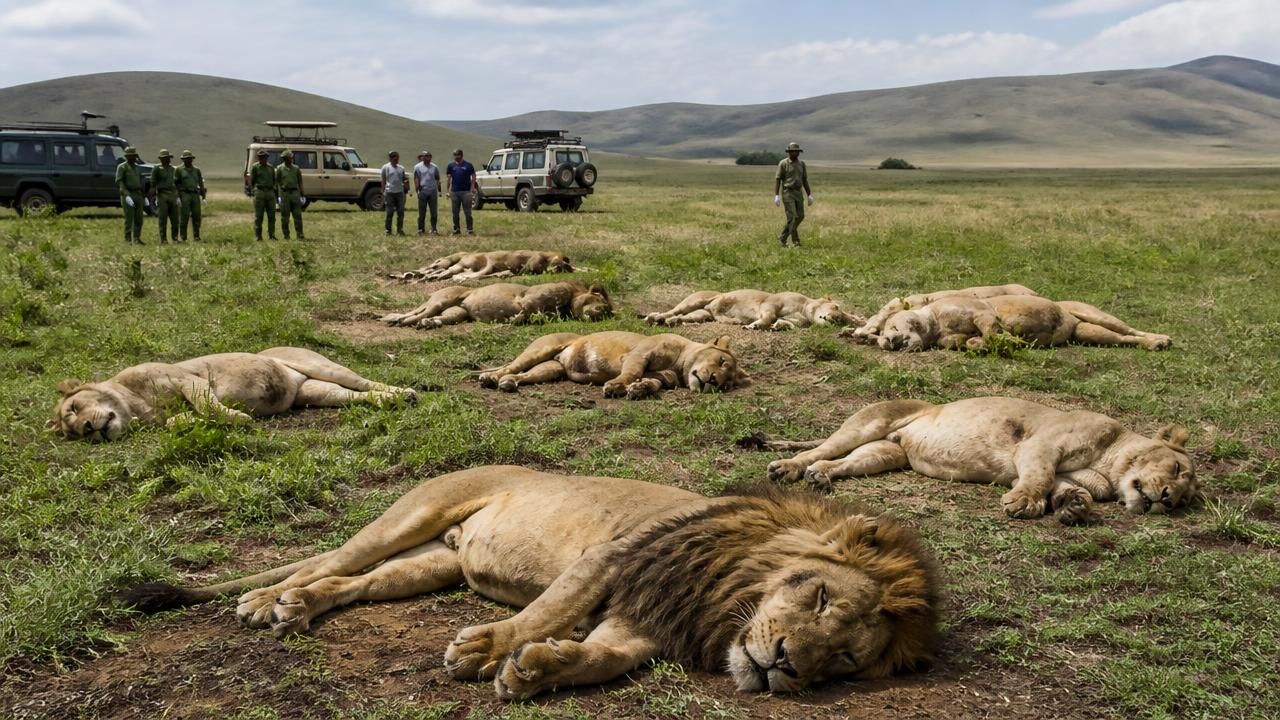
Ten lions have been found dead inside Tanzania's Ngorongoro Conservation Area, in what wildlife authorities and conservationists suspect was a deliberate poisoning — an incident that has revived alarm over a quiet but devastating pattern of wildlife killings across East Africa.
The carcasses were discovered within the reserve, a vast volcanic highland in northern Tanzania that draws hundreds of thousands of visitors a year and is among the most celebrated wildlife destinations on the planet. News of the deaths was reported by NPR and circulated widely through wire and aggregator services, all of which converged on the same essential facts: ten lions, one location, and a cause of death that investigators believe was poison rather than natural disease or conflict with other predators.
What Is Known — and What Is Not
Officials have not publicly released a definitive cause of death, and toxicology results are typically required before poisoning can be confirmed. That distinction matters: the phrase suspected poisoning has been used consistently across early reports, and no arrests or named suspects have been announced.
What is clear is the location. The Ngorongoro Conservation Area is a multi-use landscape where wildlife protection and human habitation exist side by side — a unique arrangement in which Maasai pastoralists live and graze livestock within the same boundaries as lions, elephants, rhinos and the reserve's famously dense predator populations. That overlap is central to understanding why poisoning incidents occur.
A Recurring Pattern Across East Africa
Wildlife poisoning is not a new phenomenon in the region. Conservation groups have documented repeated episodes in Tanzania, Kenya and Uganda in which carcasses were laced with agricultural chemicals — most notoriously carbofuran, a highly toxic pesticide that is cheap, widely available and lethal in tiny doses.
The usual motive is retaliation. When lions, hyenas or leopards kill livestock, herders sometimes respond by poisoning a carcass, which can wipe out an entire pride in a single night. The damage often extends far beyond the target species: vultures and other scavengers that feed on the poisoned remains die in large numbers, and the effects ripple through the ecosystem for years.
Poisoning is among the most destructive and least visible forms of wildlife crime — silent, indiscriminate, and capable of eliminating an entire social group of animals overnight.
The Stakes for Ngorongoro
The reserve sits within the larger Serengeti ecosystem and forms part of a UNESCO World Heritage property recognized for both its natural and cultural values. Tourism is a pillar of Tanzania's economy, and predators — lions above all — are the headline attraction for safari visitors.
- Ngorongoro is one of the most densely populated large-mammal areas in Africa, and its lion population has long been studied as a bellwether for the wider region.
- Lions are already under pressure from habitat fragmentation, declining prey, disease and retaliatory killing.
- A single poisoning event can remove a disproportionate share of a local pride's breeding adults, slowing recovery for a decade or more.
Losing ten animals at once is therefore not simply a numerical loss; it is a blow to the social structure of a population that researchers have tracked closely for generations.
How the Story Was Framed
The coverage so far reflects two distinct emphases. NPR's reporting foregrounded the wider implications, framing the deaths as a warning sign about wildlife poisonings across East Africa — a regional problem rather than a single isolated tragedy. Aggregated versions, by contrast, led with the raw facts of the headline: the number of lions, the suspected cause, and the location. That divergence is typical of breaking environmental news, where wire copy establishes the basic facts while originating outlets supply the context.
The result is a story that reads differently depending on where a reader encounters it: one version is a crime report, the other an indictment of a regional practice.
Why the Practice Is Hard to Stop
Prosecuting wildlife poisoning is notoriously difficult. Carcasses decompose quickly, evidence is easily destroyed, and incidents often occur in remote areas far from law enforcement. Even where cases are pursued, penalties have historically been modest relative to the scale of the loss.
Conservation organizations have pushed for tighter regulation of carbofuran and similar compounds, faster toxicology testing, and community-based programs that compensate herders for livestock losses — an approach designed to remove the economic incentive for retaliation in the first place.
What Happens Next
Attention now turns to Tanzania's wildlife authorities and the results of forensic testing. Confirmation of poisoning would almost certainly intensify scrutiny of how the Ngorongoro Conservation Area balances pastoral livelihoods with predator protection — a tension that has simmered for decades and that no single investigation is likely to resolve.
For now, the image that lingers is a familiar and troubling one: ten lions, found dead in one of Africa's most protected landscapes, in a place where the boundary between human need and wild survival is drawn thinner than almost anywhere else on Earth.