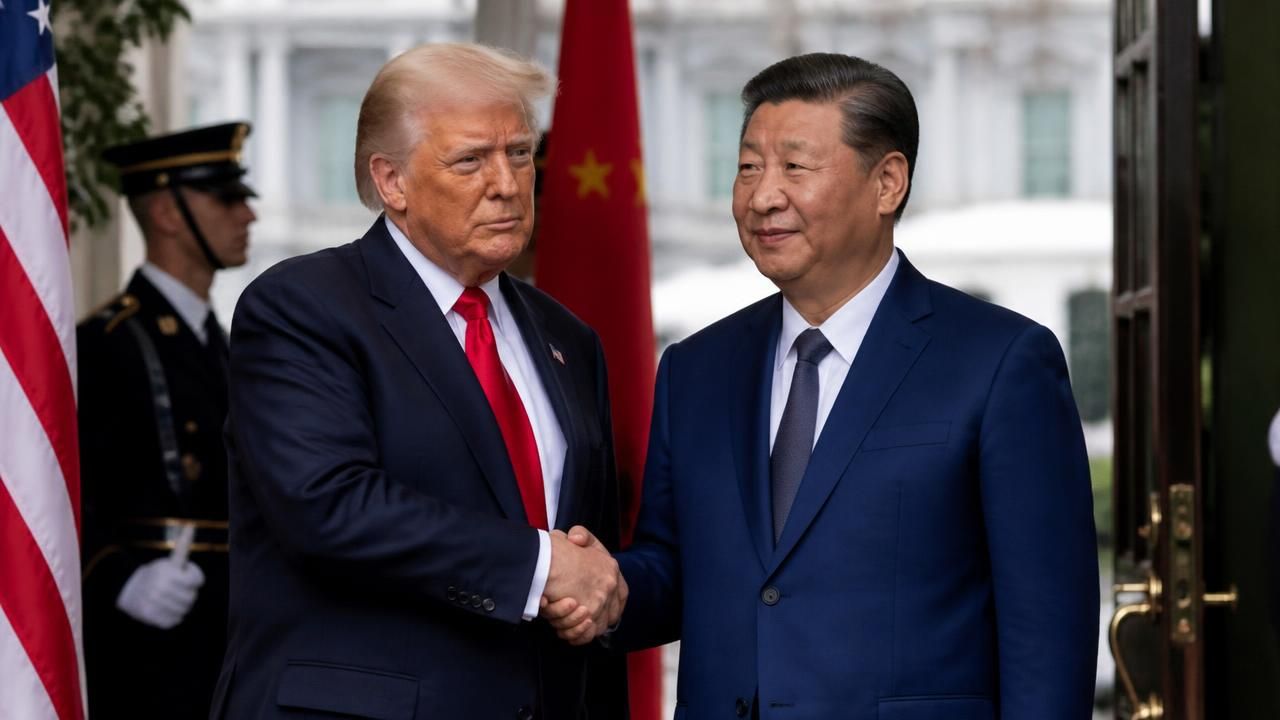
President Donald Trump will welcome Chinese President Xi Jinping to Washington on Sept. 24 for a summit that both capitals are framing as a chance to stabilize the world’s most consequential economic relationship — and a test of whether that relationship can survive the forces pulling it apart.
Previews from Bloomberg, Reuters, The New York Times, Fox News and other outlets converge on three interlocking questions: who controls the future of artificial intelligence, how far tariffs will ultimately go, and what each side is prepared to trade away to avoid a full rupture. The meeting unfolds against a looming trade-truce deadline, unresolved disputes over Taiwan and Iran, and a global economy in which allies and rivals alike are rethinking their dependence on Washington.
From tariff warrior to red-carpet host
The Associated Press captured the inversion at the heart of the moment: Trump spent years slamming China on the campaign trail, and is now rolling out the red carpet for its leader. The shift reflects a hard calculus rather than a softening — an economy still absorbing tariff costs, a technology race that cannot be won unilaterally, and a White House that would rather claim a deal than preside over an escalating trade war.
That pragmatism cuts both ways. Chinese officials arrive with leverage of their own, and with an interest in demonstrating that Beijing can sit as an equal at the table rather than as a supplicant.
Chips are the battlefield
No topic is more fraught than semiconductors. Fox News framed the encounter bluntly, describing America and China as “fighting for the future of AI — chips are the battlefield.” US export controls on advanced processors and chipmaking equipment have been the sharpest edge of Washington’s containment strategy, while Huawei’s advances are cited in Washington as evidence that the restrictions are slowing but not stopping China’s progress.
“America and China are fighting for the future of AI — chips are the battlefield.”
Bloomberg reports that AI competition and semiconductor export policy rank at the very top of the agenda. For the US, the goal is to keep the frontier of compute out of Chinese hands without triggering retaliation that would choke American firms’ access to a vast market. For China, the goal is relief — or at minimum, predictability.
A manufacturing concession on the table
One potential bargaining chip: Chinese electric-vehicle manufacturing on US soil. Investment in American plants would create jobs the White House could claim, while giving Chinese automakers a way around tariffs. Whether Beijing is willing to pay that price — and whether Congress would tolerate it — remains open.
Tariffs, rare earths and the truce clock
Malay Mail flagged tariffs, rare earths and Iran as the three variables that could make or break the summit. Rare earths are China’s quietest and most potent weapon: the minerals are essential to magnets, batteries, defense systems and electronics, and Beijing has already shown a willingness to tighten export approvals as a warning shot.
The truce deadline gives both sides a reason to produce something. A failure to extend or codify the pause risks a return to escalation that would hit supply chains on both sides of the Pacific.
China’s export machine looms large
The New York Times points to a structural problem that no summit communiqué can wish away: China’s surging exports. Even as domestic demand cools, Chinese factories keep shipping goods at a pace that alarms manufacturers in the US, Europe and the developing world. For Washington, that flood is evidence that industrial policy subsidies are distorting global trade. For Beijing, it is proof of competitiveness — and a reminder that tariffs are a tax on consumers rather than a cure.
Those dueling narratives are why trade talks rarely settle anything permanently. They adjust the temperature.
A world hedging its bets
MSN’s coverage highlights a quieter, longer-term dynamic: Trump’s America-first posture is pushing other powers to hedge. Middle-income economies in Asia, Latin America and the Gulf are diversifying trade partners, building alternative payment channels and quietly insuring themselves against a world where US policy can shift overnight.
That hedging is arguably the summit’s most important subtext. A deal between Washington and Beijing would reassure markets, but it may not reverse the fragmentation already underway.
Beyond Beijing: the template of tariff-driven dealmaking
The China summit does not happen in isolation. Reuters has documented how the same playbook unfolded with Canada — a near deal derailed by a Reagan-era advertisement, and a fentanyl dispute folded into tariff negotiations. The pattern is consistent: tariffs as leverage, announcements as victories, and details left for later.
Allies watching the Xi meeting will read it as a signal about how durable any agreement can be.
What to watch
- Chip policy: any softening of export controls, or new tightening, will move semiconductor stocks immediately.
- The truce deadline: an extension is the baseline expectation; a lapse would be a shock.
- Rare earths: watch for language on export licensing and supply-chain security.
- EV investment: Chinese plants in the US would be the most tangible deliverable.
- Iran and Taiwan: security frictions that could derail economic progress at any moment.
Domestically, the White House’s messaging has been complicated by sideshows — including online mockery of newly unveiled Space Force uniform designs, which critics compared to Star Wars villains. Such distractions rarely shape summits, but they shape the political room in which summits are judged.
For both leaders, the stakes are asymmetric but real. Trump needs a deal that looks like a win. Xi needs a deal that looks like respect. Whether Sept. 24 produces either will depend less on chemistry than on whether the two systems can tolerate the competition they have already begun.