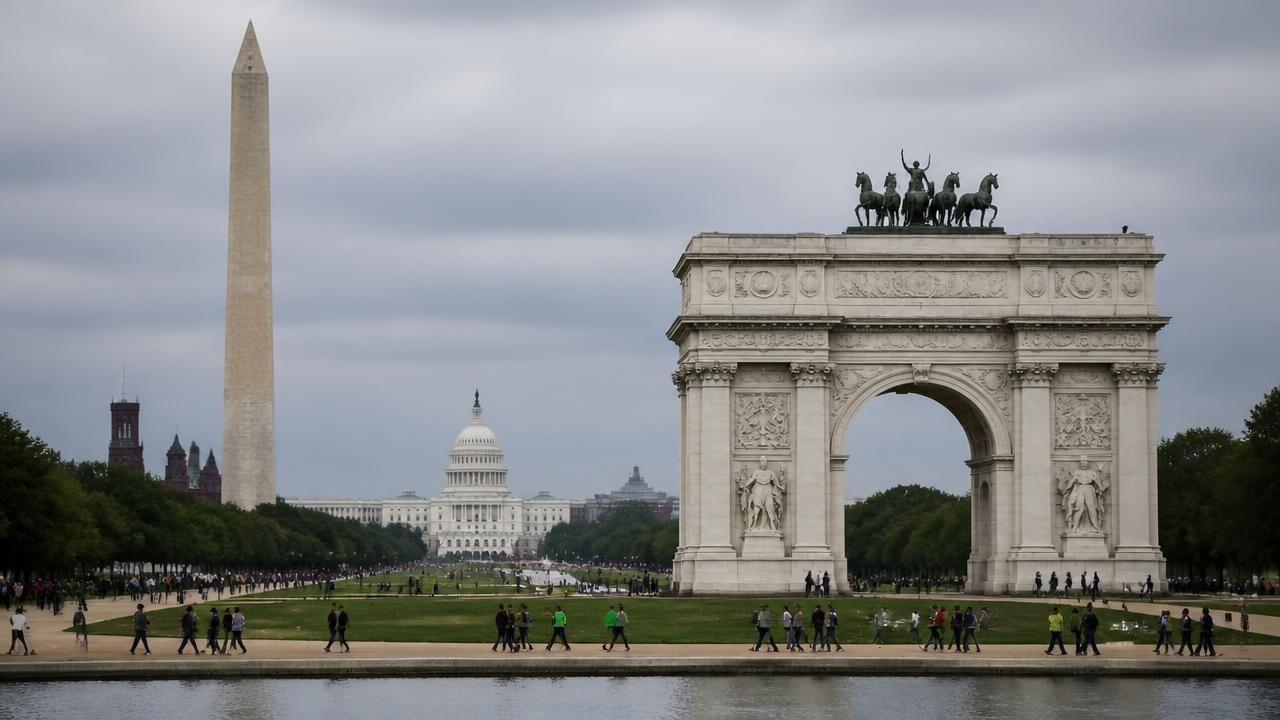
President Trump has said his proposed triumphal arch in Washington, D.C., would do more than commemorate — it would function as a “military complex,” capable of housing drones, snipers and ammunition. The remarks, first reported by NPR and picked up by UPI, HuffPost, the New York Post and a wave of aggregators, recast a long-gestating monument project as a piece of national security infrastructure at the heart of the nation's capital.
The proposal is not merely rhetorical: a federal court is currently weighing the arch's legality, meaning the president's expanded vision for the structure now sits at the intersection of two fights — one over whether it can be built at all, and another over what it would be used for if it is.
What the president said
According to accounts of his remarks, Trump described the arch — described in several reports as standing 250 feet tall — as a “military complex.” The New York Post framed the statement as a claim that the arch would become a “top grade” weapons base equipped with drones and snipers. Other outlets, including Newser, characterized the shift as the president “recasting” the project as a high-tech military installation.
“Trump says his Triumphal Arch in Washington will be used as 'top grade' weapons base with drones and snipers.” — New York Post headline
The president's description included three distinct claims: that armed personnel — snipers — could be stationed there; that drones could operate from it; and, according to at least one report, that it could be used to store ammunition. It was not immediately clear whether those functions would be permanent, ceremonial, or contingent on future authorization.
A monument with a garrison
Triumphal arches historically celebrate military victory — the Arc de Triomphe in Paris, the Arch of Titus in Rome, and, closer to home, the Arc de Triomphe at the entrance to Arlington Memorial Bridge. Trump's framing pushes that symbolism into operational territory, suggesting a commemorative structure that also serves a defense function.
That dual role raises immediate practical questions:
- Command and control: Which agency — the Secret Service, the Pentagon, or D.C. authorities — would operate drones or post armed personnel at the site?
- Airspace: Washington's airspace is among the most tightly restricted in the country, with drone flights near protected zones requiring federal coordination.
- Design review: Any structure of that scale on federal land in the capital typically must clear multiple design and planning bodies before construction begins.
- Funding and scope: No cost estimate or timeline for the military functions has been made public.
A legal cloud over the arch
NPR reported that a federal court is weighing the arch's legality, a detail that reframes the president's military language as something more than a rhetorical flourish. If the project's legal footing is unsettled, attaching operational military functions to it could complicate the government's position — or, conversely, give supporters a national-security argument for expediting approval.
Neither the White House nor the agencies potentially involved have publicly detailed how the military role would be authorized, and it remains unclear whether the president's description reflects a formal policy directive or an aspirational description of the finished monument.
How outlets framed the story
The coverage split along familiar lines, and the differences are instructive.
- NPR led with the military claim but anchored it firmly to the pending court review, keeping the legal stakes in the foreground.
- The New York Post emphasized the “top grade” weapons-base framing, foregrounding the operational language.
- HuffPost and Newser treated the statement as noteworthy for its novelty, with Newser describing it as the president “recasting” the arch as a high-tech complex.
- UPI and MSN aggregations carried a more neutral construction — that the arch would “serve as a military complex.”
Several outlets — including Yahoo, Seeking Alpha and WWL-TV — published headlines but returned access errors to readers, meaning much of the public encountered the story only through those headline-level framings.
Drones over the capital
The drone element lands in a charged context. Unauthorized drone incursions near sensitive Washington sites have repeatedly made news in recent years, and the region already hosts layered counter-drone arrangements around the White House, Capitol and Pentagon. Adding a monument-based drone capability would expand that footprint — or, depending on how the president's remarks are interpreted, simply relocate existing capabilities into a new facility.
Snipers, too, are already a visible feature of the capital's security architecture during major events. The question raised by the arch proposal is not whether such assets exist, but whether a commemorative monument should be built to house them.
What remains unanswered
The reporting across all fifteen sources leaves substantial gaps. There is no confirmed location, budget, construction timeline, or authorizing statute for the military functions. It is unclear whether the court reviewing the arch's legality has been asked to consider the military use, or whether that dimension falls outside the current litigation.
What is clear is that the project has moved beyond a debate about aesthetics and commemorative symbolism. As the president describes it, the arch is now also an installation — a framing that guarantees the legal fight over the monument will be joined by a second argument over what the federal government may build, and station, in the middle of Washington.