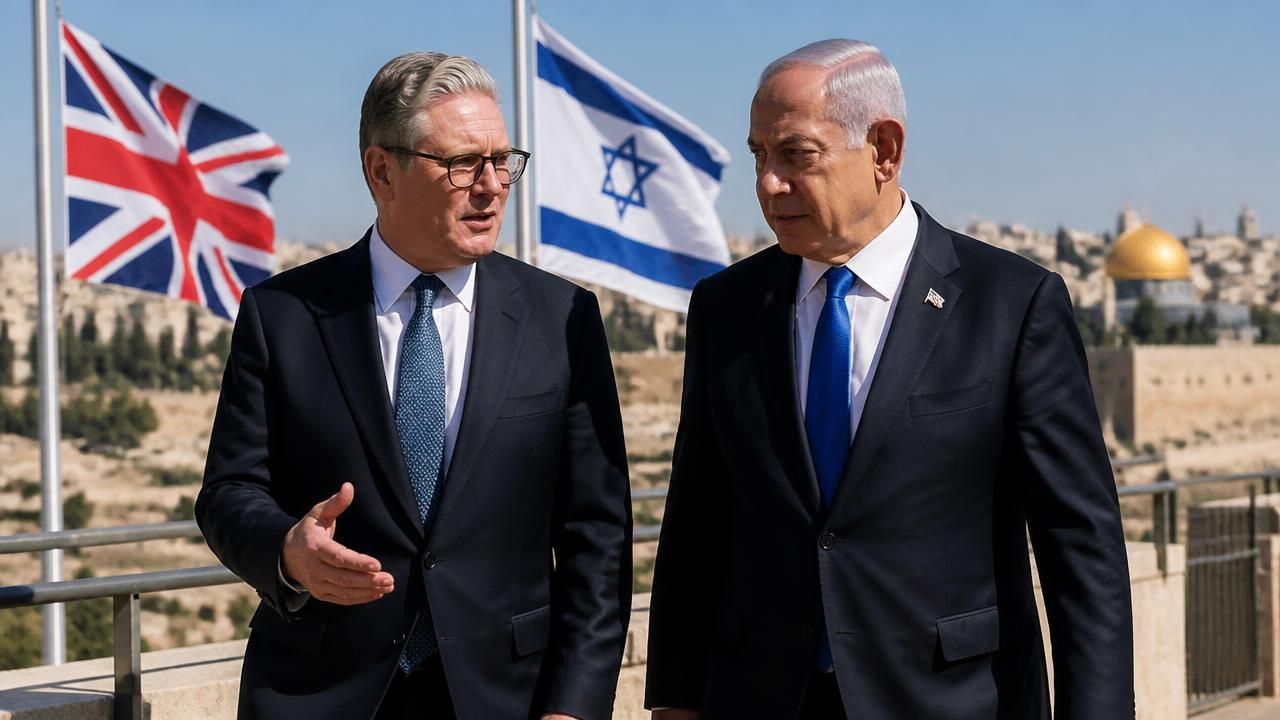
The relationship between Britain and Israel has deteriorated sharply over Israeli plans to build in E1, a strategically sensitive corridor of the occupied West Bank that much of the international community regards as the keystone of any future Palestinian state. What began as a diplomatic dispute over construction tenders has escalated into reciprocal measures: London imposed sanctions on Israeli settler entities, and Jerusalem responded by moving to shut the British consulate.
The rupture is being covered across the world as a single story with many faces — a legal and diplomatic confrontation in the pages of The New York Times, a humanitarian emergency in the Palestinian villages of the West Bank on CNN and Reuters, and a domestic political calculation in the Israeli press as analyzed by Al Jazeera and Al-Monitor.
The Promise in Dispute
At the center of the breakdown is a disagreement about what was actually said. According to reporting by The New York Times, British officials entered the dispute believing Israel had committed to holding off on advancing construction in E1. Israel says it made no such assurance. The gap between those two accounts — one of a broken understanding, the other of a misunderstanding — has hardened into a full diplomatic crisis that neither side appears eager to de-escalate.
British officials believed they had secured an Israeli commitment to hold off on E1 construction. Israel says no such promise was ever made.
Why E1 Matters
E1, shorthand for “East 1,” sits between the Israeli settlement of Ma’ale Adumim and Jerusalem. Successive Israeli governments have sought to build there; successive American, European and Arab governments have pressed them not to. The reason is geography as much as politics: construction in E1 would effectively sever the northern and southern halves of the West Bank and cut off East Jerusalem from the Palestinian population centers around Ramallah and Bethlehem. In practical terms, critics argue, it would make a contiguous, viable Palestinian state nearly impossible to assemble.
That is why the tender offer drew condemnation from a broad coalition of governments — and why Al Jazeera framed its coverage around the question of why the tenders, though smaller in scale than some previous settlement expansions, provoked such outsized outrage. The answer lies less in the number of housing units than in the location. E1 is not another hilltop outpost; it is the hinge on which the two-state map turns.
Settlements are considered illegal under international law by most countries, a position reaffirmed in UN Security Council Resolution 2334 in 2016. The reopening of once-closed settlement sites, reported by Al-Monitor, has reinforced the sense among critics that Israel is entrenching its presence rather than negotiating over it.
Sanctions and Retaliation
Britain’s response — sanctions targeting entities tied to settler activity — was described by UK officials as a necessary rebuke to what they called an “unacceptable” settlement tender offer. Israel reacted with fury, arguing that singling out Israeli entities while ignoring Palestinian militant attacks amounts to a one-sided approach. Sky News reported that Israel would shut the British consulate in retaliation, a move that would strip London of one of its most important diplomatic platforms for engaging with Palestinians.
The escalation has rippled outward. Prime ministers and foreign ministries across Europe and the Middle East joined the condemnation of the E1 plan, while Israel’s supporters warned that punitive measures against a democratic ally set a damaging precedent. The result is a rare moment in which a Western country’s sanctions and an Israeli countermeasure are unfolding simultaneously, with neither side offering a clear off-ramp.
On the Ground: Siege and Dispossession
For Palestinians living in the affected areas, the diplomatic fight is inseparable from daily violence. CNN reported that Israeli settlers stormed a Palestinian village and seized a home while its owner was still inside — an account that echoes a pattern documented by Palestinian and Israeli human rights groups for years. Reuters reported that Israeli troops were sent into West Bank homes besieged by Jewish settlers, a reminder that the Israeli military is frequently deployed to separate settlers from the Palestinians whose houses they are attempting to take over.
The Yahoo News framing — “surrounded,” with settlements bringing “chaos to Palestinians” — captures the geography of the crisis. Villages that were once separated by open land now find themselves encircled by expanding settlement blocs, checkpoints and bypass roads. For residents, each new tender is not an abstract diplomatic provocation but a change in the map outside their window.
Netanyahu’s Calculus
Perhaps the most consequential question is whether Israel’s government actually minds the outrage. Al Jazeera’s analysis argues that Prime Minister Benjamin Netanyahu and his right-wing coalition may see international condemnation as politically useful: it rallies the base, shifts attention away from domestic troubles and reinforces the narrative that Israel is being singled out unfairly. Al-Monitor’s reporting on reopened settlements points in the same direction — a government pressing ahead with facts on the ground while treating foreign criticism as noise.
That dynamic leaves Britain and its partners in a difficult position. Sanctions may impose real costs, but they also invite retaliation, as the consulate closure demonstrates. Meanwhile, the construction tenders proceed through bureaucratic stages that are hard to reverse once contracts are signed and foundations poured.
What Comes Next
The immediate outlook is for further deterioration. Britain must decide whether to escalate or seek a negotiated climbdown now that its consulate is on the line. Other European capitals, having already condemned the E1 plan, face pressure to match UK sanctions with measures of their own. And in Washington, the episode revives a debate that has recurred for three decades: whether quiet diplomacy or public pressure is more effective in restraining settlement expansion.
What is clear is that E1 has once again become the fault line on which the two-state solution is tested. Whether this crisis ends in a restored understanding, a wider rupture between Israel and its Western partners, or simply another layer of construction on contested ground will depend less on the language of the tenders than on whether any outside power still has leverage — and the will to use it.