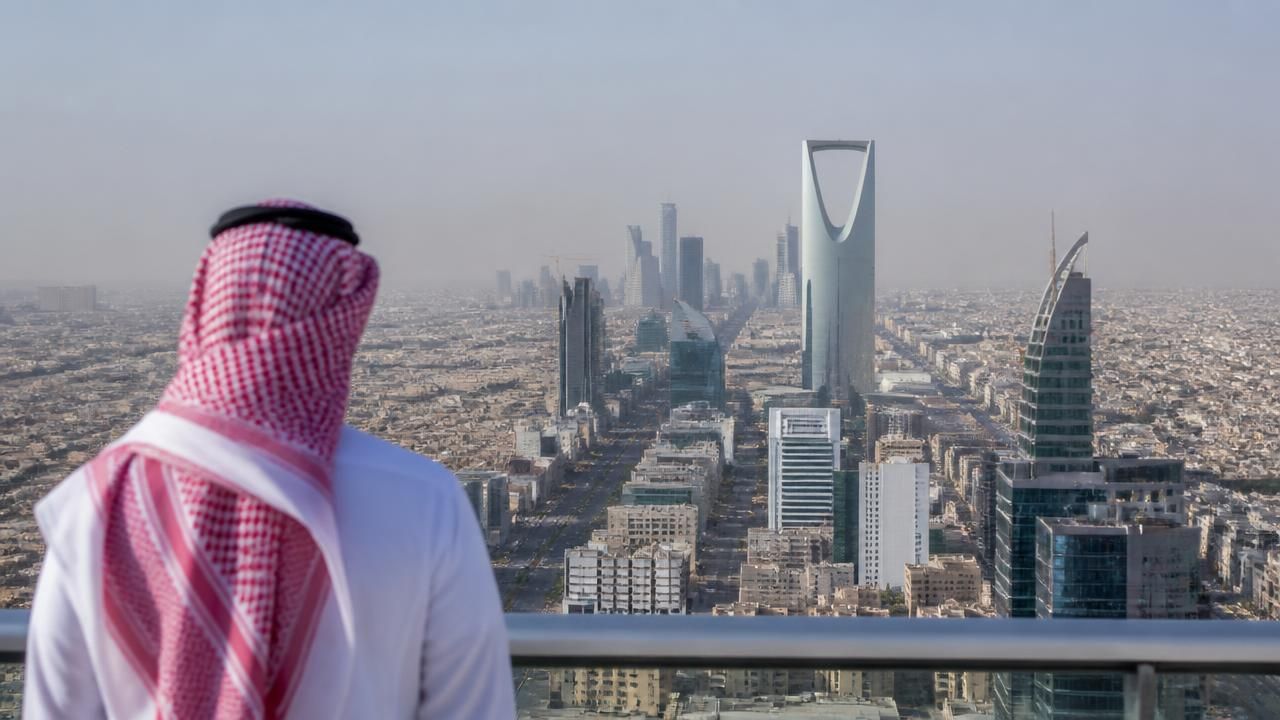
RIYADH — Saudi Arabia said Saturday that Yemen's Houthi rebels attempted to strike the Saudi capital with a ballistic missile, the first time Riyadh has been targeted since an escalation in fighting with the Iran-backed movement opened a new front in the wider Iran war.
The claim, first reported by NPR and carried across a network of U.S. public radio stations, represents a sharp geographic expansion of a conflict that for years was largely contained to Yemen's interior and the kingdom's southern border provinces. Saudi authorities did not immediately release details on interception, damage or casualties, and there was no instant claim of responsibility from Houthi media channels.
Saudi Arabia said that Yemen's Houthi rebels tried to attack Riyadh with a ballistic missile, the first time the Saudi capital has been targeted since the escalation in fighting with the Iran-backed rebels opened a new front in the Iran war.
A widening war, and a widening information war
The story arrived in fragments, and the fragmentation is itself part of the story. NPR's report framed the event in strategic terms — a capital city newly within reach, and a conflict spilling beyond its previous boundaries. The same report, with identical headline and text, was republished by member stations such as New Orleans' WWNO, a reminder of how a single wire item becomes a national narrative through public radio's syndication pipeline. Photography accompanying the report was credited to Osamah Abdulrahman, imagery drawn from inside Yemen rather than from the Saudi capital — an early signal that independent visual verification of the Riyadh claim was not immediately available.
Separately, a Wikinews headline from the same news cycle reported that Yemen's internationally recognized government said more than 100 Shiite rebels had been killed inside Yemen. That casualty figure, like the missile claim itself, rests on a single belligerent's account and could not be independently confirmed. Taken together, the two items sketch a weekend of intensifying combat in which both sides are publishing their own version of events faster than outside observers can check them.
MSN aggregated the story under a broader heading — “and other Mideast developments” — packaging the Riyadh missile claim alongside other regional news. That treatment reflects how much of the audience will encounter the event: not as a standalone crisis, but as one item in a rolling regional digest.
Why Riyadh matters
Targeting the Saudi capital carries weight far beyond its military value. Riyadh is the seat of the kingdom's leadership, the headquarters of state oil company Aramco, and the political center of the Gulf's largest economy. The Houthis have launched missiles and drones at Saudi territory for years, but strikes aimed at the capital are rare and are typically treated by Riyadh as a qualitative escalation.
- 2017: A ballistic missile was intercepted near Riyadh's international airport, the first such attempt on the capital, which Saudi officials at the time characterized as an act of war by Iran.
- 2019: Drone and cruise missile attacks on Aramco facilities at Abqaiq and Khurais knocked out roughly half of Saudi crude output — an episode that briefly rattled global energy markets and exposed gaps in air defenses.
- Since 2015: A Saudi-led coalition has conducted airstrikes in Yemen in support of the internationally recognized government, while the Houthis have steadily expanded their missile and drone arsenal.
The conflict's roots run back to 2014, when the Houthis overran the capital, Sanaa, prompting the coalition intervention a year later. A decade of war has produced what the United Nations has repeatedly called the world's worst humanitarian crisis, with hundreds of thousands dead from direct violence, hunger and disease.
Energy markets and shipping lanes
Investors will watch two chokepoints: the Strait of Hormuz, through which roughly a fifth of global oil passes, and the Bab el-Mandeb strait at the foot of the Red Sea, where Houthi forces have previously threatened shipping. Any credible threat to either route tends to move crude prices within minutes, even before damage is confirmed.
Analysts caution that the immediate market reaction will hinge on whether the missile was intercepted, whether it was aimed at civilian or energy infrastructure, and whether the Houthis claim it publicly. A failed, unclaimed launch has a very different market signature than a confirmed hit on infrastructure.
What to watch
Three questions will shape coverage in the coming days. First, verification: will Saudi Arabia release imagery of interceptors, debris or damage, and will the Houthis confirm or deny the launch? Second, scale: whether the attempted strike is an isolated gesture or the opening of a sustained campaign against Saudi cities. Third, regional entanglement: whether the episode draws Iran or other actors more directly into a confrontation that has already been described, in the reporting itself, as a new front in the Iran war.
For now, the most reliable fact is also the narrowest: a claim, issued by one government, about a missile aimed at its capital. Everything else — the warhead's path, the interceptor's success, the death toll announced in Yemen — remains contested, and in a conflict where information moves as fast as ordnance, that gap between claim and confirmation is where the next phase of this story will be decided.