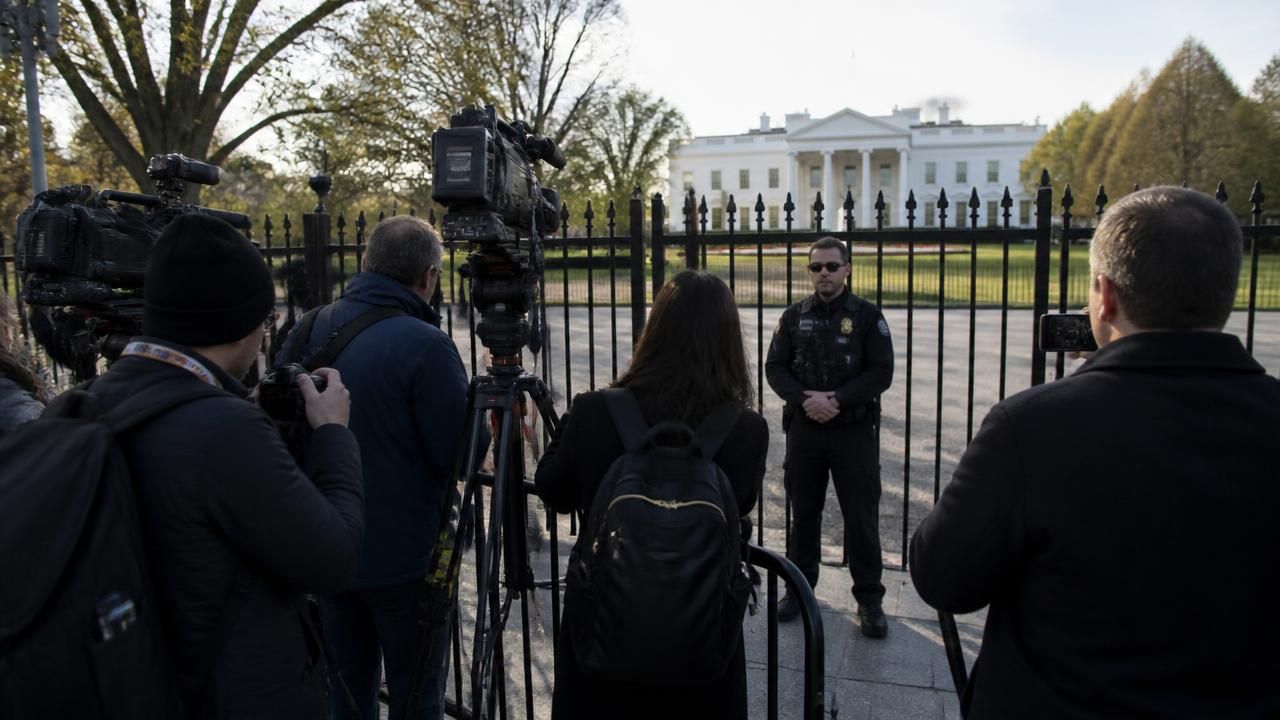
The White House turned away reporters from CNN, MS Now and Politico on Friday morning, a day after President Donald Trump publicly threatened to ban the three outlets from its grounds — turning an offhand social-media declaration into a concrete restriction on press access.
The directive was first reported by NPR and confirmed by The Verge, which described it as "an escalation in the administration's war on the First Amendment." Correspondents who had been cleared to cover the president were denied entry, effectively cutting three major newsrooms out of the daily pool that relays the White House's activities to the rest of the country.
A threat that became policy
On Friday, the president said on Truth Social that CNN, MS Now and Politico would be barred from the White House. The post might have been dismissed as one of his frequent rhetorical volleys, and Politico reported that "many senior [White House] staff were surprised by the directive" — an unusual admission that the order had not been run through the normal staffing process.
Politico also reported that the decision came down "while chief of staff Susie Wiles was out of town," suggesting the move bypassed the internal gatekeeping that has, on previous occasions, talked the president back from sweeping media restrictions. By the time reporters arrived Friday, however, the ban was operational, not theoretical.
"Many senior [White House] staff were surprised by the directive" — and it was issued "while chief of staff Susie Wiles was out of town."
The New York Times reported the ban under its live administration updates, while MSN aggregated coverage under a blunt headline: "White House turns away CNN, MS NOW, Politico reporters after Trump announces ban."
Decades of friction over the press pass
Presidents have long jostled with the press corps over access, but outright credential revocations are rare and usually temporary. In 2018, the White House pulled CNN correspondent Jim Acosta's hard pass after a combative exchange at a news conference; a federal judge ordered it restored weeks later, finding that the government had failed to provide the due process required before revoking access.
The intervening years brought a steady tightening: revised pool rotations, limits on the duration of briefings, and — more recently — disputes with wire services over editorial style and the naming of geographic features. Each step has moved the boundary of what a president can do unilaterally, and each has provoked litigation.
Is the ban legal?
That question is more complicated than the headline suggests, and it is already dividing legal commentators. The White House is not a public forum in the traditional sense, and courts have generally granted the executive branch broad discretion over who is admitted to the complex for security and scheduling reasons. Nevertheless, a line of precedent stretching back to Sherrill v. Knight in 1977 holds that once the government creates a press-pass system, it cannot deny credentials arbitrarily or in retaliation for protected speech.
That distinction — between managing access and punishing coverage — is likely to anchor any challenge. If the three outlets can show the ban was imposed because of disfavored reporting rather than a neutral rule applied evenly, a court may be receptive. If the administration frames it as a scheduling or space decision, the legal footing becomes considerably firmer.
Newsrooms close ranks
The reaction across the industry was swift and unusually unified. Rival outlets — including organizations that compete fiercely with CNN, MS Now and Politico for scoops and airtime — issued statements of solidarity, arguing that a ban on any one newsroom is a threat to all of them.
That reflex reflects a hard-won lesson: the value of a White House credential is collective. Reporters in the pool share their material with colleagues who cannot attend, meaning that excluding one outlet effectively deprives the wider public of a vantage point. Press-advocacy groups warned that the precedent could make the ban permanent or expand it.
How different outlets frame it
The story has been told several ways. The Verge, a technology and free-expression publication, framed it as a direct test of the First Amendment and connected it to a broader pattern of platform and speech battles. Politico, an outlet that found itself both subject and chronicler, focused on process — the internal surprise, the absent chief of staff, the question of "why now." The New York Times positioned the ban inside its rolling administration coverage, treating it as one data point in a widening pattern of institutional confrontation. Aggregators such as MSN led with the mechanics: reporters turned away, doors closed.
Each framing is accurate, but together they reveal something larger. The story is simultaneously a legal controversy, a personnel story inside the West Wing, and a symbolic milestone in the relationship between the president and the press.
What comes next
The practical effect may be measured in what the public does not see. If CNN, MS Now and Politico remain excluded, coverage of the White House will still exist — but it will be produced by a narrower set of eyes, with fewer chances to catch inconsistencies or ask uncomfortable questions.
Legal action is likely. The three outlets have not announced whether they will sue, but the precedent on arbitrary credential revocation gives them a plausible path, and the solidarity statements from competitors suggest the industry would support it. The administration, for its part, has given no signal that it intends to reverse course.
For now, the most immediate consequence is procedural: three chairs in the briefing room are empty, and the question of who gets to fill them has become a constitutional argument rather than a scheduling matter.